



 Chat with AI
Exam 15: Cost Allocation: Joint Products and Byproducts

Exam 1: The Accountants Vital Role in Decision Making141 Questions
Exam 2: An Introduction to Cost Terms and Purposes171 Questions
Exam 3: Cost-Volume-Profit Analysis156 Questions
Exam 4: Job Costing145 Questions
Exam 5: Activity-Based Costing and Management144 Questions
Exam 6: Master Budget and Responsibility Accounting170 Questions
Exam 7: Flexible Budgets,variances,and Management Control: I172 Questions
Exam 8: Flexible Budgets,variances,and Management Control: II148 Questions
Exam 9: Income Effects of Denominator Level on Inventory Valuation171 Questions
Exam 10: Analysis of Cost Behaviour212 Questions
Exam 11: Decision Making and Relevant Information174 Questions
Exam 12: Pricing Decisions, product Profitability Decisions, and Cost Management150 Questions
Exam 13: Strategy,balanced Scorecard,and Profitability Analysis161 Questions
Exam 14: Period Cost Allocation163 Questions
Exam 15: Cost Allocation: Joint Products and Byproducts167 Questions
Exam 16: Revenue and Customer Profitability Analysis152 Questions
Exam 17: Process Costing147 Questions
Exam 18: Spoilage, rework, and Scrap137 Questions
Exam 19: Inventory Cost Management Strategies152 Questions
Exam 20: Capital Budgeting: Methods of Investment Analysis187 Questions
Exam 21: Transfer Pricing and Multinational Management Control Systems157 Questions
Exam 22: Multinational Performance Measurement and Compensation156 Questions
Select questions type


The method of allocating joint product costs is an important guide for other management decisions.
(True/False)
4.7/5  (90)
(90) Use the information below to answer the following question(s).
Cranbrook Chemical Ltd.manufactures two industrial compounds.In the month of May,15,000 litres of direct material costing $160,000 were processed at a cost of $400,000.The joint process yielded 16,000 containers of a compound known as Jarlon and 4,000 containers of a compound known as Kharton.The respective selling prices of Jarlon and Kharton are $38 and $58.Both products may be processed further.Jarlon may be processed into Jaxton at an incremental cost of $8 per jar of the final product while Kharton may be processed into Kraxton at an additional cost of $32 per jar of the final product.The volume of jars of the final product are: 12,000 and 3,000 for Jaxton and Kraxton respectively.The selling price of Jaxton is $48 per jar.The selling price of Kraxton is $102 per jar.
-The incremental benefit or (loss)of processing Kharton into Kraxton is
(Multiple Choice)
4.8/5 (66)
(66) All of the following methods may be used to allocate joint costs EXCEPT the
(Multiple Choice)
4.9/5 (89)
(89) Answer the following questions using the information below:
Yakima Manufacturing purchases trees from Cheney Lumber and processes them up to the splitoff point where two products (paper and pencil casings)are obtained.The products are then sold to an independent company that markets and distributes them to retail outlets.The following information was collected for the month of November:
 The cost of purchasing 100 trees and processing them up to the splitoff point to yield 60,000 sheets of paper and 60,000 pencil casings is $3,000.
Yakima's accounting department reported no beginning inventories and an ending inventory of 2,000 sheets of paper.
-If the sales value at splitoff method is used,what is the approximate production cost for each pencil casing?
The cost of purchasing 100 trees and processing them up to the splitoff point to yield 60,000 sheets of paper and 60,000 pencil casings is $3,000.
Yakima's accounting department reported no beginning inventories and an ending inventory of 2,000 sheets of paper.
-If the sales value at splitoff method is used,what is the approximate production cost for each pencil casing? (Multiple Choice)
4.7/5 (70)
(70) If the value of a byproduct rises significantly,it could also be viewed as a joint product.
(True/False)
4.8/5 (71)
(71) Different joint cost allocation methods will result in different product margin percentages for the individual products.
(True/False)
4.9/5 (70)
(70) Advantages of the sales value at splitoff method include all of the following EXCEPT
(Multiple Choice)
4.8/5 (89)
(89) Use the information below to answer the following questions:
Argon Manufacturing Company processes direct materials up to the splitoff point where two products (U and V)are obtained and sold.The following information was collected for last quarter of the calendar year:
Direct materials processed: 20,000 gallons (20,000 gallons yield 19,000 gallons of good product and 1,000 gallons of shrinkage)
 The cost of purchasing 20,000 gallons of direct materials and processing it up to the splitoff point to yield a total of 19,000 gallons of good products was $1,950,000.
Beginning inventories totaled 100 gallons for U and 50 gallons for V.Ending inventory amounts reflected 600 gallons of Product U and 1,050 gallons of Product V.October costs per unit were the same as November.
-What are the physical-volume proportions for products U and V,respectively?
The cost of purchasing 20,000 gallons of direct materials and processing it up to the splitoff point to yield a total of 19,000 gallons of good products was $1,950,000.
Beginning inventories totaled 100 gallons for U and 50 gallons for V.Ending inventory amounts reflected 600 gallons of Product U and 1,050 gallons of Product V.October costs per unit were the same as November.
-What are the physical-volume proportions for products U and V,respectively? (Multiple Choice)
4.8/5 (65)
(65) The decision of whether to process products beyond the splitoff process should be based on which of the following?
(Multiple Choice)
5.0/5 (79)
(79) Helen Company processes 30,000 litres of direct materials to produce two products,Zander and Ifso.Zander,a byproduct,sells for $5 per litre,and Ifso,the main product,sells for $70 per litre.The following information is for July:
 The manufacturing costs totalled $145,000;beginning inventory $3,000.
Required:
1.Prepare a July income statement assuming that Helen Company recognizes the byproduct revenue at the time of sale.The company uses FIFO for the inventory flow assumption.
2.Prepare the journal entry to record the byproduct sales.
The manufacturing costs totalled $145,000;beginning inventory $3,000.
Required:
1.Prepare a July income statement assuming that Helen Company recognizes the byproduct revenue at the time of sale.The company uses FIFO for the inventory flow assumption.
2.Prepare the journal entry to record the byproduct sales. (Essay)
4.9/5 (71)
(71) Use the information below to answer the following question(s).
Cranbrook Chemical Ltd.manufactures two industrial compounds.In the month of May,15,000 litres of direct material costing $160,000 were processed at a cost of $400,000.The joint process yielded 16,000 containers of a compound known as Jarlon and 4,000 containers of a compound known as Kharton.The respective selling prices of Jarlon and Kharton are $38 and $58.Both products may be processed further.Jarlon may be processed into Jaxton at an incremental cost of $8 per jar of the final product while Kharton may be processed into Kraxton at an additional cost of $32 per jar of the final product.The volume of jars of the final product are: 12,000 and 3,000 for Jaxton and Kraxton respectively.The selling price of Jaxton is $48 per jar.The selling price of Kraxton is $102 per jar.
-Using the NRV method,the amount of joint costs allocated to Jaxton is
(Multiple Choice)
4.9/5 (89)
(89) Purple Paper Company processes wood pulp into two products.During July the joint costs of processing were $50,000.Production and sales value information for the month were as follows:
 Paper sells for $2.71 a kilogram and cardboard sells for $3.10 a kilogram.
There were no beginning or ending inventories for July.
Required:
 2.Should management process these products beyond the splitoff point? Justify your answer.Also comment on how this decision would be affected by the results of the expected profits using the constant gross margin percentage of NRV and physical measure methods.
Paper sells for $2.71 a kilogram and cardboard sells for $3.10 a kilogram.
There were no beginning or ending inventories for July.
Required:
2.Should management process these products beyond the splitoff point? Justify your answer.Also comment on how this decision would be affected by the results of the expected profits using the constant gross margin percentage of NRV and physical measure methods. (Essay)
4.8/5 (78)
(78) Calamata Corporation processes a single material into three separate products A,B,and C.During September,the joint costs of processing were $300,000.Production and sales value information for the month were as follows:
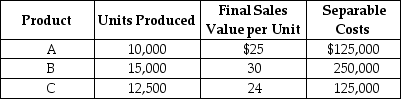 Required:
Determine the amount of joint cost allocated to each product if the constant gross margin percentage of NRV method is used.
Required:
Determine the amount of joint cost allocated to each product if the constant gross margin percentage of NRV method is used. (Essay)
4.8/5 (84)
(84) List three reasons why we allocate joint costs to individual products or services.Give an example of when the particular cost allocation reason would come into use.
(Essay)
4.8/5 (70)
(70) Which of the following is NOT a reason underlying the importance of allocations for inventory costing and cost of goods sold computations?
(Multiple Choice)
4.7/5 (75)
(75) Answer the following question(s)using the information below:
The Morton Company processes unprocessed goat milk up to the splitoff point where two products,condensed goat milk and skim goat milk result.The following information was collected for the month of October:
Direct Materials processed: 65,000 litres (shrinkage was 10%)
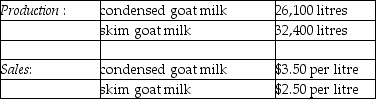 The costs of purchasing the 65,000 litres of unprocessed goat milk and processing it up to the splitoff point to yield a total of 58,500 litres of salable product was $72,240.There were no inventory balances of either product.
Condensed goat milk may be processed further to yield 19,500 litres (the remainder is shrinkage)of a medicinal milk product,Xyla,for an additional processing cost of $3 per usable litre.Xyla can be sold for $18 per litre.
Skim goat milk can be processed further to yield 28,100 litres of skim goat ice cream,for an additional processing cost per usable litre of $2.50.The product can be sold for $9 per litre.
There are no beginning and ending inventory balances.
-What is the estimated net realizable value of Xyla at the splitoff point?
The costs of purchasing the 65,000 litres of unprocessed goat milk and processing it up to the splitoff point to yield a total of 58,500 litres of salable product was $72,240.There were no inventory balances of either product.
Condensed goat milk may be processed further to yield 19,500 litres (the remainder is shrinkage)of a medicinal milk product,Xyla,for an additional processing cost of $3 per usable litre.Xyla can be sold for $18 per litre.
Skim goat milk can be processed further to yield 28,100 litres of skim goat ice cream,for an additional processing cost per usable litre of $2.50.The product can be sold for $9 per litre.
There are no beginning and ending inventory balances.
-What is the estimated net realizable value of Xyla at the splitoff point? (Multiple Choice)
4.8/5 (84)
(84) When a single manufacturing process yields two products,one of which has a relatively high sales value compared to the other,the two products are respectively known as
(Multiple Choice)
4.8/5 (87)
(87) Use the information below to answer the following question(s).
Chem Manufacturing Company processes direct materials up to the splitoff point,where two products (X and Y)are obtained and sold.The following information was collected for the month of November.
Direct materials processed:
10,000 litres (10,000 litres yield 9,500 litres of good product and 500 litres of shrinkage)
 The cost of purchasing 10,000 litres of direct materials and processing it up to the splitoff point to yield a total of 9,500 litres of good products was $975,000.
The beginning inventories totalled 50 litres for X and 25 litres for Y.Ending inventory amounts reflected 300 litres of product X and 525 litres of product Y.October costs were per unit were the same as November.
-What is the approximate portion of the joint costs that should be allocated to products X and Y,respectively,using a physical volume measure?
The cost of purchasing 10,000 litres of direct materials and processing it up to the splitoff point to yield a total of 9,500 litres of good products was $975,000.
The beginning inventories totalled 50 litres for X and 25 litres for Y.Ending inventory amounts reflected 300 litres of product X and 525 litres of product Y.October costs were per unit were the same as November.
-What is the approximate portion of the joint costs that should be allocated to products X and Y,respectively,using a physical volume measure? (Multiple Choice)
4.9/5 (70)
(70) What is the reason that accountants do not like to carry inventory at net realizable value?
(Multiple Choice)
4.8/5 (87)
(87) 
Filters
- Essay(0)
- Multiple Choice(0)
- Short Answer(0)
- True False(0)
- Matching(0)