



 Chat with AI
Exam 15: Cost Allocation: Joint Products and Byproducts

Exam 1: The Accountants Vital Role in Decision Making141 Questions
Exam 2: An Introduction to Cost Terms and Purposes171 Questions
Exam 3: Cost-Volume-Profit Analysis156 Questions
Exam 4: Job Costing145 Questions
Exam 5: Activity-Based Costing and Management144 Questions
Exam 6: Master Budget and Responsibility Accounting170 Questions
Exam 7: Flexible Budgets,variances,and Management Control: I172 Questions
Exam 8: Flexible Budgets,variances,and Management Control: II148 Questions
Exam 9: Income Effects of Denominator Level on Inventory Valuation171 Questions
Exam 10: Analysis of Cost Behaviour212 Questions
Exam 11: Decision Making and Relevant Information174 Questions
Exam 12: Pricing Decisions, product Profitability Decisions, and Cost Management150 Questions
Exam 13: Strategy,balanced Scorecard,and Profitability Analysis161 Questions
Exam 14: Period Cost Allocation163 Questions
Exam 15: Cost Allocation: Joint Products and Byproducts167 Questions
Exam 16: Revenue and Customer Profitability Analysis152 Questions
Exam 17: Process Costing147 Questions
Exam 18: Spoilage, rework, and Scrap137 Questions
Exam 19: Inventory Cost Management Strategies152 Questions
Exam 20: Capital Budgeting: Methods of Investment Analysis187 Questions
Exam 21: Transfer Pricing and Multinational Management Control Systems157 Questions
Exam 22: Multinational Performance Measurement and Compensation156 Questions
Select questions type


Trundle Ltd.produces two main products,J and K;and,a byproduct,L.There were no beginning inventories.During April,it incurred $275,000 of joint costs,which are allocated to main products using the physical output method.Additional information follows:
 Required:
Assuming Trundle recognizes byproduct revenue at the time of production,what is the total value of ending inventory?
Required:
Assuming Trundle recognizes byproduct revenue at the time of production,what is the total value of ending inventory? (Essay)
4.8/5  (74)
(74) Which of the following joint cost allocation methods calculates expected profits before any costs are allocated?
(Multiple Choice)
4.8/5 (69)
(69) Use the information below to answer the following question(s).
Beverage Drink Company processes direct materials up to the splitoff point,where two products,A and B,are obtained.The following information was collected for the month of July:
Direct materials processed: 2,500 litres (with 20 percent shrinkage)
 Cost of purchasing 2,500 litres of direct materials and processing it up to the splitoff point to yield a total of 2,000 litres of good products was $4,500.There were no inventory balances of A and B.
Product A may be processed further to yield 1,375 litres of Product Z5 for an additional processing cost of $150.Product Z5 is sold for $25.00 per litre.There was no beginning inventory and ending inventory was 125 litres.
Product B may be processed further to yield 375 litres of Product W3 for an additional processing cost of $275.Product W3 is sold for $30.00 per litre.There was no beginning inventory and ending inventory was 25 litres.
-Which of the following methods allocates joint costs according to the appraised final sales value in the ordinary course of business less the appraised separable costs of production and marketing?
Cost of purchasing 2,500 litres of direct materials and processing it up to the splitoff point to yield a total of 2,000 litres of good products was $4,500.There were no inventory balances of A and B.
Product A may be processed further to yield 1,375 litres of Product Z5 for an additional processing cost of $150.Product Z5 is sold for $25.00 per litre.There was no beginning inventory and ending inventory was 125 litres.
Product B may be processed further to yield 375 litres of Product W3 for an additional processing cost of $275.Product W3 is sold for $30.00 per litre.There was no beginning inventory and ending inventory was 25 litres.
-Which of the following methods allocates joint costs according to the appraised final sales value in the ordinary course of business less the appraised separable costs of production and marketing? (Multiple Choice)
4.7/5 (73)
(73) CSI Chemical,Inc.processes pine rosin into three products;turpentine,paint thinner,and spot remover.During May the joint costs of processing were $240,000.Production and sales value information for the month were as follows:
 Required:
Determine the amount of joint cost allocated to each product if the physical measure method is used.
Required:
Determine the amount of joint cost allocated to each product if the physical measure method is used. (Essay)
4.9/5 (78)
(78) A major deficiency of the sales value at splitoff method is that this method does not allow management to obtain individual product costs and gross margin information.
(True/False)
4.9/5 (80)
(80) A byproduct is one or more products of a joint production process that have low total sales value compared to the total sales value of the main product or joint products.
(True/False)
5.0/5 (84)
(84) In rate regulation settings,which method is usually preferred over the sales value method?
(Multiple Choice)
4.8/5 (72)
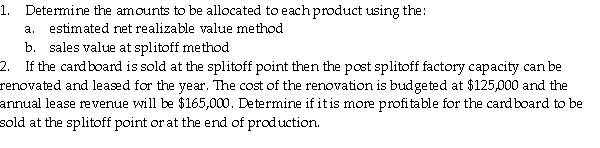
(72) Orange Paper Company processes wood pulp into two products.During April the joint costs of processing were $132,000.Production and sales value information for the month were as follows:
 Paper sells for $2.65 a kilogram and cardboard sells for $3.40 a kilogram.
There were no beginning or ending inventories for April.
Required:
Paper sells for $2.65 a kilogram and cardboard sells for $3.40 a kilogram.
There were no beginning or ending inventories for April.
Required:
(Essay)
4.9/5 (86)
(86) The constant gross margin percentage NRV method of joint cost allocation
(Multiple Choice)
4.8/5 (72)
(72) What are the two methods to account for byproducts.Which is the more appropriate method to use and why?
(Essay)
4.8/5 (78)
(78) Use the information below to answer the following question(s).
Chem Manufacturing Company processes direct materials up to the splitoff point,where two products (X and Y)are obtained and sold.The following information was collected for the month of November.
Direct materials processed:
10,000 litres (10,000 litres yield 9,500 litres of good product and 500 litres of shrinkage)
 The cost of purchasing 10,000 litres of direct materials and processing it up to the splitoff point to yield a total of 9,500 litres of good products was $975,000.
The beginning inventories totalled 50 litres for X and 25 litres for Y.Ending inventory amounts reflected 300 litres of product X and 525 litres of product Y.October costs were per unit were the same as November.
-What are the respective physical volume proportions for products X and Y?
The cost of purchasing 10,000 litres of direct materials and processing it up to the splitoff point to yield a total of 9,500 litres of good products was $975,000.
The beginning inventories totalled 50 litres for X and 25 litres for Y.Ending inventory amounts reflected 300 litres of product X and 525 litres of product Y.October costs were per unit were the same as November.
-What are the respective physical volume proportions for products X and Y? (Multiple Choice)
5.0/5 (90)
(90) A criticism of the practice of carrying inventories at estimated net realizable values is that this practice recognizes income before sales are made.
(True/False)
4.9/5 (84)
(84) Use the information below to answer the following question(s).
Troy Company processes 15,000 litres of direct materials to produce two products,Product X and Product Y.Product X,a byproduct,sells for $4 per litre,and Product Y,the main product,sells for $50 per litre.The following information is for August:
 The manufacturing costs totalled $95,000.
-How much is the ending inventory reduction for the byproduct if byproducts are recognized in the general ledger at the point of sale?
The manufacturing costs totalled $95,000.
-How much is the ending inventory reduction for the byproduct if byproducts are recognized in the general ledger at the point of sale? (Multiple Choice)
4.8/5 (81)
(81) BC Lumber processes timber into four products.During January the joint costs of processing were $280,000.There was no beginning inventory at the beginning of the month.Production and sales value information for the month were as follows:
Sales Value at
 Required:
Determine the value of ending inventory if the sales value at splitoff method is used for product costing.Round to 3 decimal places when necessary.
Required:
Determine the value of ending inventory if the sales value at splitoff method is used for product costing.Round to 3 decimal places when necessary. (Essay)
4.9/5 (85)
(85) Answer the following question(s)using the information below.
The Oxnard Corporation processes a liquid component up to the splitoff point where two products,Mr.DirtOut and Mr.SinkClean,are produced and sold.There was no beginning inventory.The following material was collected for the month of January:
Direct materials processed: 250,000 litres (242,500 litres of good product)
 The cost of purchasing 250,000 litres of direct materials and processing it up to the splitoff point to yield a total of 242,500 litres of good product was $380,000.
-When using a physical volume measure,what is the approximate amount of joint costs that will be allocated to Mr.DirtOut and Mr.SinkClean?
The cost of purchasing 250,000 litres of direct materials and processing it up to the splitoff point to yield a total of 242,500 litres of good product was $380,000.
-When using a physical volume measure,what is the approximate amount of joint costs that will be allocated to Mr.DirtOut and Mr.SinkClean? (Multiple Choice)
4.8/5 (78)
(78) Use the information below to answer the following question(s).
Chem Manufacturing Company processes direct materials up to the splitoff point,where two products (X and Y)are obtained and sold.The following information was collected for the month of November.
Direct materials processed:
10,000 litres (10,000 litres yield 9,500 litres of good product and 500 litres of shrinkage)
The cost of purchasing 10,000 litres of direct materials and processing it up to the splitoff point to yield a total of 9,500 litres of good products was $975,000.
The beginning inventories totalled 50 litres for X and 25 litres for Y.Ending inventory amounts reflected 300 litres of product X and 525 litres of product Y.October costs were per unit were the same as November.
-What is Product X's approximate production cost per unit using the physical volume method?
The cost of purchasing 10,000 litres of direct materials and processing it up to the splitoff point to yield a total of 9,500 litres of good products was $975,000.
The beginning inventories totalled 50 litres for X and 25 litres for Y.Ending inventory amounts reflected 300 litres of product X and 525 litres of product Y.October costs were per unit were the same as November.
-What is Product X's approximate production cost per unit using the physical volume method? (Multiple Choice)
4.7/5 (85)
(85) The constant gross margin percentage of NRV method allocates joint costs to joint products in such a way that the gross margin on each joint product is the same as it was in the previous year.
(True/False)
4.8/5 (96)
(96) 
Filters
- Essay(0)
- Multiple Choice(0)
- Short Answer(0)
- True False(0)
- Matching(0)