



 Chat with AI
Exam 18: Spoilage, Rework, and Scrap

Exam 1: The Accountants Vital Role in Decision Making141 Questions
Exam 2: An Introduction to Cost Terms and Purposes165 Questions
Exam 3: Cost-Volume-Profit Analysis139 Questions
Exam 4: Job Costing138 Questions
Exam 5: Activity-Based Costing and Management133 Questions
Exam 6: Master Budget and Responsibility Accounting150 Questions
Exam 7: Flexible Budgets, Variances, and Management Control: I146 Questions
Exam 8: Flexible Budgets, Variances, and Management Control: II137 Questions
Exam 9: Income Effects of Denominator Level on Inventory Valuation154 Questions
Exam 10: Quantitative Analyses of Cost Functions114 Questions
Exam 11: Decision Making and Relevant Information146 Questions
Exam 12: Pricing Decisions, Product Profitability Decisions, and Cost Management135 Questions
Exam 13: Strategy, Balanced Scorecard, and Profitability Analysis140 Questions
Exam 14: Period Cost Allocation153 Questions
Exam 15: Cost Allocation: Joint Products and Byproducts149 Questions
Exam 16: Revenue and Customer Profitability Analysis137 Questions
Exam 17: Process Costing128 Questions
Exam 18: Spoilage, Rework, and Scrap121 Questions
Exam 19: Cost Management: Quality, Time, and the Theory of Constraints158 Questions
Exam 20: Inventory Cost Management Strategies136 Questions
Exam 21: Capital Budgeting: Methods of Investment Analysis128 Questions
Exam 22: Capital Budgeting: a Closer Look120 Questions
Exam 23: Transfer Pricing and Multinational Management Control Systems141 Questions
Exam 24: Multinational Performance Measurement and Compensation139 Questions
Select questions type


Answer the following question(s) using the information below.
Samantha's Office Supplies manufactures desk organizers in its Processing Department. Direct materials are added at the beginning of the process and conversion costs are incurred evenly throughout the production cycle. Inspection takes place at the end of the process and spoiled units generally constitute 4% of the good units. Data provided for February are as follows:
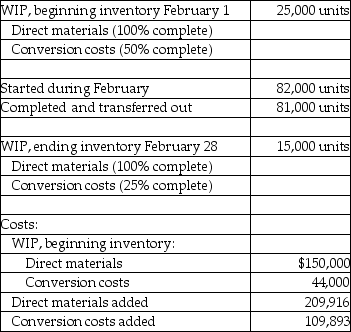 -What costs would be associated with normal and abnormal spoilage, respectively, using the FIFO method of process costing?
 (Multiple Choice)
4.8/5  (81)
(81) When abnormal rework is distinguished from normal rework, and charged to a separate loss account, which of the following is a likely result?
(Multiple Choice)
4.9/5 (82)
(82) The Skate Board Company uses a process cost system for making skateboard wheels. Materials are added at the beginning of the process and conversion costs are uniformly incurred. At the beginning of September the work in process is 40 percent complete and at the end of the month it is 60 percent complete. Spoilage is detected at the end of the process. Other data for the month include:
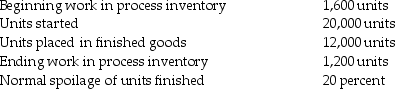
 Beginning work in process costs:
 Required:
a. Prepare a production cost worksheet using the weighted-average method of process costing. Recognize spoilage.
b. Prepare journal entries to record transferring out of cost from the work in process accounts.
Beginning work in process costs:
Required:
a. Prepare a production cost worksheet using the weighted-average method of process costing. Recognize spoilage.
b. Prepare journal entries to record transferring out of cost from the work in process accounts. (Essay)
4.8/5 (76)
(76) In job costing, costs of abnormal spoilage are not considered as inventoriable costs and are therefore written off as costs of the period in which detection occurs.
(True/False)
4.7/5 (80)
(80) Boss Cycle generally has spoiled goods during each job. Costs are assigned to normal spoilage at $10.00 per unit and abnormal spoilage at $20.00 per unit. Disposal fees typically run $5.00 per item. Boss Cycle has a policy never to rework spoiled units. Management believes that once a unit is damaged it cannot be reworked into a quality product. The losses are charged back to the specific job. What is the appropriate journal entry if 300 units are considered abnormal spoilage and are not disposed of in a process costing system?
(Multiple Choice)
4.9/5 (96)
(96) Use the information below to answer the following question(s).
Craft Concept manufactures small tables in its Processing Department. Direct Materials are added at the initiation of the production cycle and must be bundled in single kits for each unit. Conversion costs are incurred evenly throughout the production cycle. Before inspection, some units are spoiled due to non-detectable materials defects. Inspection occurs at the end of the process. Spoiled units generally constitute 5 percent of the good units. Data for December are as follows:
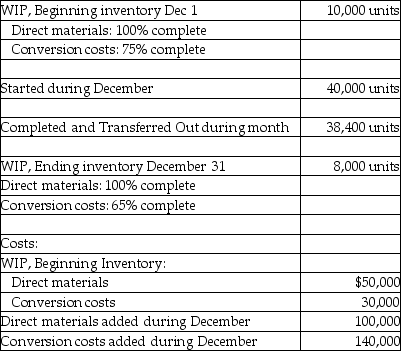 -What cost is allocated to abnormal spoilage using the weighted-average process costing method?
 (Multiple Choice)
4.7/5 (86)
(86) Distinguish among spoilage, reworked units, and scrap. Give an example of each.
(Essay)
4.7/5 (73)
(73) Redwing Shoes manufactures shoes. All direct materials are included at the inception of the production process. For March there were 2,000 units in beginning inventory with a direct material cost of $1,000. Direct materials totalled $20,000 for the month. Work in process records revealed that 40,000 shoes were started in March and that 36,000 were finished. Normal spoilage of 5 percent of units finished was incurred. Ending work in process units are complete in respect to direct materials costs. Spoilage is not detected until the process is complete. Redwing uses the weighted-average method.
Required:
a. What are the direct materials costs assigned to completed good units when spoilage units are recognized and when they are not recognized?
b. What are the direct material amounts allocated to the work in process ending inventory when spoilage units are recognized and when spoilage units are ignored?
(Essay)
4.7/5 (76)
(76) Costs incurred due to spoilage in a job order costing system, may be treated in all of the following ways, EXCEPT
(Multiple Choice)
4.9/5 (65)
(65) Use the information below to answer the following question(s).
Cartwright Custom Carpentry manufactures chairs in its Processing Department, and uses the FIFO cost flow assumption. Direct Materials are included at the inception of the production cycle and must be bundled in single kits for each unit. Conversion costs are incurred evenly throughout the production cycle. Inspection takes place at the end of the process, and spoiled units generally constitute 3 percent of the good output. Information provided for March is as follows:
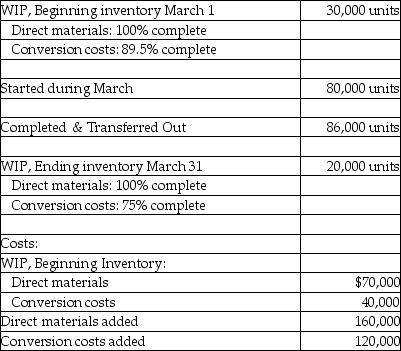 -What are the costs per equivalent unit for direct materials and conversion respectively?
 (Multiple Choice)
4.8/5 (92)
(92) Total cost per equivalent unit using the weighted-average method equals
(Multiple Choice)
4.8/5 (92)
(92) Wilson Sports uses a process costing system. Direct material A is placed into production at the beginning of the process, while direct material B is placed into production at the end of the process. Inspection occurs at the end of the process, before the addition of direct material B. Normal spoilage is 5% of good units. For March the company had the following activities:
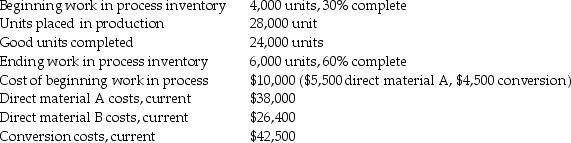 Required:
Prepare a production cost worksheet using the weighted average method.
Required:
Prepare a production cost worksheet using the weighted average method. (Essay)
4.9/5 (71)
(71) Answer the following question(s) using the information below.
Samantha's Office Supplies manufactures desk organizers in its Processing Department. Direct materials are added at the beginning of the process and conversion costs are incurred evenly throughout the production cycle. Inspection takes place at the end of the process and spoiled units generally constitute 4% of the good units. Data provided for February are as follows:
-What are the normal and abnormal spoilage units, respectively, for October assuming Hawk uses the weighted average method of process costing?
-What are the normal and abnormal spoilage units, respectively, for October assuming Hawk uses the weighted average method of process costing? (Multiple Choice)
4.9/5 (85)
(85) Under efficient operating conditions, all spoilage is considered to be abnormal spoilage.
(True/False)
4.9/5 (81)
(81) If the inspection point occurs at 33% into the production cycle, which of the following units would be allocated costs of spoilage detected at inspection?
(Multiple Choice)
4.9/5 (64)
(64) Answer the following question(s) using the information below.
Samantha's Office Supplies manufactures desk organizers in its Processing Department. Direct materials are added at the beginning of the process and conversion costs are incurred evenly throughout the production cycle. Inspection takes place at the end of the process and spoiled units generally constitute 4% of the good units. Data provided for February are as follows:
-What costs are allocated to the ending work-in-process inventory for direct materials and conversion costs, respectively, using the FIFO method of process costing?
-What costs are allocated to the ending work-in-process inventory for direct materials and conversion costs, respectively, using the FIFO method of process costing? (Multiple Choice)
4.8/5 (80)
(80) Boss Manufacturing generally has spoiled goods during each job. Costs are assigned to normal spoilage at $10.00 per unit and abnormal spoilage at $20.00 per unit. Disposal fees typically run $5.00 per item. Boss has a policy never to rework spoiled units. Management believes that once a unit is damaged it cannot be reworked into a quality product. What is the appropriate journal entry if 500 units are considered abnormal spoilage in a job costing system?
(Multiple Choice)
4.9/5 (76)
(76) Answer the following question(s) using the information below.
Samantha's Office Supplies manufactures desk organizers in its Processing Department. Direct materials are added at the beginning of the process and conversion costs are incurred evenly throughout the production cycle. Inspection takes place at the end of the process and spoiled units generally constitute 4% of the good units. Data provided for February are as follows:
-Assuming Hawk uses the FIFO method of process costing, the cost per equivalent unit for direct materials and conversion costs respectively are:
-Assuming Hawk uses the FIFO method of process costing, the cost per equivalent unit for direct materials and conversion costs respectively are: (Multiple Choice)
4.7/5 (81)
(81) 
Filters
- Essay(0)
- Multiple Choice(0)
- Short Answer(0)
- True False(0)
- Matching(0)