



 Chat with AI
Exam 18: Spoilage, Rework, and Scrap

Exam 1: The Accountants Vital Role in Decision Making141 Questions
Exam 2: An Introduction to Cost Terms and Purposes165 Questions
Exam 3: Cost-Volume-Profit Analysis139 Questions
Exam 4: Job Costing138 Questions
Exam 5: Activity-Based Costing and Management133 Questions
Exam 6: Master Budget and Responsibility Accounting150 Questions
Exam 7: Flexible Budgets, Variances, and Management Control: I146 Questions
Exam 8: Flexible Budgets, Variances, and Management Control: II137 Questions
Exam 9: Income Effects of Denominator Level on Inventory Valuation154 Questions
Exam 10: Quantitative Analyses of Cost Functions114 Questions
Exam 11: Decision Making and Relevant Information146 Questions
Exam 12: Pricing Decisions, Product Profitability Decisions, and Cost Management135 Questions
Exam 13: Strategy, Balanced Scorecard, and Profitability Analysis140 Questions
Exam 14: Period Cost Allocation153 Questions
Exam 15: Cost Allocation: Joint Products and Byproducts149 Questions
Exam 16: Revenue and Customer Profitability Analysis137 Questions
Exam 17: Process Costing128 Questions
Exam 18: Spoilage, Rework, and Scrap121 Questions
Exam 19: Cost Management: Quality, Time, and the Theory of Constraints158 Questions
Exam 20: Inventory Cost Management Strategies136 Questions
Exam 21: Capital Budgeting: Methods of Investment Analysis128 Questions
Exam 22: Capital Budgeting: a Closer Look120 Questions
Exam 23: Transfer Pricing and Multinational Management Control Systems141 Questions
Exam 24: Multinational Performance Measurement and Compensation139 Questions
Select questions type


When a unit has to be reworked, the rework may be classified in three ways. What are those ways, and how does the accounting for each differ?
(Essay)
4.8/5  (78)
(78) Which of the following entries would correctly record costs associated with reworked items?
(Multiple Choice)
4.9/5 (74)
(74) Marvin Randall had a background in the manufacturing of building bricks. The building brick industry used clay and other material which were first mixed, then aged. After aging, they were molded into shapes, retouched and fired in kilns. The materials were fairly durable and spoilage was not significant. As a result, any spoilage that did occur was not specifically accounted for. Marvin saw the similarities between brick and tile manufacturing and felt that he could apply his knowledge successfully in tile manufacturing and started his business, Randall Tile Ltd. on July 1.
In tile manufacturing, as it brick manufacturing, the process starts with the selection of the raw materials including clays. However feldspar, sand, and other materials are used. In the initial stages, it is important that all materials are homogenized; this is done through a wet grinding process. The material output of this process is known as slip.
Water content is then removed from the slip through spray-drying . After, the material is moulded , pressed and dried before the tiles are fired. Hydraulic presses are used to guarantee maximum compaction. Consistency in the press cycle time is critical to ensure the tiles have the correct moisture content. If the water content is too high, the tiles will crack or break.
Unglazed tiles proceed to firing, whereas glazed tiles must first be covered with one or more layers of glaze. Firing time and temperature are important in the firing process to ensure the resulting product meets required specifications for strength, stability, resistance and easy cleaning.
After firing, tiles are inspected for quality. Irregularities in size, shape or colouring will lead to spoiled units. The final step is packing the ceramic tiles.
Randall Tile was organized into 4 main departments.: 1) Mixing & Grinding, 2) Moulding & Pressing, 3) Glazing & Firing and 4) Inspecting & Packing. Randall was not manufacturing many glazed tiles, so any glazing that was required was done in the Firing department. The weighted average method of process costing was used in each department, however spoilage was not tracked. Marvin quickly realized that, although the processes in brick and tile manufacturing processes were similar, tile manufacturing required much more precision. After 3 months of operations, he estimated that he had a 50% defect rate when considering all stages of manufacturing. Employees were frustrated by the constant changes in manufacturing as pressing times, firing times, and temperatures were all altered in attempts to improve quality. Furthermore, Marvin believed that both frustration and nervousness led to high spoilage in the packing process.
Required:
What factors might have contributed to the high defect rate that Marvin noted? What steps might Marvin have taken prior to starting production to minimize defects? What recommendations would you make to Marvin regarding the management accounting system at Randall Tile?
(Essay)
4.9/5 (89)
(89) Answer the following question(s) using the information below.
Samantha's Office Supplies manufactures desk organizers in its Processing Department. Direct materials are added at the beginning of the process and conversion costs are incurred evenly throughout the production cycle. Inspection takes place at the end of the process and spoiled units generally constitute 4% of the good units. Data provided for February are as follows:
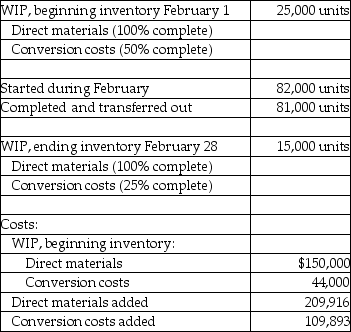 -What are the normal and abnormal spoilage units, respectively, for February when using FIFO?
 (Multiple Choice)
4.9/5 (69)
(69) A company manufactures draperies. Because of strict production specifications, the manufacturing department often has spoiled items. If the spoiled items are under 10 percent of a job's total items they are treated as normal spoilage. During February job #101 for 200 draperies had 16 spoiled items. The spoiled items were detected immediately before they were packaged. They had already passed the safety inspection. The marketing manager believes the items can be sold for $280 each. They had a cost at point of detection of $600 each. These costs included $300 for direct manufacturing labour, $200 for direct materials, and $100 for factory overhead.
Required:
a. Make the necessary journal entry, or entries, to record the spoiled units if the spoilage is normal and assigned to an overhead control account.
b. Make the necessary journal entry, or entries, to record the spoiled units if the spoilage is assigned to job #101.
(Essay)
4.9/5 (83)
(83) Companies that attempt to achieve zero defects in the manufacturing process treat all spoilage as which of the following?
(Multiple Choice)
4.8/5 (91)
(91) Use the information below to answer the following question(s).
Craft Concept manufactures small tables in its Processing Department. Direct Materials are added at the initiation of the production cycle and must be bundled in single kits for each unit. Conversion costs are incurred evenly throughout the production cycle. Before inspection, some units are spoiled due to non-detectable materials defects. Inspection occurs at the end of the process. Spoiled units generally constitute 5 percent of the good units. Data for December are as follows:
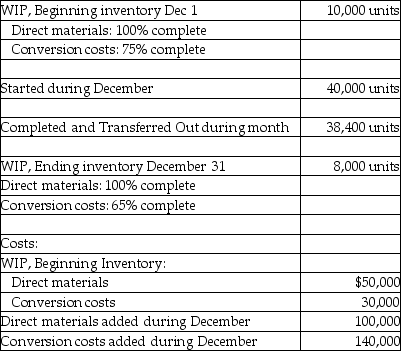 -What is the total cost per equivalent unit using the weighted-average method of process costing?
 (Multiple Choice)
4.7/5 (79)
(79) Scrap has no value (or minimal value) therefore it is not traced back to specific jobs.
(True/False)
4.9/5 (80)
(80) Viking Sports is a manufacturer of sportswear. It produces all of its products in one department. The information for the current month is as follows:

 Beginning work in process was half complete as to conversion. Direct materials are added at the beginning of the process. Factory overhead is applied at a rate equal to 50 percent of direct manufacturing labour. Ending work in process was 60 percent complete. All spoilage is normal and is detected at end of the process.
Required:
Prepare a production cost worksheet assuming that spoilage is recognized and the weighted-average method is used.
Beginning work in process was half complete as to conversion. Direct materials are added at the beginning of the process. Factory overhead is applied at a rate equal to 50 percent of direct manufacturing labour. Ending work in process was 60 percent complete. All spoilage is normal and is detected at end of the process.
Required:
Prepare a production cost worksheet assuming that spoilage is recognized and the weighted-average method is used. (Essay)
4.9/5 (88)
(88) A company whose goal is zero defects would usually treat all spoilage as abnormal.
(True/False)
4.9/5 (82)
(82) Reworked goods are unacceptable units of production usually not capable of being repaired or converted into a salable product.
(True/False)
4.9/5 (72)
(72) Boutin Company uses a job costing system. During October, the following costs are incurred on Job 110 to manufacture 200 motors:
Original costs:
 Manufacturing overhead allocated
 Direct cost of reworking 10 motors:
 Required:
a. Prepare the journal entry to record the rework costs, assuming the rework is attributable specifically to Job 110.
b. Compute the cost per finished motor for Job 110, assuming the rework is attributable specifically to this job.
c. Prepare the journal entry to record the rework costs, assuming the rework is common to all jobs.
d. Compute the cost per finished motor for Job 110, assuming the rework is common to all jobs.
Manufacturing overhead allocated
Direct cost of reworking 10 motors:
Required:
a. Prepare the journal entry to record the rework costs, assuming the rework is attributable specifically to Job 110.
b. Compute the cost per finished motor for Job 110, assuming the rework is attributable specifically to this job.
c. Prepare the journal entry to record the rework costs, assuming the rework is common to all jobs.
d. Compute the cost per finished motor for Job 110, assuming the rework is common to all jobs. (Essay)
4.8/5 (69)
(69) Scrap products may be reprocessed and subsequently sold as a finished good.
(True/False)
4.8/5 (77)
(77) Assume the amount of scrap is material and the scrap is sold immediately after it is produced. If the scrap attributable to a specific job is sold on account, the journal entry is:
(Multiple Choice)
4.7/5 (74)
(74) Shazam Machines produces numerous types of money change machines. All machines are made in the same production department and many use exactly the same processes. Because customers have such different demands for the machine characteristics, the company uses a job costing system. Unfortunately, some of the production managers have been upset for the last few months when their jobs were charged with the spoilage that occurred over an entire processing run of several types of machines. Some of the best managers have even threatened to quit unless the accounting system is changed.
Required:
What recommendations can you suggest to improve the accounting for spoilage?
(Essay)
4.9/5 (87)
(87) Which of the following entries reflects the original cost assignment before production items are reworked?
(Multiple Choice)
4.9/5 (71)
(71) Carriage Florists operate a flower shop. Because most of the orders are via telephone, fax or email, numerous orders have to be reworked. The average cost of the reworked orders is $4: $2.50 for labour, $1 for more flowers, and $0.50 for overhead. This ratio of costs holds for the average original order. On a recent day the shop reworked 32 orders out of 166. The original cost of the 32 orders totalled $480. The average cost of all orders is $12.50, including rework, with an average selling price of $20.
Required:
Prepare the necessary journal entry, or entries, to record the rework for the day if the shop charges such activities to Arrangement Department Overhead Control. Prepare a journal entry to transfer the finished goods to Finished Goods Inventory.
(Essay)
4.9/5 (81)
(81) The Hawg Manufacturing Shop produces motorcycle parts. Typically, 20 pieces out of a job lot of 2,000 parts are normally spoiled. Costs are assigned at the inspection point, $100.00 per unit. Spoiled pieces may be disposed of for proceeds of $20.00 per unit. The spoiled goods must be inventoried appropriately when the normal spoilage is detected. The current job requires the production of 5,000 good parts. Which of the following journal entries properly reflects the recording of spoiled goods?
(Multiple Choice)
4.7/5 (79)
(79) Spoilage costs allocated to completed units are larger by which method and by how much?
(Multiple Choice)
4.9/5 (83)
(83) 
Filters
- Essay(0)
- Multiple Choice(0)
- Short Answer(0)
- True False(0)
- Matching(0)