



 Chat with AI
Exam 20: Inventory Cost Management Strategies


Sequential tracking refers to a method of costing in which the accounting system entries occur at the same order as actual purchases and products.

 (78)
 Verified
True
Use the information below to answer the following question(s).
Office Supply House purchases 4,160 reams of paper per year, ordered in lots of 80 reams per week at $150 per ream. The vendor covers all shipping costs. Office Supply House is not required to inspect the shipment upon entry. Office Supply House earns 20% on its cash investments. The purchase-order lead time is two weeks. The following cost data are available:
 -The level of inventory which should trigger a new order is called
 (72) VerifiedD
Sudbury Ore Company mines nickel ore for production into various metal products. During recent years the company has had large fluctuations in its inventories of metal ingots. Much of the volatility of the inventory levels is due to the variability of demand by the company's largest customers, automobile manufacturers. For large orders the company has the technology to quickly shift production from one product to another.
Required:
Explain how the company can improve its inventory control system and give the advantages of whatever you recommend.
(80) VerifiedThe company can probably benefit from changing to a just-in-time system for inventory control. This would allow the company to be responsive to actual needs rather than stockpiling finished goods inventory. The advantages would be:
1. Lower inventory investments.
2. Reductions in carrying and handling costs of inventories.
3. Reduction in risks of obsolete inventories.
4. Emphasis on reducing manufacturing lead time.
JIT systems mean that there are minimal inventories at each stage of production, therefore, defects arising at one stage can quickly affect subsequent stages of production. It is therefore important in JIT systems, to also have a policy of TQM, solving problems and eliminating defects as soon as possible.
Note: If mining is a routine operation without much variability, you may consider selling extra inventory - a reverse JIT process.
For supply item ABC, Andrews Company has been ordering 125 units based on the recommendation of the salesperson who calls on the company monthly. A new purchasing agent has been hired by the company who wants to start using the economic-order-quantity method and its supporting decision elements. She has gathered the following information:
 Required:
Determine the EOQ, average inventory, orders per year, average daily demand, reorder point, annual ordering costs, and annual carrying costs.
Required:
Determine the EOQ, average inventory, orders per year, average daily demand, reorder point, annual ordering costs, and annual carrying costs. (80) To determine the Economic Order Quantity, the relevant ordering costs are minimized and the relevant carrying costs are maximized.
(75) The following information has been gathered for Product A:  What are the annual carrying costs if the company orders at the EOQ amount?
 (75) Costs associated with holding inventories and the resulting opportunity cost of the investment tied up in inventory fall into which of the following categories?
(80) Just-in-time purchasing is guided solely by the economic order quantity.
(80) The only product of a company has an annual demand of 2,000 units. The cost of placing an order is $40
and the cost of carrying one unit in inventory for one year is $16.
Required:
Determine the economic order quantity.
(75) Cyclone Electronics manufactures automobile radios. All processing is initiated when an order is received. For March there were no beginning inventories. Conversion Costs and Direct Materials are the only manufacturing cost accounts. Direct Materials are purchased under a just-in-time system. Backflush costing is used with a finished goods trigger point (i.e., one trigger point). Additional information for the month is as follows:
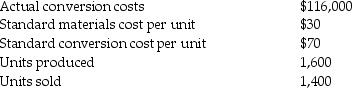 Required:
Record all journal entries for the monthly activities related to the above transactions if backflush costing is used.
Required:
Record all journal entries for the monthly activities related to the above transactions if backflush costing is used. (82) Use the information below to answer the following question(s).
Office Supply House purchases 4,160 reams of paper per year, ordered in lots of 80 reams per week at $150 per ream. The vendor covers all shipping costs. Office Supply House is not required to inspect the shipment upon entry. Office Supply House earns 20% on its cash investments. The purchase-order lead time is two weeks. The following cost data are available:
-What are the total relevant costs assuming the quantity ordered equals 80 reams?
-What are the total relevant costs assuming the quantity ordered equals 80 reams? (81) Ralph was in the process of completing the quarterly planning for the purchasing department when a
major computer malfunction lost most of his data. For direct material XXX he was able to recover the
following:
 Ralph purchases at the EOQ quantity level.
Required:
Determine the annual demand, the cost of placing an order, the economic order quantity and the annual total costs of inventory.
Ralph purchases at the EOQ quantity level.
Required:
Determine the annual demand, the cost of placing an order, the economic order quantity and the annual total costs of inventory. (79) Acme Industries is currently experiencing problems with its inventory of anvils. Its manager, Willy Coy currently orders the anvils in batches of 10,000. Four orders are placed during the year to meet the estimated sales demand of 40,000 units. Each order costs $20 and each unit costs $2 to carry. Mr. Coy maintains a safety stock of 500 anvils.
Required:
 b. What is the Economic Order Quantity for Acme Industries?
c. What is the average inventory if Acme uses the EOQ calculated in part b) and it still maintains its 500 units of safety stock?
d. What is Acme's annual savings in inventory costs by using the EOQ and maintaining its safety stock?
b. What is the Economic Order Quantity for Acme Industries?
c. What is the average inventory if Acme uses the EOQ calculated in part b) and it still maintains its 500 units of safety stock?
d. What is Acme's annual savings in inventory costs by using the EOQ and maintaining its safety stock? (81) Use the information below to answer the following question(s).
Movie Time is a distributor of DVDs. Video Mart is a local retail outlet which sells blank and recorded DVDs. Video Mart purchases DVDs from Movie Time at $5.00 each; the units are shipped in packages of 25. Movie Time pays all incoming freight, and Video Mart does not inspect the DVDs due to Movie Time's reputation for high quality. Annual demand is 104,000 DVDs at a rate of 2,000 units per week. Video Mart earns 15% on its cash investments. The purchase-order lead time is one week. The following cost data are available:
 -What is the economic-order quantity?
 (82) Answer the following question(s) using the information below:
The Wood Furniture company produces a specialty wood furniture product, and has the following information available concerning its inventory items:
 Annual demand is 10,000 packages per year. The purchase price per package is $16.
-Sandrington Ltd. operates a retail bicycle shop. Wheel covers are popular with customers. Sandrington purchases these covers for $48 (per pair) and expects to sell 5,000 pairs per year. Ordering costs are estimated at $180 per order and relevant insurance handling etc. costs are estimated at $0.30 per month. The company has established a 14% annual return on investment. The EOQ quantity for Sandrington is:
Annual demand is 10,000 packages per year. The purchase price per package is $16.
-Sandrington Ltd. operates a retail bicycle shop. Wheel covers are popular with customers. Sandrington purchases these covers for $48 (per pair) and expects to sell 5,000 pairs per year. Ordering costs are estimated at $180 per order and relevant insurance handling etc. costs are estimated at $0.30 per month. The company has established a 14% annual return on investment. The EOQ quantity for Sandrington is: (84) The annual demand for a company's product is 3,750 units, and monthly demand varies from 200 to 400 units with the following probability of demand:
200 units have a 25 percent probability
300 units have a 50 percent probability
400 units have a 25 percent probability
The EOQ model provides an optimal order quantity of 250 units. The opportunity costs of being out of stock are $2 per unit, with a carrying cost of $13 per unit, and the reorder point is 250 units.
Required:
a. Prepare a table showing stockouts, expected stockout costs, related carrying costs, and total costs, at each level of demand if the selected safety stocks are: 0, 50, 100 and 150.
b. What is the best level of safety stock to carry?
(74) The possibility of a conflict between the order quantity that an EOQ model recommends and the order quantity that the purchasing manager regards as optimal is increased with
(87) Companies that have fast manufacturing lead times usually find that a version of backflush costing will report cost numbers similar to what a sequential costing approach would report.
(69) What are the major relevant costs in maintaining safety stock?
(69) 
Filters
- Essay(0)
- Multiple Choice(0)
- Short Answer(0)
- True False(0)
- Matching(0)