



 Chat with AI
Exam 16: Revenue and Customer Profitability Analysis

Exam 1: The Accountants Vital Role in Decision Making141 Questions
Exam 2: An Introduction to Cost Terms and Purposes165 Questions
Exam 3: Cost-Volume-Profit Analysis139 Questions
Exam 4: Job Costing138 Questions
Exam 5: Activity-Based Costing and Management133 Questions
Exam 6: Master Budget and Responsibility Accounting150 Questions
Exam 7: Flexible Budgets, Variances, and Management Control: I146 Questions
Exam 8: Flexible Budgets, Variances, and Management Control: II137 Questions
Exam 9: Income Effects of Denominator Level on Inventory Valuation154 Questions
Exam 10: Quantitative Analyses of Cost Functions114 Questions
Exam 11: Decision Making and Relevant Information146 Questions
Exam 12: Pricing Decisions, Product Profitability Decisions, and Cost Management135 Questions
Exam 13: Strategy, Balanced Scorecard, and Profitability Analysis140 Questions
Exam 14: Period Cost Allocation153 Questions
Exam 15: Cost Allocation: Joint Products and Byproducts149 Questions
Exam 16: Revenue and Customer Profitability Analysis137 Questions
Exam 17: Process Costing128 Questions
Exam 18: Spoilage, Rework, and Scrap121 Questions
Exam 19: Cost Management: Quality, Time, and the Theory of Constraints158 Questions
Exam 20: Inventory Cost Management Strategies136 Questions
Exam 21: Capital Budgeting: Methods of Investment Analysis128 Questions
Exam 22: Capital Budgeting: a Closer Look120 Questions
Exam 23: Transfer Pricing and Multinational Management Control Systems141 Questions
Exam 24: Multinational Performance Measurement and Compensation139 Questions
Select questions type


Roper's Cablevision encounters revenue-allocation decisions with its bundled product sales. Here, two or more of its services are sold as a single package. Managers at Roper's are keenly interested in individual product-profitability figures. Information pertaining to its three bundled products and the stand-alone prices of its individual products is as follows:
 The unit variable costs are estimated at $4.00, $3.00, and $2.50 for Sports, Lifestyle, and TV Classics, respectively. In all cases, Sports is considered to be the primary product.
Required:
a. Allocate the bundled revenue to each product in the 'Sports & Classics' bundle, using selling prices as the base.
b. What is the allocated revenue to the Sports in each bundle, using the incremental revenue-allocation method?
The unit variable costs are estimated at $4.00, $3.00, and $2.50 for Sports, Lifestyle, and TV Classics, respectively. In all cases, Sports is considered to be the primary product.
Required:
a. Allocate the bundled revenue to each product in the 'Sports & Classics' bundle, using selling prices as the base.
b. What is the allocated revenue to the Sports in each bundle, using the incremental revenue-allocation method? (Essay)
4.9/5  (83)
(83) Columbia Coffee Inc. sells two types of coffee, Regular and Decaf. The monthly budget for Canadian coffee sales is based on a combination of last year's performance, a forecast of industry sales, and the company's expected share of the Canadian market. The following information is provided for March:

 Budgeted fixed costs are $58,000. Actual fixed costs are $62,000.
Required:
Calculate the static-budget, flexible-budget and sales-volume variances for contribution margin, for the company for March.
Budgeted fixed costs are $58,000. Actual fixed costs are $62,000.
Required:
Calculate the static-budget, flexible-budget and sales-volume variances for contribution margin, for the company for March. (Essay)
4.9/5 (73)
(73) An example of a bundled product is when a resort hotel charges a single price for lodging, food, and recreational activities.
(True/False)
5.0/5 (83)
(83) Give examples of bundled products for each of the following industries:
a. Resort hotel
b. Bank
c. Restaurant
d. Computer store
e. Gasoline service station/convenience store
f. Software manufacturer
(Essay)
4.9/5 (85)
(85) A customer cost hierarchy categorizes costs related to customers into different cost pools on the basis of using only one cost driver.
(True/False)
4.8/5 (66)
(66) Use the information below to answer the following question(s).
Teddy Bear Company sold a total of 30,000 stuffed tigers and lions. During August the following information was gathered:
 -What is the total sales-quantity variance?
 (Multiple Choice)
4.9/5 (69)
(69) A company sells two products: radios and speakers. The expected sales for radios were 1,500 units; 2,000 were sold. The budgeted selling price for radios was $15.00; however, the actual selling price was $13.00. The expected sales for speakers were 4,600 units; 5,000 were sold. The budgeted selling price for speakers was $7.50; however, the actual selling price was $9.00. Budgeted and actual variable costs were $4.00 per unit for the radios and $2.00 per unit for the speakers. What is the contribution margin sales-volume variance for the period?
(Multiple Choice)
4.8/5 (62)
(62) A policy of dropping any customer that is currently unprofitable will eliminate, in the short run, all of the costs assigned to it.
(True/False)
4.8/5 (75)
(75) The sales-volume variance plus or minus the static budget amount results in
(Multiple Choice)
4.8/5 (64)
(64) A difficulty with the market share and market size variances is that accurate measures of market share and market size often do not exist.
(True/False)
4.8/5 (83)
(83) Each division manager for a paint manufacturer is provided with a customer profitability analysis for the past year. The managers use the analysis to determine how best to allocate the company's resources within their division, and when a customer is a "loss customer," that customer is dropped.
Required:
Advise (briefly) the managers on their strategy of focusing only on profitabilty over the year, in terms of improving the bottom line of their respective divisions. Include at least three other factors that managers should consider in deciding how to allocate resources across customers.
(Essay)
4.8/5 (75)
(75) Top management and general administration costs would MOST likely be classified as a
(Multiple Choice)
4.9/5 (75)
(75) If the market-size variance is $400 U and the sales-mix variance is $700 F, and the market share variance is $300 F, we know that which of the following is true?
(Multiple Choice)
4.9/5 (80)
(80) Various Product Company is a manufacturer of numerous products which are similar and are processed on the same assembly line. The production manager has decided that she will require all product managers and assembly line managers to be responsible for their own operations. The accounting information system is a large complex system that can provide specialized reporting when needed. It also has room for new, permanent applications.
Required:
Discuss how the production manager can expand the reporting responsibilities of these managers.
(Essay)
4.9/5 (70)
(70) Bob's Appliances manufactures industrial dryers and washers. During February the following data are available:
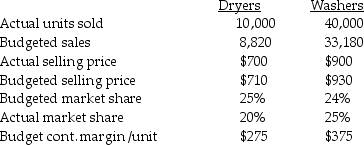 Required:
Determine the following:
1. Sales-mix and sales-quantity variances
2. Market-share and market-size variances (for calculation purposes round combined actual and budgeted market share percentages to six decimal places.)
Required:
Determine the following:
1. Sales-mix and sales-quantity variances
2. Market-share and market-size variances (for calculation purposes round combined actual and budgeted market share percentages to six decimal places.) (Essay)
4.9/5 (80)
(80) The stand-alone revenue allocation method is a weighted average method.
(True/False)
4.8/5 (71)
(71) The purpose of price discounting is to encourage increases in customer purchases.
(True/False)
4.9/5 (75)
(75) The Chair Company manufactures two modular types of chairs; one for the residential (home) market, and the other for the office market. Budgeted and actual operating data for the past year are:
 The industry volume for residential and office chairs of the type sold by the Chair company had been estimated at 2,400,000. Actual industry volume for the year was 2,200,000 chairs.
Required:
1. Compute the sale-mix variance and the sales- quantity variance by type of chair, and in total.
2. Compute the market-share variance and market-size variances. (Calculate actual and budgeted market share percentages to two decimal places.)
The industry volume for residential and office chairs of the type sold by the Chair company had been estimated at 2,400,000. Actual industry volume for the year was 2,200,000 chairs.
Required:
1. Compute the sale-mix variance and the sales- quantity variance by type of chair, and in total.
2. Compute the market-share variance and market-size variances. (Calculate actual and budgeted market share percentages to two decimal places.) (Essay)
4.9/5 (87)
(87) Use the information below to answer the following question(s).
Special Tea Products (STP) has an exclusive contract with Tea Distributors. Two brands of Teas are imported, Strong and Mild, and sold to retail outlets. The monthly budget for the contract is based on a combination of last year's performance, a forecast of general industry sales, and the company's expected share of the Canadian market for imported Tea. The following information is provided for the month of May:
 Budgeted fixed costs are $1,750. Actual fixed costs are $2,000.
-What is the STP total sales-mix variance for contribution margin?
Budgeted fixed costs are $1,750. Actual fixed costs are $2,000.
-What is the STP total sales-mix variance for contribution margin? (Multiple Choice)
4.8/5 (68)
(68) The (the difference between the actual market size in units and the budgeted market size in units) times (the budgeted market share) times (budgeted contribution margin per composite unit for the budgeted mix) is called the
(Multiple Choice)
4.8/5 (85)
(85) 
Filters
- Essay(0)
- Multiple Choice(0)
- Short Answer(0)
- True False(0)
- Matching(0)