



 Chat with AI
Exam 16: Revenue and Customer Profitability Analysis

Exam 1: The Accountants Vital Role in Decision Making141 Questions
Exam 2: An Introduction to Cost Terms and Purposes165 Questions
Exam 3: Cost-Volume-Profit Analysis139 Questions
Exam 4: Job Costing138 Questions
Exam 5: Activity-Based Costing and Management133 Questions
Exam 6: Master Budget and Responsibility Accounting150 Questions
Exam 7: Flexible Budgets, Variances, and Management Control: I146 Questions
Exam 8: Flexible Budgets, Variances, and Management Control: II137 Questions
Exam 9: Income Effects of Denominator Level on Inventory Valuation154 Questions
Exam 10: Quantitative Analyses of Cost Functions114 Questions
Exam 11: Decision Making and Relevant Information146 Questions
Exam 12: Pricing Decisions, Product Profitability Decisions, and Cost Management135 Questions
Exam 13: Strategy, Balanced Scorecard, and Profitability Analysis140 Questions
Exam 14: Period Cost Allocation153 Questions
Exam 15: Cost Allocation: Joint Products and Byproducts149 Questions
Exam 16: Revenue and Customer Profitability Analysis137 Questions
Exam 17: Process Costing128 Questions
Exam 18: Spoilage, Rework, and Scrap121 Questions
Exam 19: Cost Management: Quality, Time, and the Theory of Constraints158 Questions
Exam 20: Inventory Cost Management Strategies136 Questions
Exam 21: Capital Budgeting: Methods of Investment Analysis128 Questions
Exam 22: Capital Budgeting: a Closer Look120 Questions
Exam 23: Transfer Pricing and Multinational Management Control Systems141 Questions
Exam 24: Multinational Performance Measurement and Compensation139 Questions
Select questions type


An activity-based costing system may focus on customers rather than products.
(True/False)
4.8/5  (83)
(83) Use the information below to answer the following question(s).
John's Video Game Outlet encounters revenue-allocation decisions with its bundled product sales. Here, two or more of the video games are sold as a single package. Managers at John's are keenly interested in individual product-profitability figures. Information pertaining to its three bundled products and the stand-alone prices of its individual products is as follows:
 The unit manufacturing costs are $3.60, $4.00, and $5.00 for games A, B, and C, respectively.
-Calculate the allocation of packaged price for Game A in Package 1, using selling prices as the base.
The unit manufacturing costs are $3.60, $4.00, and $5.00 for games A, B, and C, respectively.
-Calculate the allocation of packaged price for Game A in Package 1, using selling prices as the base. (Multiple Choice)
4.9/5 (95)
(95) Fresh Bread Company sells a special mix of wheat bread. If the expected output equals the actual output, the sales-volume variance
(Multiple Choice)
4.8/5 (79)
(79) Costs incurred to process orders would MOST likely be classified as a
(Multiple Choice)
4.8/5 (82)
(82) Allocated corporate costs are irrelevant when analyzing whether to drop a customer.
(True/False)
4.7/5 (86)
(86) In general, distribution-channel costs are more easily influenced by customer actions than customer batch-level costs.
(True/False)
4.9/5 (76)
(76) Use the information below to answer the following question(s).
John's Video Game Outlet encounters revenue-allocation decisions with its bundled product sales. Here, two or more of the video games are sold as a single package. Managers at John's are keenly interested in individual product-profitability figures. Information pertaining to its three bundled products and the stand-alone prices of its individual products is as follows:
The unit manufacturing costs are $3.60, $4.00, and $5.00 for games A, B, and C, respectively.
-Calculate the revenue allocation for Game A in Package 1, using physical units as the base.
The unit manufacturing costs are $3.60, $4.00, and $5.00 for games A, B, and C, respectively.
-Calculate the revenue allocation for Game A in Package 1, using physical units as the base. (Multiple Choice)
4.9/5 (85)
(85) Comment on why marketing managers generally find the market-share variance is more controllable than the market- size variance.
(Essay)
4.7/5 (85)
(85) A composite unit is a hypothetical unit with weights based on the mix of individual units.
(True/False)
4.8/5 (70)
(70) Customer revenues are calculated independently from price discounts.
(True/False)
5.0/5 (77)
(77) Additional insight can be gained by dividing the sales-mix variance into the flexible-budget variance and the sales-volume variance.
(True/False)
4.8/5 (79)
(79) A favorable sales-mix variance arises when the actual sales-mix percentage is less than the budgeted sales-mix percentage.
(True/False)
4.8/5 (61)
(61) The Omega Corporation manufactures two types of vacuum cleaners, the ZENITH for commercial building use and the House-Helper for residences. Budgeted and actual operating data for the year are as follows:

 Prior to the beginning of the year, a consulting firm estimated the total volume for vacuum cleaners of the Zenith and House-Helper category to be 300,000 units, but actual industry volume was only 275,000 units.
Required:
Compute the market-share variance and market-size variance in terms of the contribution margin.
Prior to the beginning of the year, a consulting firm estimated the total volume for vacuum cleaners of the Zenith and House-Helper category to be 300,000 units, but actual industry volume was only 275,000 units.
Required:
Compute the market-share variance and market-size variance in terms of the contribution margin. (Essay)
4.9/5 (85)
(85) Price discounting is the reduction of selling prices below listed levels in order to encourage an increase in purchases by customers.
(True/False)
4.7/5 (83)
(83) The cost of the manager of a retail distribution channel would MOST likely be classified as a
(Multiple Choice)
4.8/5 (75)
(75) The cost of visiting customers would MOST likely be classified as a
(Multiple Choice)
4.9/5 (69)
(69) The sales-mix variance is the difference between two amounts: (1) the budgeted amount based on actual quantities sold of all products and the budgeted mix, and (2) the amount in the static budget.
(True/False)
4.8/5 (59)
(59) Harry's Electronics manufactures electronic parts. Data for two of the company's customers is as follows:
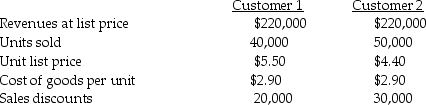 Customer-specific costs
 Required:
Prepare a Customer-Profitability Analysis.
Customer-specific costs
Required:
Prepare a Customer-Profitability Analysis. (Essay)
4.9/5 (81)
(81) Big Products sells only one product. Last year it sold 22,000 items when the budget was 16,000 items. The increased sales were due in part to reduced selling prices averaging $52. The budgeted selling price was $60. Total variable costs were budgeted at $144,000 .
Required:
Compute the contribution margin sales-volume variance. Why doesn't the contribution sales volume variance equal the difference between budgeted and actual revenue?
(Essay)
4.9/5 (72)
(72) 
Filters
- Essay(0)
- Multiple Choice(0)
- Short Answer(0)
- True False(0)
- Matching(0)