



 Chat with AI
Exam 6: Bonds

Exam 1: Corporate Finance and the Financial Manager86 Questions
Exam 2: Introduction to Financial Statement Analysis95 Questions
Exam 3: Time Value of Money: an Introduction112 Questions
Exam 4: Time Value of Money: Valuing Cash Flow Streams62 Questions
Exam 5: Interest Rates110 Questions
Exam 6: Bonds109 Questions
Exam 7: Stock Valuation64 Questions
Exam 8: Investment Decision Rules123 Questions
Exam 9: Fundamentals of Capital Budgeting113 Questions
Exam 10: Stock Valuation: a Second Look46 Questions
Exam 11: Risk and Return in Capital Markets110 Questions
Exam 12: Systematic Risk and the Equity Risk Premium104 Questions
Exam 13: The Cost of Capital107 Questions
Exam 14: Raising Equity Capital107 Questions
Exam 15: Debt Financing101 Questions
Exam 16: Capital Structure109 Questions
Exam 17: Payout Policy110 Questions
Exam 18: Financial Modeling and Pro Forma Analysis95 Questions
Exam 19: Working Capital Management107 Questions
Exam 20: Short-Term Financial Planning104 Questions
Exam 21: Option Applications and Corporate Finance102 Questions
Exam 22: Mergers and Acquisitions47 Questions
Exam 23: International Corporate Finance108 Questions
Exam 24: Leasing46 Questions
Exam 25: Insurance and Risk Management38 Questions
Exam 26: Corporate Governance45 Questions
Select questions type


Consider a zero-coupon bond with a $1000 face value and 15 years left until maturity. If the bond is currently trading for $431, then the yield to maturity on this bond is closest to ________.
(Multiple Choice)
4.8/5  (86)
(86) What is the yield to maturity of a one-year, risk-free, zero-coupon bond with a $10,000 face value and a price of $9400 when released?
(Multiple Choice)
4.7/5 (91)
(91) What care, if any, should be taken regarding the sign of the cash flows while drawing the timeline and associated cash flows of a coupon bond?
(Essay)
4.8/5 (77)
(77) A bond has a $10,000 face value, ten years to maturity, and 8% semiannual coupon payments. What would be the expected difference in this bond's price immediately before and immediately after the next coupon payment?
(Multiple Choice)
4.9/5 (82)
(82) The following table summarizes prices of various default-free zero-coupon bonds (expressed as a percentage of face value):  Based upon the information provided in the table above, you can conclude ________.
 (Multiple Choice)
4.7/5 (74)
(74) Luther Industries needs to raise $25 million to fund a new office complex. The company plans on issuing ten-year bonds with a face value of $1,000 and a coupon rate of 6.0% (annual payments). The following table summarizes the YTM for similar ten-year corporate bonds of various credit ratings:  Assuming that Luther's bonds receive a AA rating, the price of the bonds will be closest to ________.
 (Multiple Choice)
4.9/5 (91)
(91) Why is the yield to maturity of a zero-coupon, risk-free bond that matures at the end of a given period the risk-free interest rate for that period?
(Multiple Choice)
4.8/5 (84)
(84) Which of the following bonds will be most sensitive to a change in interest rates?
(Multiple Choice)
4.9/5 (79)
(79) A firm issues two-year bonds with a coupon rate of 6.7%, paid semiannually. The credit spread for this firm's two-year debt is 0.8%. New two-year Treasury notes are being issued at par with a coupon rate of 3.1%. What should the price of the firm's outstanding two-year bonds be per $100 of face value?
(Multiple Choice)
4.9/5 (93)
(93)  The above table shows the price per $100-face value bond of several risk-free, zero-coupon bonds. What is the yield to maturity of the two year, zero-coupon, risk-free bond shown?
 (Multiple Choice)
4.9/5 (87)
(87) Use the figure for the question(s) below. 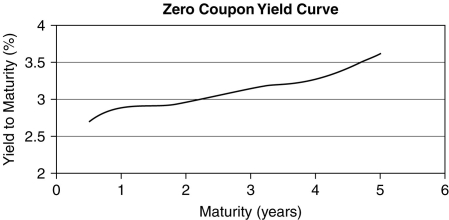 -The current zero-coupon yield curve for risk-free bonds is shown above. What is the risk-free interest rate on a 4-year maturity?
 (Multiple Choice)
4.7/5 (85)
(85) A company releases a five-year bond with a face value of $1000 and coupons paid semiannually. If market interest rates imply a YTM of 8%, which of the following coupon rates will cause the bond to be issued at a premium?
(Multiple Choice)
4.8/5 (71)
(71) An investor holds a Ford bond with a face value of $5000, a coupon rate of 8.5%, and semiannual payments that matures on January 15, 2029. How much will the investor receive on January 15, 2029?
(Multiple Choice)
4.9/5 (76)
(76) Bond traders generally quote bond yields rather than bond prices, since yield to maturity depends on the face value of the bond.
(True/False)
4.8/5 (70)
(70) Use the information for the question(s) below.  -Which of the following best describes a bond rated by Standard & Poor's and Moody as B?
 (Multiple Choice)
4.9/5 (83)
(83) A bond is said to mature on the date when the issuer repays its notional value.
(True/False)
4.8/5 (68)
(68) A bond has five years to maturity, a $1000 face value, and a 5.5% coupon rate with annual coupons. What is its yield to maturity if it is currently trading at $846.11?
(Multiple Choice)
4.9/5 (77)
(77) An investor purchases a 30-year, zero-coupon bond with a face value of $5000 and a yield to maturity of 8.4%. He sells this bond ten years later. What is the rate of return on his investment, assuming yield to maturity does not change?
(Multiple Choice)
4.8/5 (79)
(79)  A mining company needs to raise $100 million in order to begin open-pit mining of a coal seam. The company will fund this by issuing 30-year bonds with a face value of $1,000 and a coupon rate of 6.5%, paid annually. The above table shows the yield to maturity for similar 30-year corporate bonds of different ratings. If the company's bonds are rated A, what will be their selling price?
 (Multiple Choice)
4.8/5 (79)
(79) 
Filters
- Essay(0)
- Multiple Choice(0)
- Short Answer(0)
- True False(0)
- Matching(0)