



 Chat with AI
Exam 8: Investment Decision Rules

Exam 1: Corporate Finance and the Financial Manager86 Questions
Exam 2: Introduction to Financial Statement Analysis95 Questions
Exam 3: Time Value of Money: an Introduction112 Questions
Exam 4: Time Value of Money: Valuing Cash Flow Streams62 Questions
Exam 5: Interest Rates110 Questions
Exam 6: Bonds109 Questions
Exam 7: Stock Valuation64 Questions
Exam 8: Investment Decision Rules123 Questions
Exam 9: Fundamentals of Capital Budgeting113 Questions
Exam 10: Stock Valuation: a Second Look46 Questions
Exam 11: Risk and Return in Capital Markets110 Questions
Exam 12: Systematic Risk and the Equity Risk Premium104 Questions
Exam 13: The Cost of Capital107 Questions
Exam 14: Raising Equity Capital107 Questions
Exam 15: Debt Financing101 Questions
Exam 16: Capital Structure109 Questions
Exam 17: Payout Policy110 Questions
Exam 18: Financial Modeling and Pro Forma Analysis95 Questions
Exam 19: Working Capital Management107 Questions
Exam 20: Short-Term Financial Planning104 Questions
Exam 21: Option Applications and Corporate Finance102 Questions
Exam 22: Mergers and Acquisitions47 Questions
Exam 23: International Corporate Finance108 Questions
Exam 24: Leasing46 Questions
Exam 25: Insurance and Risk Management38 Questions
Exam 26: Corporate Governance45 Questions
Select questions type


According to Graham and Harvey's 2001 survey (Figure 8.2 in the text), the most popular decision rules for capital budgeting used by CFOs are ________.
(Multiple Choice)
4.9/5  (61)
(61) Which of the following decision rules might best be used as a supplement to net present value (NPV) by a firm that favors liquidity?
(Multiple Choice)
4.9/5 (71)
(71) Use the table for the question(s) below.
Consider the following list of projects:
 -Assuming that your capital is constrained, which project should you invest in last?
 (Multiple Choice)
4.8/5 (73)
(73) A janitorial services firm is considering two brands of industrial vacuum cleaners to equip their staff. Option A will cost $1,500, require servicing of $200 per year, and it will last five years. Option B will cost $1,000, require servicing of $100 per year, and it will last three years. If the cost of capital is 8%, which is the better option, given that the firm has an ongoing requirement for vacuum cleaners?
(Multiple Choice)
4.9/5 (84)
(84) 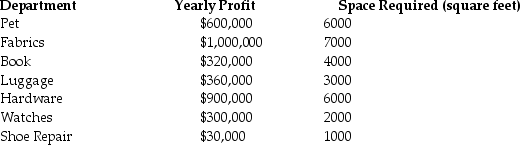 A small department store in a mall has the opportunity to rent an additional 20,000 square feet of space for five years. It can divide up this space between the above new departments. Each department will require a different amount of space, and each department is expected to make a yearly profit as shown, for each of the next five years. The discount rate is 10%. Based on this information, what departments should be added?
 (Multiple Choice)
4.9/5 (81)
(81) Use the information for the question(s) below.
 -A florist is buying a number of motorcycles to expand its delivery service. These will cost $78,000 but are expected to increase profits by $3000 per month over the next four years. What is the payback period in this case?
 (Multiple Choice)
4.9/5 (77)
(77) Consider the following two projects:  The profitability index for project B is closest to ________.
 (Multiple Choice)
4.8/5 (80)
(80) Use the information for the question(s) below.
-If WiseGuy Inc. uses payback period rule to choose projects, which of the projects (Project A or Project B) will WiseGuy Inc. prefer?
-If WiseGuy Inc. uses payback period rule to choose projects, which of the projects (Project A or Project B) will WiseGuy Inc. prefer? (Multiple Choice)
4.7/5 (68)
(68) Which of the following is true regarding the profitability index?
(Multiple Choice)
4.8/5 (72)
(72) Use the table for the question(s) below.
Consider the following list of projects:
-Assuming that your capital is constrained, which project should you invest in first?
-Assuming that your capital is constrained, which project should you invest in first? (Multiple Choice)
4.9/5 (76)
(76) Consider a project with the following cash flows: 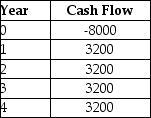 Assume the appropriate discount rate for this project is 14%. The profitability index for this project is closest to ________.
 (Multiple Choice)
4.9/5 (85)
(85) Use the information for the question(s) below.
-If WiseGuy Inc. uses IRR rule to choose projects, which of the projects (Project A or Project B) will rank highest?
-If WiseGuy Inc. uses IRR rule to choose projects, which of the projects (Project A or Project B) will rank highest? (Multiple Choice)
4.9/5 (84)
(84) The internal rate of return (IRR) is the interest rate that sets the net present value (NPV) of the cash flows equal to zero.
(True/False)
5.0/5 (78)
(78)  An investor is considering the two investments shown above. Her cost of capital is 8%. Which of the following statements about these investments is true?
 (Multiple Choice)
4.9/5 (80)
(80) Which of the following decision rules is best defined as the amount of time it takes to pay back the initial investment?
(Multiple Choice)
4.9/5 (73)
(73) A local government awards a landscaping company a contract worth $1.5 million per year for five years for maintaining public parks. The landscaping company will need to buy some new machinery before they can take on the contract. If the cost of capital is 6%, what is the most that this equipment could cost if the contract is to be worthwhile for the landscaping company?
(Multiple Choice)
5.0/5 (91)
(91) How do you apply the Net Present Value rule when multiple projects are available and you have the added constraint of accepting only one project?
(Essay)
4.9/5 (76)
(76) A consultancy calculates that it can supply crude oil assaying services to a small oil producer for $115,000 per year for five years. There are some upfront costs the consultancy will require the oil producer to absorb. What is the maximum that these upfront costs could be, if the equivalent annual annuity to the oil company is to be under $160,000, given that the cost of capital is 9%?
(Multiple Choice)
4.8/5 (80)
(80) Consider the following two projects:  Assume that projects Alpha and Beta are mutually exclusive. The correct investment decision and the best rationale for that decision is to ________.
 (Multiple Choice)
4.9/5 (81)
(81) When different investment rules give conflicting answers, then decisions should be based on the Net Present Value rule, as it is the most reliable and accurate decision rule.
(True/False)
4.8/5 (79)
(79) 
Filters
- Essay(0)
- Multiple Choice(0)
- Short Answer(0)
- True False(0)
- Matching(0)