



 Chat with AI
Exam 9: Fundamentals of Capital Budgeting

Exam 1: Corporate Finance and the Financial Manager86 Questions
Exam 2: Introduction to Financial Statement Analysis95 Questions
Exam 3: Time Value of Money: an Introduction112 Questions
Exam 4: Time Value of Money: Valuing Cash Flow Streams62 Questions
Exam 5: Interest Rates110 Questions
Exam 6: Bonds109 Questions
Exam 7: Stock Valuation64 Questions
Exam 8: Investment Decision Rules123 Questions
Exam 9: Fundamentals of Capital Budgeting113 Questions
Exam 10: Stock Valuation: a Second Look46 Questions
Exam 11: Risk and Return in Capital Markets110 Questions
Exam 12: Systematic Risk and the Equity Risk Premium104 Questions
Exam 13: The Cost of Capital107 Questions
Exam 14: Raising Equity Capital107 Questions
Exam 15: Debt Financing101 Questions
Exam 16: Capital Structure109 Questions
Exam 17: Payout Policy110 Questions
Exam 18: Financial Modeling and Pro Forma Analysis95 Questions
Exam 19: Working Capital Management107 Questions
Exam 20: Short-Term Financial Planning104 Questions
Exam 21: Option Applications and Corporate Finance102 Questions
Exam 22: Mergers and Acquisitions47 Questions
Exam 23: International Corporate Finance108 Questions
Exam 24: Leasing46 Questions
Exam 25: Insurance and Risk Management38 Questions
Exam 26: Corporate Governance45 Questions
Select questions type


A maker of kitchenware is planning on selling a new chef-quality kitchen knife. The manufacturer expects to sell 1.6 million knives at a price of $120 each. These knives cost $80 each to produce. Selling, general, and administrative expenses are $500,000. The machinery required to produce the knives cost $1.4 million, depreciated by straight-line depreciation over five years. The maker determines that the EBIT break-even point for units sold and sale price is less than these estimates and that the EBIT break-even point for costs per unit, SG&A, and depreciation are greater than these estimates, so decides to go ahead with manufacturing the knife. Was this the correct decision?
(Multiple Choice)
4.9/5  (65)
(65) How are the taxes paid under MACRS different from that paid under straight-line depreciation?
(Essay)
4.7/5 (79)
(79) You are considering adding a microbrewery onto one of your firm's existing restaurants. This will entail an investment of $47,000 in new equipment. This equipment will be depreciated straight-line over five years. If your firm's marginal corporate tax rate is 35%, then what is the value of the microbrewery's depreciation tax shield in the first year of operation?
(Multiple Choice)
4.9/5 (81)
(81) The Sisyphean Corporation is considering investing in a new cane manufacturing machine that has an estimated life of three years. The cost of the machine is $30,000 and the machine will be depreciated straight line over its three-year life to a residual value of $0. The cane manufacturing machine will result in sales of 2400 canes in year 1. Sales are estimated to grow by 9% each year through year 3. The price per cane that Sisyphean will charge its customers is $15 each and is to remain constant. The canes have a cost per unit to manufacture of $8 each.
Installation of the machine and the resulting increase in manufacturing capacity will require an increase in various net working capital accounts. It is estimated that the Sisyphean Corporation needs to hold 3% of its annual sales in cash, 5% of its annual sales in accounts receivable, 9% of its annual sales in inventory, and 6% of its annual sales in accounts payable. The firm is in the 35% tax bracket and has a cost of capital of 8%.
The change in net working capital from year 1 to year 2 is closest to ________.
(Multiple Choice)
5.0/5 (92)
(92) Shepard Industries is evaluating a proposal to expand its current distribution facilities. Management has projected that the project will produce the following cash flows for the first two years (in millions of dollars). 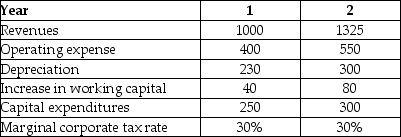 The depreciation tax shield for Shepard Industries project in year 2 is closest to ________.
 (Multiple Choice)
4.8/5 (81)
(81)  A fast-food company invests $2.2 million to buy machines for making slurpees. These can be depreciated using the MACRS schedule shown above. If the cost of capital is 10%, what is the increase in the net present value (NPV) of the product gained by using MACRS depreciation over straight-line depreciation for three years?
 (Multiple Choice)
4.8/5 (72)
(72) The Sisyphean Corporation is considering investing in a new cane manufacturing machine that has an estimated life of three years. The cost of the machine is $30,000 and the machine will be depreciated straight line over its three-year life to a residual value of $0. The cane manufacturing machine will result in sales of 2000 canes in year 1. Sales are estimated to grow by 10% each year through year 3. The price per cane that Sisyphean will charge its customers is $17 each and is to remain constant. The canes have a cost per unit to manufacture of $8 each.
Installation of the machine and the resulting increase in manufacturing capacity will require an increase in various net working capital accounts. It is estimated that the Sisyphean Corporation needs to hold 2% of its annual sales in cash, 5% of its annual sales in accounts receivable, 10% of its annual sales in inventory, and 6% of its annual sales in accounts payable. The firm is in the 35% tax bracket and has a cost of capital of 9%.
The required net working capital in the second year for the Sisyphean Corporation's project is closest to ________.
(Multiple Choice)
4.8/5 (79)
(79)  MACRS
 A firm is considering the purchase of a new machine for $325,000. The firm is unsure if it should use the 3-Year MACRS schedule or straight-line depreciation over three years. What is the difference in the book value after three years if the firm uses MACRS instead of straight-line depreciation?
MACRS
A firm is considering the purchase of a new machine for $325,000. The firm is unsure if it should use the 3-Year MACRS schedule or straight-line depreciation over three years. What is the difference in the book value after three years if the firm uses MACRS instead of straight-line depreciation? (Multiple Choice)
4.7/5 (81)
(81) Which of the following formulas will correctly calculate Net Working Capital?
(Multiple Choice)
4.8/5 (94)
(94)  A bakery invests $40,000 in a light delivery truck. This was depreciated using the five-year MACRS schedule shown above. If the company sold it immediately after the end of year 2 for $21,000, what would be the after-tax cash flow from the sale of this asset, given a tax rate of 40%?
 (Multiple Choice)
4.8/5 (79)
(79) Temporary Housing Services Incorporated (THSI) is considering a project that involves setting up a temporary housing facility in an area recently damaged by a hurricane. THSI will lease space in this facility to various agencies and groups providing relief services to the area. THSI estimates that this project will initially cost $6 million to set up and will generate $22 million in revenues during its first and only year in operation (paid in one year). Operating expenses are expected to total $11 million during this year and depreciation expense will be another $2 million. THSI will require no working capital for this investment. THSI's marginal tax rate is 35%. Ignoring the original investment of $5 million, what is THSI's free cash flow for the first and only year of operation?
(Multiple Choice)
5.0/5 (78)
(78) Which of the following is usually NOT a factor that must be considered when estimating the revenues and costs arising from a new product?
(Multiple Choice)
4.9/5 (90)
(90) A company spends $20 million researching whether it is possible to create a durable plastic from the process waste from feedstock preparation. The $20 million should best be considered ________.
(Multiple Choice)
4.7/5 (68)
(68) The Sisyphean Corporation is considering investing in a new cane manufacturing machine that has an estimated life of three years. The cost of the machine is $30,000 and the machine will be depreciated straight line over its three-year life to a residual value of $0. The cane manufacturing machine will result in sales of 2500 canes in year 1. Sales are estimated to grow by 9% each year through year 3. The price per cane that Sisyphean will charge its customers is $16 each and is to remain constant. The canes have a cost per unit to manufacture of $10 each.
Installation of the machine and the resulting increase in manufacturing capacity will require an increase in various net working capital accounts. It is estimated that the Sisyphean Corporation needs to hold 3% of its annual sales in cash, 5% of its annual sales in accounts receivable, 10% of its annual sales in inventory, and 5% of its annual sales in accounts payable. The firm is in the 35% tax bracket and has a cost of capital of 9%.
The required net working capital in the first year for the Sisyphean Corporation's project is closest to ________.
(Multiple Choice)
4.8/5 (78)
(78) An exploration of the effect of changing multiple project parameters on net present value (NPV) is called ________.
(Multiple Choice)
4.7/5 (75)
(75) Joe pre-orders a non-refundable movie ticket. He then reads a number of reviews of the movie in question that make him realize that he will not enjoy it. He goes to see it anyway, rationalizing that otherwise his money will have been wasted. Is Joe succumbing to the Sunk Cost Fallacy, and why?
(Multiple Choice)
4.7/5 (72)
(72) What is the correct tax rate that should be used for capital budgeting decisions?
(Essay)
4.8/5 (71)
(71) Cameron Industries is purchasing a new chemical vapor depositor in order to make silicon chips. It will cost $5,000,000 to buy the machine and $10,000 to have it delivered and installed. Building a clean room in the plant for the machine will cost an additional $3 million. The machine is expected to raise gross profits by $4,500,000 per year, starting at the end of the first year, with associated costs of $1 million for each of those years. The machine is expected to have a working life of six years and will be depreciated over those six years. The marginal tax rate is 40%. What are the incremental free cash flows associated with the new machine in year 2?
(Multiple Choice)
4.8/5 (80)
(80) The Sisyphean Corporation is considering investing in a new cane manufacturing machine that has an estimated life of three years. The cost of the machine is $30,000 and the machine will be depreciated straight line over its three-year life to a residual value of  The cane manufacturing machine will result in sales of 2000 canes in year 1. Sales are estimated to grow by 10% per year each year through year 3. The price per cane that Sisyphean will charge its customers is
 each and is to remain constant. The canes have a cost per unit to manufacture of
 each. Installation of the machine and the resulting increase in manufacturing capacity will require an increase in various net working capital accounts. It is estimated that the Sisyphean Corporation needs to hold 2% of its annual sales in cash, 4% of its annual sales in accounts receivable, 9% of its annual sales in inventory, and 5% of its annual sales in accounts payable. The firm is in the 35% tax bracket and has a cost of capital of 10%.
The depreciation tax shield for the Sisyphean Corporation's project in the first year is closest to ________.
The cane manufacturing machine will result in sales of 2000 canes in year 1. Sales are estimated to grow by 10% per year each year through year 3. The price per cane that Sisyphean will charge its customers is each and is to remain constant. The canes have a cost per unit to manufacture of each. Installation of the machine and the resulting increase in manufacturing capacity will require an increase in various net working capital accounts. It is estimated that the Sisyphean Corporation needs to hold 2% of its annual sales in cash, 4% of its annual sales in accounts receivable, 9% of its annual sales in inventory, and 5% of its annual sales in accounts payable. The firm is in the 35% tax bracket and has a cost of capital of 10%.
The depreciation tax shield for the Sisyphean Corporation's project in the first year is closest to ________. (Multiple Choice)
4.8/5 (87)
(87) Epiphany Industries is considering a new capital budgeting project that will last for three years. Epiphany plans on using a cost of capital of 12% to evaluate this project. Based on extensive research, it has prepared the following incremental cash flow projects: 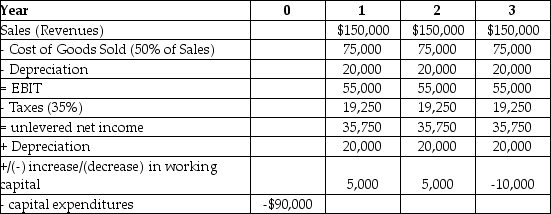 The free cash flow for the last year of Epiphany's project is closest to ________.
 (Multiple Choice)
5.0/5 (84)
(84) 
Filters
- Essay(0)
- Multiple Choice(0)
- Short Answer(0)
- True False(0)
- Matching(0)