



 Chat with AI
Exam 4: Tariffs

Exam 1: The International Economy and Globalization48 Questions
Exam 2: Foundations of Modern Trade Theory: Comparative Advantage166 Questions
Exam 3: Sources of Comparative Advantage108 Questions
Exam 4: Tariffs124 Questions
Exam 5: Nontariff Trade Barriers134 Questions
Exam 6: Trade Regulations and Industrial Policies129 Questions
Exam 7: Trade Policies for the Developing Nations100 Questions
Exam 8: Regional Trading Arrangements130 Questions
Exam 9: International Factor Movements and Multinational Enterprises96 Questions
Exam 10: The Balance of Payments92 Questions
Exam 11: Foreign Exchange121 Questions
Exam 12: Exchange-Rate Determination133 Questions
Exam 13: Mechanisms of International Adjustment107 Questions
Exam 14: Exchange-Rate Adjustments and the Balance of Payments100 Questions
Exam 15: Exchange-Rate Systems and Currency Crises107 Questions
Exam 16: Macroeconomic Policy in an Open Economy72 Questions
Exam 17: International Banking: Reserves, Debt, and Risk96 Questions
Select questions type


Assume the United States adopts a tariff quota on steel in which the quota is set at 2 million tons,the within-quota tariff rate equals 5 percent,and the over-quota tariff rate equals 10 percent.Suppose the U.S.imports 1 million tons of steel.The resulting revenue effect of the tariff quota would accrue to:
(Multiple Choice)
4.8/5  (80)
(80) 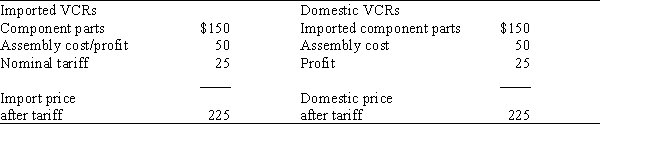 -Consider Table 4.1.Prior to the tariff,domestic value added equals:
 (Multiple Choice)
4.9/5 (81)
(81) During a business recession,when cheaper products are purchased,a specific tariff provides domestic producers a greater amount of protection against import-competing goods.
(True/False)
4.8/5 (80)
(80) Refer to Exhibit 4.2.All of the import tariff is shifted to the Canadian consumer via a higher price of motorcycles.
(True/False)
4.9/5 (76)
(76) 
Filters
- Essay(0)
- Multiple Choice(0)
- Short Answer(0)
- True False(0)
- Matching(0)