



 Chat with AI
Exam 4: Tariffs

Exam 1: The International Economy and Globalization48 Questions
Exam 2: Foundations of Modern Trade Theory: Comparative Advantage166 Questions
Exam 3: Sources of Comparative Advantage108 Questions
Exam 4: Tariffs124 Questions
Exam 5: Nontariff Trade Barriers134 Questions
Exam 6: Trade Regulations and Industrial Policies129 Questions
Exam 7: Trade Policies for the Developing Nations100 Questions
Exam 8: Regional Trading Arrangements130 Questions
Exam 9: International Factor Movements and Multinational Enterprises96 Questions
Exam 10: The Balance of Payments92 Questions
Exam 11: Foreign Exchange121 Questions
Exam 12: Exchange-Rate Determination133 Questions
Exam 13: Mechanisms of International Adjustment107 Questions
Exam 14: Exchange-Rate Adjustments and the Balance of Payments100 Questions
Exam 15: Exchange-Rate Systems and Currency Crises107 Questions
Exam 16: Macroeconomic Policy in an Open Economy72 Questions
Exam 17: International Banking: Reserves, Debt, and Risk96 Questions
Select questions type


The nominal tariff rate signifies the total increase in domestic productive activities compared to what would occur under free-trade conditions.

Free
(True/False)
4.9/5  (63)
(63) Correct Answer: Verified
False
With a compound duty,its "specific" portion neutralizes the cost disadvantage of domestic manufacturers that results from tariff protection granted to domestic suppliers of raw materials,and the "ad valorem" portion of the duty grants protection to the finished-goods industry.
Free
(True/False)
4.9/5 (83)
(83) Correct Answer:Verified
VerifiedTrue
Refer to Exhibit 4.2.The tariff leads to a deadweight welfare loss for Canada totaling $1,000.
Free
(True/False)
4.8/5 (78)
(78) Correct Answer:Verified
VerifiedFalse
Suppose that the tariff on imported steel is 40 percent,the tariff on imported iron ore is 20 percent,and 30 percent of the cost of producing a ton of steel consists of the iron ore it contains.The effective rate of protection of steel is approximately 49 percent.
(True/False)
5.0/5 (77)
(77) A nation whose imports constitute a very small portion of the world market supply is a price taker,facing a constant world price for its import commodity.
(True/False)
4.7/5 (92)
(92) Suppose that the production of a $30,000 automobile in Canada requires $10,000 worth of steel.The Canadian nominal tariff rates for importing these goods are 25 percent for automobiles and 10 percent for steel.Given this information,the effective rate of protection for the Canadian automobile industry is approximately:
(Multiple Choice)
5.0/5 (61)
(61) Suppose that the United States eliminates its tariff on steel imports,permitting foreign-produced steel to enter the U.S.market.Steel prices to U.S.consumers would be expected to:
(Multiple Choice)
4.8/5 (83)
(83) If we consider the impact on both consumers and producers,then protection of the steel industry is:
(Multiple Choice)
4.9/5 (86)
(86) According to Figure 4.1,the loss in Mexican consumer surplus due to the tariff equals:
(Multiple Choice)
4.9/5 (71)
(71) A lower tariff on imported aluminum would most likely benefit:
(Multiple Choice)
4.9/5 (87)
(87) A tariff on steel imports tends to improve the competitiveness of domestic automobile companies.
(True/False)
5.0/5 (80)
(80) Although tariffs on imported steel may lead to job gains for domestic steel workers,they can lead to job losses for domestic auto workers.
(True/False)
4.7/5 (87)
(87) Figure 4.4 Market for Gasoline in a Small Nation 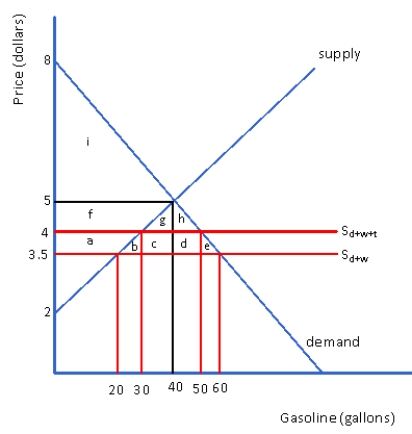 -Figure 4.4 represents the market for gasoline in a small nation.The free trade world price of gasoline is $3.50.Suppose this small nation imposes a tariff on gasoline of $.50 per gallon.The change in producer surplus would be
 (Multiple Choice)
4.9/5 (71)
(71) The most vocal political pressure for tariffs is generally made by:
(Multiple Choice)
4.8/5 (83)
(83) With a compound tariff,a domestic importer of an automobile might be required to pay a duty of $200 plus 4 percent of the value of the automobile.
(True/False)
4.9/5 (74)
(74) 
Filters
- Essay(0)
- Multiple Choice(0)
- Short Answer(0)
- True False(0)
- Matching(0)