



 Chat with AI
Exam 4: Tariffs

Exam 1: The International Economy and Globalization48 Questions
Exam 2: Foundations of Modern Trade Theory: Comparative Advantage166 Questions
Exam 3: Sources of Comparative Advantage108 Questions
Exam 4: Tariffs124 Questions
Exam 5: Nontariff Trade Barriers134 Questions
Exam 6: Trade Regulations and Industrial Policies129 Questions
Exam 7: Trade Policies for the Developing Nations100 Questions
Exam 8: Regional Trading Arrangements130 Questions
Exam 9: International Factor Movements and Multinational Enterprises96 Questions
Exam 10: The Balance of Payments92 Questions
Exam 11: Foreign Exchange121 Questions
Exam 12: Exchange-Rate Determination133 Questions
Exam 13: Mechanisms of International Adjustment107 Questions
Exam 14: Exchange-Rate Adjustments and the Balance of Payments100 Questions
Exam 15: Exchange-Rate Systems and Currency Crises107 Questions
Exam 16: Macroeconomic Policy in an Open Economy72 Questions
Exam 17: International Banking: Reserves, Debt, and Risk96 Questions
Select questions type


Figure 4.4 Market for Gasoline in a Small Nation 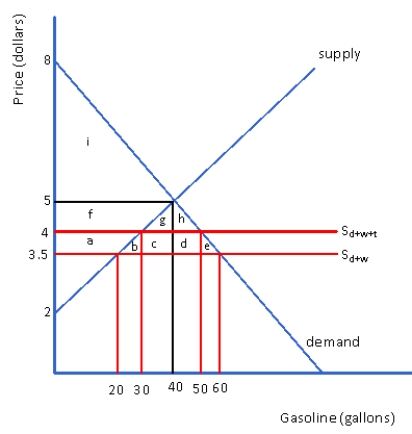 -Figure 4.4 represents the market for gasoline in a small nation.The free trade world price of gasoline is $3.50.Suppose this small nation imposes a tariff on gasoline of $.50 per gallon.The change in producer surplus would be
 (Multiple Choice)
4.8/5  (87)
(87) Bonded warehouses and foreign trade zones have the effect of allowing domestic importers to postpone and prorate over time their import duty obligations.
(True/False)
4.8/5 (88)
(88) A $100 specific tariff provides home producers more protection from foreign competition when:
(Multiple Choice)
5.0/5 (93)
(93) If the world price of steel is $600 per ton,a specific tariff of $120 per ton is equivalent to an ad valorem tariff of 25 percent.
(True/False)
4.7/5 (75)
(75) A tariff quota is a combination of a specific tariff and an ad valorem tariff.
(True/False)
4.9/5 (68)
(68) Should the home country be "large" relative to the world,its imposition of a tariff on imports would lead to an increase in domestic welfare if the terms-of-trade effect exceeds the sum of the:
(Multiple Choice)
4.8/5 (85)
(85) According to the tariff escalation effect,industrial countries apply low tariffs to imports of finished goods and high tariffs to imports of raw materials.
(True/False)
4.9/5 (79)
(79) A tariff can increase the welfare of a "large" levying country if the favorable terms-of-trade effect more than offsets the unfavorable protective effect and consumption effect.
(True/False)
4.8/5 (81)
(81) Consider Figure 4.1.With free trade,Mexico's producer surplus and consumer surplus respectively equal:
(Multiple Choice)
4.9/5 (88)
(88) A ad valorem tariff provides domestic producers a declining degree of protection against import-competing goods during periods of changing prices.
(True/False)
4.7/5 (79)
(79) Under the Offshore Assembly Provision of U.S.tariff policy,U.S.import duties apply only to the value added in the foreign assembly process,provided that U.S.-made components are used by overseas companies in their assembly operations.
(True/False)
4.8/5 (82)
(82) Which trade policy results in the government levying a "two-tier" tariff on imported goods?
(Multiple Choice)
4.8/5 (87)
(87) Graphically,consumer surplus is represented by the area above the demand curve and below the product's market price.
(True/False)
4.7/5 (86)
(86) Which of the following is true concerning a specific tariff?
(Multiple Choice)
4.8/5 (76)
(76) Suppose an importer of steel is required to pay a tariff of $20 per ton plus 5 percent of the value of steel.This is an example of a (an):
(Multiple Choice)
4.8/5 (71)
(71) For a "small" country,a tariff raises the domestic price of an imported product by the full amount of the duty.
(True/False)
4.8/5 (81)
(81) A specific tariff is expressed as a fixed percentage of the total value of an imported product.
(True/False)
4.8/5 (78)
(78) Suppose that the production of $500,000 worth of steel in the United States requires $100,000 worth of iron ore.The U.S.nominal tariff rates for importing these goods are 15 percent for steel and 5 percent for iron ore.Given this information,the effective rate of protection for the U.S.steel industry is approximately:
(Multiple Choice)
4.8/5 (85)
(85) Consider Figure 4.1.With a per-unit tariff of $3,the quantity of imports decreases to:
(Multiple Choice)
5.0/5 (75)
(75) 
Filters
- Essay(0)
- Multiple Choice(0)
- Short Answer(0)
- True False(0)
- Matching(0)