



 Chat with AI
Exam 13: Mechanisms of International Adjustment

Exam 1: The International Economy and Globalization48 Questions
Exam 2: Foundations of Modern Trade Theory: Comparative Advantage166 Questions
Exam 3: Sources of Comparative Advantage108 Questions
Exam 4: Tariffs124 Questions
Exam 5: Nontariff Trade Barriers134 Questions
Exam 6: Trade Regulations and Industrial Policies129 Questions
Exam 7: Trade Policies for the Developing Nations100 Questions
Exam 8: Regional Trading Arrangements130 Questions
Exam 9: International Factor Movements and Multinational Enterprises96 Questions
Exam 10: The Balance of Payments92 Questions
Exam 11: Foreign Exchange121 Questions
Exam 12: Exchange-Rate Determination133 Questions
Exam 13: Mechanisms of International Adjustment107 Questions
Exam 14: Exchange-Rate Adjustments and the Balance of Payments100 Questions
Exam 15: Exchange-Rate Systems and Currency Crises107 Questions
Exam 16: Macroeconomic Policy in an Open Economy72 Questions
Exam 17: International Banking: Reserves, Debt, and Risk96 Questions
Select questions type


Figure 13.1.U.S.Capital and Financial Account 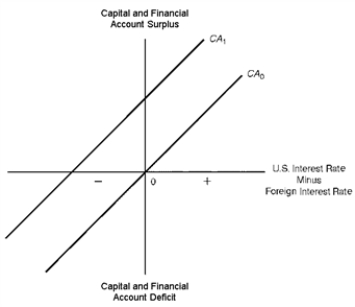 -Refer to Figure 13.1.Upward movements along U.S.capital and financial account schedule CA0 would be caused by:
Free
(Multiple Choice)
4.9/5  (71)
(71) Correct Answer: Verified
A
According to the equation of exchange,the total expenditures on final goods equals the monetary value of the final goods sold.
Free
(True/False)
4.8/5 (89)
(89) Correct Answer:Verified
VerifiedTrue
Figure 13.4.Canadian Economy Under a Fixed Exchange Rate System  -Referring to Figure 13.4,Canada's foreign-trade multiplier equals 2.0.
Free
(True/False)
4.7/5 (80)
(80) Correct Answer:Verified
VerifiedTrue
Starting from a position where the nation's money demand equals the money supply and its balance of payments is in equilibrium,economic theory suggests that the nation's balance of payments would move into a surplus position if there occurred in the nation:
(Multiple Choice)
4.7/5 (76)
(76) The monetary approach to balance-of-payments adjustments suggests that all payments deficits are the result of:
(Multiple Choice)
4.9/5 (91)
(91) In explaining balance-of-payments adjustments,the classical economists
(Multiple Choice)
4.8/5 (83)
(83) Figure 13.2.Australian Economy Under a Fixed Exchange Rate System 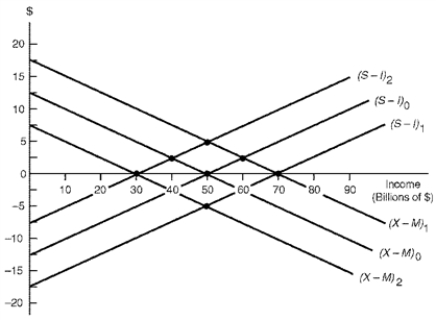 -Refer to Figure 13.2.Starting at equilibrium income $50 billion,where (S-I)0 intersects (X-M)0,suppose that increased thriftiness leads to an autonomous increase in Australian saving of $5 billion.Australian income thus ____ which leads to Australia's trade account moving to a ____.
 (Multiple Choice)
4.9/5 (80)
(80) For the income adjustment mechanism to reverse a trade deficit,economic policymakers must be willing to permit domestic income to increase which leads to rising imports.
(True/False)
4.9/5 (78)
(78) Refer to Exhibit 13.1.The change in the level of U.S.income resulting from the additional investment spending equals
(Multiple Choice)
4.9/5 (86)
(86) David Hume's price-adjustment mechanism supported the mercantilist view that a nation could maintain a trade surplus indefinitely.
(True/False)
4.9/5 (78)
(78) Figure 13.2.Australian Economy Under a Fixed Exchange Rate System
-Refer to Figure 13.2.Starting at equilibrium income $50 billion,where (S-I)0 intersects (X-M)0,suppose that improving profit expectations lead to an autonomous increase in Australian investment of $5 billion.Australian income thus ____ which leads to Australia's trade account moving to a ____.
-Refer to Figure 13.2.Starting at equilibrium income $50 billion,where (S-I)0 intersects (X-M)0,suppose that improving profit expectations lead to an autonomous increase in Australian investment of $5 billion.Australian income thus ____ which leads to Australia's trade account moving to a ____. (Multiple Choice)
4.8/5 (71)
(71) An "automatic" adjustment mechanism would require a trade-surplus nation to accept price deflation and/or falling income as the cost of increasing imports.
(True/False)
4.8/5 (84)
(84) According to the quantity theory of money,a change in the money supply will induce an inverse and less-than-proportionate change in the price level.
(True/False)
4.9/5 (82)
(82) The balance-of-payments adjustment mechanism developed during the 1700s by the English economist David Hume is the:
(Multiple Choice)
4.7/5 (81)
(81) Suppose Japan increases its imports from Sweden,leading to a rise in Sweden's exports and income level.With a higher income level,Sweden imports more goods from Japan.Thus a change in imports in Japan results in a feedback effect on its exports.This process is best referred to as the:
(Multiple Choice)
4.7/5 (76)
(76) Starting from a position where the nation's money demand equals the money supply and its balance of payments is in equilibrium,economic theory suggests that the nation's balance of payments would move into a deficit position if there occurred in the nation:
(Multiple Choice)
4.8/5 (72)
(72) Compared to classical economists,how did Keynesian economics change the discussion of trade adjustment?
(Essay)
4.9/5 (77)
(77) Figure 13.2.Australian Economy Under a Fixed Exchange Rate System
-Refer to Figure 13.2.Starting at equilibrium income $50 billion,where (S-I)0 intersects (X-M)0,suppose that dwindling thriftiness leads to an autonomous decrease in Australian saving to $5 billion.Australian income thus ____ which leads to Australia's trade account moving to a ____.
-Refer to Figure 13.2.Starting at equilibrium income $50 billion,where (S-I)0 intersects (X-M)0,suppose that dwindling thriftiness leads to an autonomous decrease in Australian saving to $5 billion.Australian income thus ____ which leads to Australia's trade account moving to a ____. (Multiple Choice)
5.0/5 (74)
(74) Assume identical interest rates on comparable securities in the United States and foreign countries.Suppose investors anticipate that in the future the U.S.dollar will depreciate against foreign currencies.Investment funds would tend to:
(Multiple Choice)
4.8/5 (83)
(83) Figure 13.2.Australian Economy Under a Fixed Exchange Rate System
-Refer to Figure 13.2.Starting at equilibrium income $50 billion,where (S-I)0 intersects (X-M)0,suppose that improving economic conditions abroad lead to an autonomous increase in Australian exports of $5 billion.Australian income thus ____ which leads to Australia's trade account moving to a ____.
-Refer to Figure 13.2.Starting at equilibrium income $50 billion,where (S-I)0 intersects (X-M)0,suppose that improving economic conditions abroad lead to an autonomous increase in Australian exports of $5 billion.Australian income thus ____ which leads to Australia's trade account moving to a ____. (Multiple Choice)
4.8/5 (76)
(76) 
Filters
- Essay(0)
- Multiple Choice(0)
- Short Answer(0)
- True False(0)
- Matching(0)