



 Chat with AI
Exam 13: First Law of Thermodynamics

Exam 1: Introduction32 Questions
Exam 2: Kinematics: Motion in One Dimension162 Questions
Exam 3: Newtonian Mechanics54 Questions
Exam 4: Applying Newtons Laws178 Questions
Exam 5: Circular Motion119 Questions
Exam 6: Impulse and Linear Momentum82 Questions
Exam 7: Work and Energy191 Questions
Exam 8: Extended Bodies at Rest59 Questions
Exam 9: Rotational Motion124 Questions
Exam 10: Gases84 Questions
Exam 11: Static Fluids65 Questions
Exam 12: Fluids in Motion30 Questions
Exam 13: First Law of Thermodynamics119 Questions
Exam 14: Second Law of Thermodynamics70 Questions
Exam 15: Electric Charge force and Energy78 Questions
Exam 16: The Electric Field151 Questions
Exam 17: Dc Circuits225 Questions
Exam 18: Magnetism136 Questions
Exam 19: Electromagnetic Induction99 Questions
Exam 20: Vibrational Motion94 Questions
Exam 21: Mechanical Waves155 Questions
Exam 22: Reflection and Refraction36 Questions
Exam 23: Mirrors and Lenses221 Questions
Exam 24: Wave Optics135 Questions
Exam 25: Electromagnetic Waves79 Questions
Exam 26: Special Relativity124 Questions
Exam 27: Quantum Optics100 Questions
Exam 28: Atomic Physics141 Questions
Exam 29: Nuclear Physics155 Questions
Exam 30: Particle Physics21 Questions
Select questions type


If 150 kcal of thermal energy raises the temperature of 2.0 kg of a material by 400 F°,what is the specific heat capacity of the material?
(Multiple Choice)
4.7/5  (67)
(67) In an adiabatic compression,200 J of work is done on a gas.What is the change in internal (thermal)energy of the gas during this compression?
(Multiple Choice)
4.8/5 (71)
(71) A machine part consists of 0.10 kg of iron (of specific heat 470 J/kg ∙ K )and 0.16 kg of copper (of specific heat 390 J/kg ∙ K).How much thermal energy must be added to the gear to raise its temperature from 18°C to 53°C?
(Multiple Choice)
4.7/5 (80)
(80) A gas expands from an initial volume of 30.0 L to a final volume of 65.0 L at a constant pressure of 110 kPa.How much work is done on the gas during this expansion?
(Multiple Choice)
4.8/5 (72)
(72) An ideal gas is compressed isothermally to one-third of its initial volume.The resulting pressure will be
(Multiple Choice)
4.8/5 (75)
(75) A lab student drops a 400.0-g piece of metal at 120.0°C into a cup containing 450.0 g of water at 15.0°C.After waiting for a few minutes,the student measures that the final temperature of the system is 40.0°C.What is the specific heat of the metal,assuming that no significant thermal energy is exchanged with the surroundings or the cup? The specific heat of water is 4186 J/kg ∙ K.
(Multiple Choice)
4.9/5 (78)
(78) A concrete wall of a cold storage room measures 3.0 m high,5.0 m wide,and 20 cm thick.The inside wall is to be covered by a layer of wood in order to reduce the rate of thermal energy flow through the wall by 90 percent.The inner surface of the wooden wall is maintained at -10°C and the outer surface of the concrete wall is at 20°C.The thermal conductivities of concrete and wood are 0.80 W/m ∙ K (concrete)and 0.040 W/m ∙ K (wood).What is the temperature difference across the layer of wood?
(Multiple Choice)
5.0/5 (87)
(87) How much thermal energy is required to raise the temperature of a 225-g lead ball from 15.0°C to 25.0°C? The specific heat of lead is 128 J/kg ∙ K.
(Multiple Choice)
4.9/5 (78)
(78) 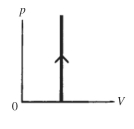
At room temperature,a typical person transfers energy to the surroundings at the rate of 62 W.If this energy transfer has to be made up by an equivalent food intake,how many kilocalories (food calories)does this person need to consume every day just to make up this energy? (1 cal = 4.186 J)
(Multiple Choice)
4.8/5 (73)
(73) In a flask,114.0 g of water is heated using of power,with perfect efficiency.How long will it take to raise the temperature of the water from to The specific heat of water is 4186 J/kg ∙ K.
(Multiple Choice)
4.8/5 (82)
(82) A 400-g block of iron at 400°C is dropped into a calorimeter (of negligible heat capacity)containing 60 g of water at 30°C.How much steam is produced? The latent heat of vaporization of water is 22.6 × 10⁵ J/kg and its specific heat is 4186 J/kg ∙ K.The average specific heat of iron over this temperature range is 560 J/kg ∙ K.
(Multiple Choice)
4.9/5 (83)
(83) How many grams of ice at -17°C must be added to 741 grams of water that is initially at a temperature of to produce water at a final temperature of Assume that no thermal energy is lost to the surroundings and that the container has negligible mass.The specific heat of liquid water is 4190 J/kg ∙ C° and of ice is 2000 J/kg ∙ C°.For water the normal melting point is 0°C and the heat of fusion is 334 × 103 J/kg.The normal boiling point is 100°C and the heat of vaporization is 2.256 × 10⁶ J/kg.
(Short Answer)
4.9/5 (90)
(90) A glass tea kettle containing 500 g of water is on the stove.The portion of the tea kettle that is in contact with the heating element has an area of 0.090 m2 and is 1.5 mm thick.At a certain moment,the temperature of the water is 75°C,and it is rising at the rate of 3 C° per minute.What is the temperature of the outside surface of the bottom of the tea kettle? Neglect the heat capacity of the kettle,and assume that the inner surface of the kettle is at the same temperature as the water inside.The thermal conductivity of glass is 0.840 W/m ∙ K and the specific heat of water is 4186 J/kg ∙ K.
(Multiple Choice)
4.7/5 (76)
(76) An ideal gas undergoes the process a→b→c→a shown in the pV diagram.In the figure,Pa = Pc = 240 kPa,Vb = Vc = 40 L,Va = 15 L,and Pb = 400 kPa.How much internal (thermal)energy is gained by the gas in this a→b→c→a process? 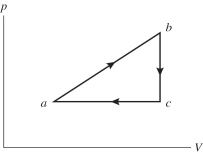
(Multiple Choice)
4.9/5 (79)
(79) A person running in place on an exercise machine for 10 min uses up 17 kcal (food calories).Another person exercises by repeatedly lifting two 2.5-kg weights a distance of 50 cm.How many repetitions of this exercise are equivalent to 10 minutes of running in place? Assume that the person uses negligible energy in letting down the weights after each lift.(1 cal = 4.186 J)
(Multiple Choice)
4.9/5 (74)
(74) A 40.0-L container is divided into two equal parts by a rubber membrane.One half of the container has 1.50 moles of an ideal monatomic gas at 250 K,and the other half is a vacuum.The container is well insulated,so there is no exchange of heat with the surroundings.The membrane breaks,and eventually the gas reaches a new equilibrium condition occupying the entire volume.What is the final temperature of the gas?
(Multiple Choice)
4.8/5 (91)
(91) A beaker of negligible heat capacity contains 456 g of ice at -25.0°C.A lab technician begins to supply thermal energy through the process of heating to the container at the rate of 1000 J/min.How long after starting will it take before the temperature starts to rise above 0°C? The specific heat of ice is 2090 J/kg ∙ K and the latent heat of fusion of water is 33.5 × 10⁴ J/kg.
(Short Answer)
4.9/5 (91)
(91) A 45.0-kg sample of ice is at 0.00° C.How much thermal energy is needed to melt it? For water LF = 334,000 J/kg and LV = 2.256 × 10⁶ J/kg.
(Multiple Choice)
4.7/5 (86)
(86) 
Filters
- Essay(0)
- Multiple Choice(0)
- Short Answer(0)
- True False(0)
- Matching(0)