



 Chat with AI
Exam 13: First Law of Thermodynamics

Exam 1: Introduction32 Questions
Exam 2: Kinematics: Motion in One Dimension162 Questions
Exam 3: Newtonian Mechanics54 Questions
Exam 4: Applying Newtons Laws178 Questions
Exam 5: Circular Motion119 Questions
Exam 6: Impulse and Linear Momentum82 Questions
Exam 7: Work and Energy191 Questions
Exam 8: Extended Bodies at Rest59 Questions
Exam 9: Rotational Motion124 Questions
Exam 10: Gases84 Questions
Exam 11: Static Fluids65 Questions
Exam 12: Fluids in Motion30 Questions
Exam 13: First Law of Thermodynamics119 Questions
Exam 14: Second Law of Thermodynamics70 Questions
Exam 15: Electric Charge force and Energy78 Questions
Exam 16: The Electric Field151 Questions
Exam 17: Dc Circuits225 Questions
Exam 18: Magnetism136 Questions
Exam 19: Electromagnetic Induction99 Questions
Exam 20: Vibrational Motion94 Questions
Exam 21: Mechanical Waves155 Questions
Exam 22: Reflection and Refraction36 Questions
Exam 23: Mirrors and Lenses221 Questions
Exam 24: Wave Optics135 Questions
Exam 25: Electromagnetic Waves79 Questions
Exam 26: Special Relativity124 Questions
Exam 27: Quantum Optics100 Questions
Exam 28: Atomic Physics141 Questions
Exam 29: Nuclear Physics155 Questions
Exam 30: Particle Physics21 Questions
Select questions type


A 6.5-g iron meteor hits Earth at a speed of 295 m/s.If its kinetic energy is entirely converted to the thermal energy of the meteor,by how much will its temperature rise? The specific heat of iron is 113 cal/kg ∙ C°,and 1 cal = 4.186 J.
(Multiple Choice)
4.8/5  (84)
(84) An ideal gas undergoes the process a→b→c→a shown in the pV diagram.The thermal energy transferred to the gas through heating gas in process a→b is 546 J,while in process the gas loses 62.0 J of thermal energy through heating.In process a→b there is - of work performed on the gas,while in process c→a 223 J of work is done on the gas.How much heat is gained by the gas in process c→a? 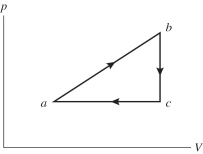
(Multiple Choice)
4.8/5 (86)
(86) A substance has a melting point of 20°C and a heat of fusion of 3.4 × J/kg.The boiling point is and the heat of vaporization is at a pressure of one atmosphere.The specific heats for the solid,liquid,and gaseous phases are 600 J/kg ∙ K (solid),1000 J/kg ∙ K (liquid),and 400 J/kg ∙ K (gaseous).How much thermal energy is required to raise the temperature of this substance from to at a pressure of one atmosphere?
(Multiple Choice)
4.9/5 (87)
(87) A 0.600-kg piece of metal X is heated to 100°C and placed in an aluminum can of mass 0.200-kg which contains 0.500 kg of water initially at 17.3°C.The final equilibrium temperature of the mixture is 20.2°C,what is the specific heat of metal X? The specific heats of water and aluminum are 4186 J/kg ∙ K (water)and 910 J/kg ∙ K (aluminum).
(Multiple Choice)
4.8/5 (82)
(82) A person is walking outdoors on a cold day when the temperature is -20°C.He is breathing at the rate of 16 breaths per minute,and each time he breathes in he inhales 0.0050 m3 of air.At what rate does he lose thermal energy by breathing if the air in his lungs is heated to body temperature (37°C)before it is exhaled? The specific heat of air is 1020 J/kg ∙ K and the density of air is 1.29 kg/m3.
(Multiple Choice)
4.8/5 (77)
(77) A 200-L electric water heater uses 2.0 kW.Assuming no thermal energy loss,how many hours would it take to change the temperature of water in this tank from 23°C to 75°C? The specific heat of water is 4186 J/kg ∙ K and its density is 1000 kg/m3.
(Multiple Choice)
4.7/5 (60)
(60) Object 1 has three times the specific heat capacity and four times the mass of Object 2.The same amount of energy is transferred to each object though the process of heating.If the temperature of Object 1 changes by an amount ΔT,the change in temperature of Object 2 will be
(Multiple Choice)
4.9/5 (96)
(96) Which one of the following quantities is the smallest unit of thermal energy?
(Multiple Choice)
4.7/5 (81)
(81) A glass beaker of unknown mass contains of water.The system absorbs of thermal energy and the temperature rises as a result.What is the mass of the beaker? The specific heat of glass is 0.18 cal/g ∙ °C,and that of water is 1.0 cal/g ∙ C°.
(Multiple Choice)
4.9/5 (86)
(86) Two processes are shown on the pV diagram in the figure.One of them is an adiabat and the other one is an isotherm.Which process is the isotherm? 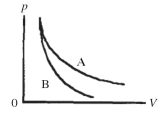
(Multiple Choice)
4.9/5 (84)
(84) The melting point of aluminum is 660°C,its latent heat of fusion is 4.00 × 10⁵ J/kg,and its specific heat is 900J/kg ∙ K.How much thermal energy must be added to 500 g of aluminum originally at 27°C to completely melt it?
(Multiple Choice)
4.8/5 (85)
(85) A 600-g piece of iron at 100°C is dropped into a calorimeter of negligible specific heat containing 100 g of ice at 0°C and 120 g of water,also at 0°C.What is the final temperature of the system? The specific heat of iron is 448 J/kg ∙ K,the latent heat of fusion of water is 33.5 × 10⁴ J/kg,and the specific heat of water is 4186 J/kg ∙ K.
(Short Answer)
4.9/5 (75)
(75) A metal has a latent heat of fusion of 2.32 × 10⁴ J/kg,a specific heat of 128 J/kg ∙ K,and a melting point of 228°C.A 30-g pellet of this metal at 16°C hits a solid wall and comes to a complete stop.What would the speed of the pellet have to be in order for it to melt completely when it hits the wall,assuming that all of its kinetic energy is transformed into thermal energy within the pellet?
(Multiple Choice)
5.0/5 (89)
(89) A gas is taken through the cycle shown in the pV diagram in the figure.During one cycle,how much work is done by the gas? 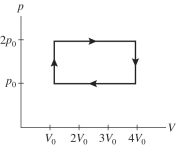
(Multiple Choice)
4.8/5 (96)
(96) A substance has a melting point of 20°C and a heat of fusion of The boiling point is and the heat of vaporization is at a pressure of one atmosphere.The specific heats for the solid,liquid,and gaseous phases are 600 J/kg ∙ K (solid),1000 J/kg ∙ K (liquid),and 400 J/kg ∙ K (gaseous).How much thermal energy is emitted by of this substance when it is cooled from 170°C to 86°C at a pressure of one atmosphere?
(Multiple Choice)
4.8/5 (83)
(83) A 360-g metal container,insulated on the outside,holds 180.0 g of water in thermal equilibrium at 22.0°C.A 24.0-g ice cube,at the melting point,is dropped into the water,and when thermal equilibrium is reached the temperature is 15.0°C.Assume there is no thermal energy exchange with the surroundings.For water,the specific heat is 4190 J/kg ∙ K and the heat of fusion is 3.34 × 10⁵ J/kg.What is the specific heat of the metal of the container?
(Multiple Choice)
4.7/5 (77)
(77) If you add 700 kJ of thermal energy to 700 g of water originally at 70.0°C,how much water is left in the container? The latent heat of vaporization of water is 22.6 × J/kg,and its specific heat capacity is 4186 J/kg ∙ K.
(Multiple Choice)
4.9/5 (75)
(75) A beaker of negligible heat capacity contains 456 g of ice at -25.0°C.A lab technician begins to supply thermal energy through the process of heating to the container at the rate of 1000 J/min.How long after starting will the ice begin to melt,assuming all of the ice has the same temperature? The specific heat of ice is 2090 J/kg ∙ K and the latent heat of fusion of water is 33.5 × 10⁴ J/kg.
(Short Answer)
4.9/5 (72)
(72) A thermally isolated system is made up of a hot piece of aluminum and a cold piece of copper,with the aluminum and the copper in thermal contact.The specific heat capacity of aluminum is more than double that of copper.Which object will have the greater magnitude gain or loss of internal energy during the time the system takes to reach thermal equilibrium?
(Multiple Choice)
4.8/5 (78)
(78) When 50 g of a certain material at 100°C is mixed with 100 g of water at 0°C,the final temperature is 40°C.What is the specific heat of the material? The specific heat of water is 1.00 kcal/kg ∙ C°.
(Multiple Choice)
4.8/5 (68)
(68) 
Filters
- Essay(0)
- Multiple Choice(0)
- Short Answer(0)
- True False(0)
- Matching(0)