



 Chat with AI
Exam 13: First Law of Thermodynamics

Exam 1: Introduction32 Questions
Exam 2: Kinematics: Motion in One Dimension162 Questions
Exam 3: Newtonian Mechanics54 Questions
Exam 4: Applying Newtons Laws178 Questions
Exam 5: Circular Motion119 Questions
Exam 6: Impulse and Linear Momentum82 Questions
Exam 7: Work and Energy191 Questions
Exam 8: Extended Bodies at Rest59 Questions
Exam 9: Rotational Motion124 Questions
Exam 10: Gases84 Questions
Exam 11: Static Fluids65 Questions
Exam 12: Fluids in Motion30 Questions
Exam 13: First Law of Thermodynamics119 Questions
Exam 14: Second Law of Thermodynamics70 Questions
Exam 15: Electric Charge force and Energy78 Questions
Exam 16: The Electric Field151 Questions
Exam 17: Dc Circuits225 Questions
Exam 18: Magnetism136 Questions
Exam 19: Electromagnetic Induction99 Questions
Exam 20: Vibrational Motion94 Questions
Exam 21: Mechanical Waves155 Questions
Exam 22: Reflection and Refraction36 Questions
Exam 23: Mirrors and Lenses221 Questions
Exam 24: Wave Optics135 Questions
Exam 25: Electromagnetic Waves79 Questions
Exam 26: Special Relativity124 Questions
Exam 27: Quantum Optics100 Questions
Exam 28: Atomic Physics141 Questions
Exam 29: Nuclear Physics155 Questions
Exam 30: Particle Physics21 Questions
Select questions type


A lab assistant drops a 400.0-g piece of metal at 100.0°C into a 100.0-g aluminum cup containing 500.0 g of water at In a few minutes,she measures the final temperature of the system to be 40.0°C.What is the specific heat of the 400.0-g piece of metal,assuming that no significant thermal energy is exchanged with the surroundings? The specific heat of this aluminum is 900.0 J/kg ∙ K and that of water is 4186 J/kg ∙ K.
(Multiple Choice)
4.8/5  (82)
(82) An ideal gas undergoes an adiabatic process while -25 J of work is done on it.What is the change in the internal (thermal)energy of the gas?
(Multiple Choice)
4.8/5 (80)
(80) Solar houses use a variety of energy storage devices to retain the thermal energy absorbed during the day so that it can be released during the night.Suppose that you were to use a device of this kind to produce steam at 100°C during the day,and then allow the steam to cool to 0°C and freeze during the night.How many kilograms of water would be needed to store 20.0 kWh of energy in this way? The latent heat of vaporization of water is 22.6 × 10⁵ J/kg,the latent heat of fusion of water is 33.5 × 10⁴ J/kg,and the specific heat of water is 4186 J/kg ∙ K.
(Multiple Choice)
4.7/5 (97)
(97) On his honeymoon,James Joule attempted to explore the relationships between various forms of energy by measuring the rise of temperature of water which had fallen down a waterfall on Mount Blanc.What maximum temperature rise would one expect for a waterfall with a vertical drop of 20 m? The specific heat of water is 4186 J/kg ∙ K.
(Multiple Choice)
4.9/5 (94)
(94) An aluminum electric tea kettle with a mass of 500 g is heated with a 500-W heating coil.How long will it take to change the temperature of 1.0 kg of water from 18°C to 98°C in the tea kettle? The specific heat of aluminum is 900 J/kg ∙ K and that of water is 4186 J/kg ∙ K.
(Multiple Choice)
4.9/5 (97)
(97) If you add 1.33 MJ of thermal energy to 500 g of water at 50°C in a sealed container,what is the final temperature of the steam? The latent heat of vaporization of water is 22.6 × 10⁵ J/kg,the specific heat of steam is 2010 J/kg ∙ K,and the specific heat of water is 4186 J/kg ∙ K.
(Multiple Choice)
4.8/5 (84)
(84) During an isochoric process,the internal (thermal)energy of a gas decreases by 50 J.How much energy via heating is added to the gas during this process?
(Multiple Choice)
4.7/5 (87)
(87) A window glass that is 0.5 cm thick has dimensions of 3 m by 1.5 m.The thermal conductivity of this glass is 0.8 W/m ∙ K.If the outside surface of the glass is at -10°C and the inside surface is at 20°C,how much thermal energy flows through the window in every hour?
(Multiple Choice)
4.9/5 (93)
(93) A carpenter is driving a 15.0-g steel nail into a board.His 1.00-kg hammer is moving at 8.50 m/s when it strikes the nail.Half of the kinetic energy of the hammer is converted into internal energyin the nail and does not flow out of the nail.What is the increase in temperature of the nail after the three blows that the carpenter needs to drive the nail in completely? The specific heat of steel is 448 J/kg ∙ K.
(Multiple Choice)
4.9/5 (70)
(70) An ideal gas undergoes the process a→b→c→a shown in the pV diagram.In this figure,Pa = Pc = 3.60 × 10⁵ Pa,Vb = Vc = 68.00 L,Va = 35 L,and Pb = 5.60 × 10⁵ Pa.How much work is done on the system in this process? 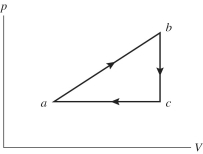
(Multiple Choice)
4.9/5 (82)
(82) A cyclic process is carried out on an ideal gas such that it returns to its initial state at the end of a cycle,as shown in the pV diagram in the figure.If the process is carried out in a clockwise sense around the enclosed area,as shown on the figure,then the change of internal energy over the full cycle 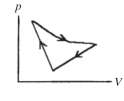
(Multiple Choice)
4.9/5 (98)
(98) As shown in the figure,an air pocket at the top of a vertical tube,closed at the upper end and open at the lower,occupies a volume of at the surface of a lake where the air pressure is and the temperature is What is the volume of the air in the pocket if the tube is taken to a depth of 56 meters,where the temperature is Assume that none of the air escapes from the tube.The density of the water in the lake is 1000 kg/m3. 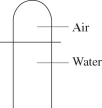
(Short Answer)
4.8/5 (85)
(85) The figure shows a pV diagram for a gas going through a cycle from A to B to C and back to A.From point A to point B,the gas absorbs 50 J of energy through heating and finds its internal (thermal)energy has increased by 20 J.Going from B to C,the internal (thermal)energy decreases by 5.0 J.
(a)How much work was done in the gas from A to B?
(b)How much energy through heating was absorbed by the gas from B to C?
(c)How much work was done on the gas going from B to C? 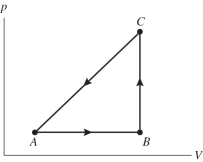
(Short Answer)
4.7/5 (93)
(93) A concrete wall of a cold storage room measures 3.0 m high,5.0 m wide,and 20 cm thick.The inside wall is to be covered by a layer of wood in order to reduce the rate of thermal energy flow through the wall by 90 percent.The inner surface of the wooden wall is maintained at -10°C and the outer surface of the concrete wall is at 20°C.The thermal conductivities of concrete and wood are 0.80 W/m ∙ K (concrete)and 0.040 W/m ∙ K (wood).What should be the thickness of the layer of wood?
(Multiple Choice)
4.9/5 (88)
(88) By what primary thermal energy transfer mechanism does the Sun warm Earth?
(Multiple Choice)
4.8/5 (90)
(90) A fixed amount of an ideal monatomic gas is maintained at constant volume as it is cooled by 50 K.This feat is accomplished by removing 400 J of energy from the gas.How much work is done on the gas during this process?
(Multiple Choice)
4.7/5 (80)
(80) A 5.00-g lead BB moving at 44.0 m/s penetrates a wood block and comes to rest inside the block.If half of its kinetic energy is absorbed by the BB,what is the change in the temperature of the BB? The specific heat of lead is 128 J/kg ∙ K.
(Multiple Choice)
4.9/5 (75)
(75) A rod,with sides insulated to prevent thermal energy exchange with the environment,has one end immersed in boiling water at 100°C and the other end in a water-ice mixture at 0°C.The rod has uniform cross-sectional area and length The thermal energy conducted by the rod melts the ice at a rate of 1.0 g every 11 seconds.What is the thermal conductivity of the rod? Recall that the heat of fusion of water is 3.34 × 10⁵ J/kg.
(Short Answer)
4.8/5 (72)
(72) A 400-g stainless steel tea kettle containing 500 g of water is on the stove.The portion of the tea kettle that is in contact with the heating element has an area of 0.090 m2 and is 2.0 mm thick.At a certain moment,the temperature of the water is 75°C,and it is rising at the rate of 3.0 C° per minute.What is the difference in temperature between the inside and the outside of the bottom of the tea kettle? Assume that the inner surface of the kettle is at the same temperature as the water inside.The thermal conductivity of stainless steel is 16.3 W/m ∙ K,the specific heat of the steel is 448 J/kg ∙ K,and the specific heat of water is 4186 J/kg .K.
(Multiple Choice)
4.8/5 (75)
(75) A piece of iron of mass 0.12 kg is taken from an oven where its temperature is 336°C and quickly placed in an insulated copper can that contains 0.20 kg of water.The copper can has mass 0.50 kg,and it and the water in it are originally at a temperature of 20°C.Calculate the final temperature of the system,assuming no thermal energy is transferred to the surroundings.Use the following specific heats: 4190J/kg ∙ C° (water),470 J/kg ∙ C° (iron),and 390 J/kg ∙ C° (copper).
(Short Answer)
4.9/5 (89)
(89) 
Filters
- Essay(0)
- Multiple Choice(0)
- Short Answer(0)
- True False(0)
- Matching(0)