



 Chat with AI
Exam 13: First Law of Thermodynamics

Exam 1: Introduction32 Questions
Exam 2: Kinematics: Motion in One Dimension162 Questions
Exam 3: Newtonian Mechanics54 Questions
Exam 4: Applying Newtons Laws178 Questions
Exam 5: Circular Motion119 Questions
Exam 6: Impulse and Linear Momentum82 Questions
Exam 7: Work and Energy191 Questions
Exam 8: Extended Bodies at Rest59 Questions
Exam 9: Rotational Motion124 Questions
Exam 10: Gases84 Questions
Exam 11: Static Fluids65 Questions
Exam 12: Fluids in Motion30 Questions
Exam 13: First Law of Thermodynamics119 Questions
Exam 14: Second Law of Thermodynamics70 Questions
Exam 15: Electric Charge force and Energy78 Questions
Exam 16: The Electric Field151 Questions
Exam 17: Dc Circuits225 Questions
Exam 18: Magnetism136 Questions
Exam 19: Electromagnetic Induction99 Questions
Exam 20: Vibrational Motion94 Questions
Exam 21: Mechanical Waves155 Questions
Exam 22: Reflection and Refraction36 Questions
Exam 23: Mirrors and Lenses221 Questions
Exam 24: Wave Optics135 Questions
Exam 25: Electromagnetic Waves79 Questions
Exam 26: Special Relativity124 Questions
Exam 27: Quantum Optics100 Questions
Exam 28: Atomic Physics141 Questions
Exam 29: Nuclear Physics155 Questions
Exam 30: Particle Physics21 Questions
Select questions type


In grinding a steel knife,the metal can get as hot as 400°C.If the blade has a mass of 80 g,what is the minimum amount of water needed at 20°C if the water is to remain liquid and not rise above 100°C when the hot blade is quenched in it? The specific heat of the steel is 0.11 cal/g ∙ C° and the specific heat of water is 1.0 cal/g ∙ C°.
(Multiple Choice)
4.8/5  (89)
(89) A solid cylindrical bar conducts thermal energy at a rate of 25 W from a hot to a cold reservoir under steady state conditions.If both the length and the diameter of this bar are doubled,the rate at which it will conduct thermal energy between these reservoirs will be
(Multiple Choice)
4.9/5 (82)
(82) The figure shows a graph of the temperature of a pure substance as a function of time as energy through heating is added to it at a constant rate in a closed container.If LF is the latent heat of fusion of this substance and LV is its latent heat of vaporization,what is the value of the ratio LV/LF? 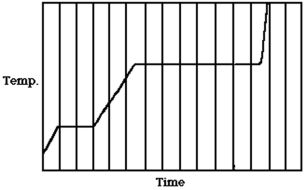
(Multiple Choice)
4.9/5 (81)
(81) In an experiment to measure the thermal conductivity of a certain material,a slab of material 10.0 mm thick separates a steam chamber from a block of ice with a square cross-section with dimensions 8.00 cm × 8.00 cm.After 5.00 min of running the experiment,64.0 g of ice have melted.What is the thermal conductivity of this material? The latent heat of fusion of water is 33.5 × 10⁴ J/kg,the latent heat of vaporization of water is 2.256 × 10⁶ J/kg,and both the ice and water are under 1.00 atm of pressure.
(Multiple Choice)
4.9/5 (72)
(72) A 90-g aluminum calorimeter contains 390 g of water at an equilibrium temperature of A piece of metal,initially at is added to the calorimeter.The final temperature at equilibrium is 32° C.Assume there is no external thermal energy exchange.The specific heat capacities of aluminum and water are 910 J/kg ∙ K (aluminum)and 4190 J/kg ∙ K (water).What is the specific heat of the 160-g piece of metal?
(Multiple Choice)
4.9/5 (71)
(71) If you wanted to know how much the temperature of a particular piece of material would rise when a known amount of energy through the process of heating was added to it,which of the following quantities would be most helpful to know?
(Multiple Choice)
4.8/5 (93)
(93) A 2294-kg sample of water at 0° C is cooled to and freezes in the process.How much thermal energy is released? For water LF = 334,000 J/kg and LV = 2.256 × 10⁶ J/kg.The specific heat of ice is 2050 J/kg ∙ K.
(Multiple Choice)
4.9/5 (80)
(80) A container of 114.0 g of water is heated using of power,with perfect efficiency.How long will it take to raise the temperature of the water from to The specific heat of the container is negligible,and the specific heat of water is 4.186 × 10³ J/kg ∙ C.
(Multiple Choice)
4.8/5 (93)
(93) A 920-g empty iron kettle is put on a stove.How much thermal energy in joules must be transferred to it to raise its temperature form to The specific heat for iron is 113 cal/kg ∙ C°,and 1 cal = 4.186 J.
(Multiple Choice)
5.0/5 (60)
(60) An expansion process on an ideal diatomic ideal gas has a linear path between the initial and final coordinates on a pV diagram.The coordinates of the initial state are: the pressure is 300 kPa,the volume is and the temperature is The final pressure is and the final temperature is How much work is done on the gas during this process? (R = 8.31 J/mol ∙ K)
(Multiple Choice)
4.8/5 (97)
(97) In a given reversible process,the temperature of an ideal gas is kept constant as the gas is compressed to a smaller volume.Which one of the following statements about the gas is correct?
(Multiple Choice)
4.7/5 (76)
(76) When a sample of water at 0.0°C is cooled to -36.0°C and freezes in the process,935,000 kJ of thermal energy is liberated.What is the mass of this sample of water? For water LF = 334,000 J/kg,LV = 2.256 × 10⁶ J/kg,and the specific heat of ice is 2050 J/kg ∙ C°.
(Multiple Choice)
4.9/5 (76)
(76) The thermal conductivity of a certain concrete is 0.80 W/m ∙ K and the thermal conductivity of a certain wood is 0.10 W/m ∙ K.How thick would a solid concrete wall have to be in order to have the same rate of thermal energy flow through it as an 8.0-cm thick wall made of solid wood? Both walls have the same surface area and the same temperature difference across their faces.
(Multiple Choice)
4.8/5 (80)
(80) An 920-g piece of iron at 100°C is dropped into a calorimeter of negligible specific heat containing 50 g of ice at 0°C and 92 g of water,also at 0°C.What is the final temperature of the system? The specific heat of iron is 448 J/kg ∙ K,that of water is 4186 J/kg ∙ K,and the latent heat of fusion of water is 33.5 × 10⁴ J/kg.
(Multiple Choice)
4.8/5 (74)
(74) A 4.0-kg aluminum block is originally at 10°C.If 160 kJ of thermal energy is added to the block,what is its final temperature? The specific heat capacity of aluminum is 910 J/kg ∙ K.
(Multiple Choice)
4.8/5 (79)
(79) 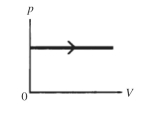
A 44.0-g block of ice at -15.0°C is dropped into a calorimeter (of negligible heat capacity)containing of water at 5.0°C.When equilibrium is reached,how much of the ice will have melted? The specific heat of ice is 2090 J/kg ∙ K,that of water is 4186 J/kg ∙ K,and the latent heat of fusion of water is 33.5 × 10⁴ J/kg.
(Multiple Choice)
4.9/5 (77)
(77) A certain gas is compressed adiabatically.The amount of work done on the gas is 800 J.What is the change in the internal (thermal)energy of the gas?
(Multiple Choice)
5.0/5 (93)
(93) A 35-g block of ice at -14°C is dropped into a calorimeter (of negligible heat capacity)containing 400 g of water at 0°C.When the system reaches equilibrium,how much ice is left in the calorimeter? The specific heat of ice is 2090 J/kg ∙ K,that of water is 4186 J/kg ∙ K,and the latent heat of fusion of water is 33.5 × 10⁴ J/kg.
(Multiple Choice)
4.8/5 (74)
(74) A 771.0-kg copper bar is put into a smelter for melting.The initial temperature of the copper is 300.0 K.How much thermal energy must the smelter produce to completely melt the copper bar? The specific heat for copper is 386 J/kg∙K,the heat of fusion for copper is 205,000 J/kg,and its melting point is 1357 K.
(Multiple Choice)
4.9/5 (73)
(73) 
Filters
- Essay(0)
- Multiple Choice(0)
- Short Answer(0)
- True False(0)
- Matching(0)