



 Chat with AI
Exam 9: Monopolistic Competition and Oligopoly

Exam 1: Economics: Foundations and Models142 Questions
Exam 2: Choices and Trade-Offs in the Market192 Questions
Exam 3: Where Prices Come From: the Interaction of Demand and Supply241 Questions
Exam 4: Elasticity: The Responsiveness of Demand and Supply224 Questions
Exam 5: Economic Efficiency,government Price Setting and Taxes169 Questions
Exam 6: Technology,production and Costs255 Questions
Exam 7: Firms in Perfectly Competitive Markets269 Questions
Exam 8: Monopoly Markets187 Questions
Exam 9: Monopolistic Competition and Oligopoly350 Questions
Exam 10: The Markets for Labour and Other Factors of Production250 Questions
Exam 11: Government Intervention in the Market325 Questions
Exam 12: Social Policy and Inequality125 Questions
Exam 13: Gdp: Measuring Total Production, income and Economic Growth202 Questions
Exam 14: Unemployment and Inflation230 Questions
Exam 15: Aggregate Demand and Aggregate Supply Analysis166 Questions
Exam 16: Money,banks and the Reserve Bank of Australia110 Questions
Exam 17: Monetary Policy111 Questions
Exam 18: Fiscal Policy138 Questions
Exam 19: Comparative Advantage and the Gains From International Trade131 Questions
Exam 20: Macroeconomics in an Open Economy276 Questions
Select questions type


Which of the following is an example of a way in which a firm in oligopoly can escape the prisoner's dilemma?
(Multiple Choice)
4.7/5  (80)
(80) If economies of scale are significant,the typical firm will not reach the minimum point on its long-run average cost curve until it has produced a large fraction of industry sales.
(True/False)
4.7/5 (70)
(70) Which of the following is not a characteristic of monopolistic competition?
(Multiple Choice)
4.9/5 (78)
(78) Figure 9.14  -Refer to Figure 9.14.Economies of scale are exhausted at which output level?
 (Multiple Choice)
4.9/5 (73)
(73) Firms in monopolistic competition compete by selling similar,but not identical products.
(True/False)
4.8/5 (79)
(79) Table 9.1
Quantity Price Total Revenue (dollars) (dollars) 1 7.50 7.50 2 7.00 14.00 3 6.50 19.50 4 6.00 24.00 5 5.50 27.50 6 5.00 30.00
-Refer to Table 9.1.What portion of the marginal revenue of the 5th unit is due to the output effect and what portion is due to the price effect?
(Multiple Choice)
4.8/5 (87)
(87) A form of implicit collusion where one firm in an oligopoly announces a price change which is matched by other firms in the same industry is ________.
(Multiple Choice)
4.8/5 (78)
(78) Occupational licensing is an example of an entry barrier that improves a country's standard of living.
(True/False)
4.7/5 (78)
(78) Why do economists refer to the pricing strategies of oligopoly firms as a prisoner's dilemma game?
__________________________________________________________________________________________________________________________________________________________________________________________
(Essay)
4.8/5 (78)
(78) An oligopolistic industry is characterised by a few large firms acting independently.
(True/False)
4.9/5 (68)
(68) What is an oligopoly? Give two examples of oligopolistic industries in Australia.
__________________________________________________________________________________________________________________________________________________________________________________________
(Essay)
4.8/5 (74)
(74) For a profit-maximising monopolistically competitive firm,for the last unit sold,the marginal cost of production is less than the marginal benefit received by a customer from the purchase of that unit.
(True/False)
4.9/5 (85)
(85) Sparkle,one of many firms in the market for toothpaste,is in long-run equilibrium.Sparkle has a small market share and has been in business for a long time.
a.Identify the market structure in which Sparkle operates.Explain your answer.
b.What is Sparkle's profit or loss? Explain your answer.If you cannot determine the profit or loss,explain what information is missing.
c.Draw a diagram showing Sparkle's demand curve,marginal revenue curve,average total cost curve,and marginal cost curve.Label your diagram.
__________________________________________________________________________________________________________________________________________________________________________________________
(Essay)
4.9/5 (83)
(83) Figure 9.7  Figure 9.7 shows short-run cost and demand curves for a monopolistically competitive firm in the footwear market.
-Refer to Figure 9.7.Which of the following statements describes the best course of action for the firm depicted in the diagram?
Figure 9.7 shows short-run cost and demand curves for a monopolistically competitive firm in the footwear market.
-Refer to Figure 9.7.Which of the following statements describes the best course of action for the firm depicted in the diagram? (Multiple Choice)
4.7/5 (66)
(66) Explain the differences between total revenue,average revenue,and marginal revenue.
__________________________________________________________________________________________________________________________________________________________________________________________
(Essay)
4.8/5 (83)
(83) Figure 9.3 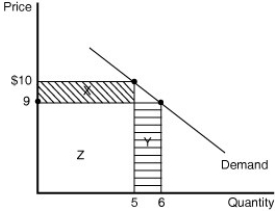 -Refer to Figure 9.3.The marginal revenue of the sixth unit of output is _____.
 (Multiple Choice)
5.0/5 (75)
(75) Figure 9.14
-Refer to Figure 9.14.If the diagram represents a typical firm in the market,what is likely to happen to its average cost of production in the long run?
-Refer to Figure 9.14.If the diagram represents a typical firm in the market,what is likely to happen to its average cost of production in the long run? (Multiple Choice)
5.0/5 (73)
(73) Figure 9.17  -Refer to Figure 9.17.The productively efficient output for the firm represented in the diagram is _____.
 (Multiple Choice)
4.7/5 (81)
(81) 
Filters
- Essay(0)
- Multiple Choice(0)
- Short Answer(0)
- True False(0)
- Matching(0)