



 Chat with AI
Exam 10: Accounting for Long-Term Liabilities

Exam 1: Accounting in Business285 Questions
Exam 2: Accounting for Business Transactions251 Questions
Exam 3: Adjusting Accounts for Financial Statements403 Questions
Exam 4: Accounting for Merchandising Operations252 Questions
Exam 5: Inventories and Cost of Sales238 Questions
Exam 6: Cash,fraud,and Internal Controls228 Questions
Exam 7: Accounting for Receivables219 Questions
Exam 8: Accounting for Long-Term Assets258 Questions
Exam 9: Accounting for Current Liabilities219 Questions
Exam 10: Accounting for Long-Term Liabilities231 Questions
Exam 11: Corporate Reporting and Analysis247 Questions
Exam 12: Reporting Cash Flows247 Questions
Exam 13: Analysis of Financial Statements245 Questions
Exam 14: Managerial Accounting Concepts and Principles252 Questions
Exam 15: Job Order Costing and Analysis215 Questions
Exam 16: Process Costing and Analysis225 Questions
Exam 17: Activity-Based Costing and Analysis223 Questions
Exam 18: Cost Behavior and Cost-Volume-Profit Analysis247 Questions
Exam 19: Variable Costing and Analysis202 Questions
Exam 20: Master Budgets and Performance Planning224 Questions
Exam 21: Flexible Budgets and Standard Costs223 Questions
Exam 22: Performance Measurement and Responsibility Accounting210 Questions
Exam 23: Relevant Costing for Managerial Decisions149 Questions
Exam 24: Capital Budgeting and Investment Analysis161 Questions
Exam 25: Time Value of Money84 Questions
Exam 26: Investments217 Questions
Exam 27: Lean Principles and Accounting30 Questions
Select questions type


Charger Company's most recent balance sheet reports total assets of $27,000,000,total liabilities of $15,000,000 and total equity of $12,000,000.The debt to equity ratio for the period is (rounded to two decimals):
(Multiple Choice)
4.8/5  (87)
(87) On April 1,a company issues 6%,10-year,$600,000 par value bonds that pay interest semiannually each March 31 and September 30.The bonds sold at $592,000.The company uses the straight-line method of amortizing bond discounts.Prepare the general journal entry to record the first interest payment on September 30.
(Essay)
4.8/5 (74)
(74) Return on equity increases when the expected rate of return from the acquired assets is higher than the interest rate on the debt issued to finance the acquired assets.
(True/False)
4.8/5 (74)
(74) The debt-to-equity ratio is calculated by dividing stockholders' equity attributable to common shareholders by total liabilities.
(True/False)
4.9/5 (78)
(78) A premium reduces the interest expense of a bond over its life.
(True/False)
4.7/5 (83)
(83) On January 1,a company issues bonds dated January 1 with a par value of $200,000.The bonds mature in 3 years.The contract rate is 4%,and interest is paid semiannually on June 30 and December 31.The market rate is 5%.Using the present value factors below,the issue (selling)price of the bonds is: 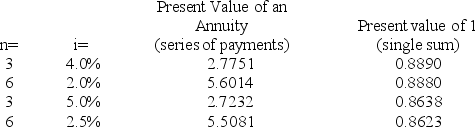
(Multiple Choice)
4.7/5 (81)
(81) When the contract rate on a bond issue is less than the market rate,the bonds sell at a discount.
(True/False)
4.8/5 (98)
(98) An advantage of bond financing is that issuing bonds does not affect owner control.
(True/False)
4.8/5 (72)
(72) ________ bonds have an option exercisable by the issuer to retire them at a stated dollar amount prior to maturity.
(Short Answer)
4.9/5 (84)
(84) Bond interest paid by a corporation is an expense,whereas dividends paid are not an expense of the corporation.
(True/False)
4.8/5 (77)
(77) The carrying (book)value of a bond at the time it is issued is always equal to its par value.
(True/False)
5.0/5 (73)
(73) A company enters into an agreement to make 5 annual year-end payments of $3,000 each,starting one year from now.The annual interest rate is 6%.The present value of an annuity (series of payments)for 5 periods at 6% is 4.2124.What is the present value of these five payments?
(Short Answer)
4.7/5 (85)
(85) ________ bonds are bonds that are scheduled for maturity on one specified date.
(Short Answer)
4.9/5 (80)
(80) Present values can be found using Excel,a calculator or present value tables.
(True/False)
4.8/5 (60)
(60) On January 1,a company issues bonds dated January 1 with a par value of $600,000.The bonds mature in 3 years.The contract rate is 7%,and interest is paid semiannually on June 30 and December 31.The bonds are sold for $564,000.The journal entry to record the first interest payment using straight-line amortization is:
(Multiple Choice)
5.0/5 (82)
(82) A company calls its bonds at a price of $105,000.The face value is $100,000 and the carrying value of the bonds at the retirement date is $103,745.The issuer's journal entry to record the retirement will include a:
(Multiple Choice)
4.8/5 (88)
(88) A pension plan is a contractual agreement between an employer and its employees to provide benefits to employees after they retire.
(True/False)
4.8/5 (84)
(84) On January 1,a company issued 10-year,10% bonds payable with a par value of $500,000,and received $442,647 in cash proceeds.The market rate of interest at the date of issuance was 12%.The bonds pay interest semiannually on July 1 and January 1.The issuer uses the straight-line method for amortization.Prepare the issuer's journal entry to record the first semiannual interest payment on July 1.
(Essay)
4.8/5 (67)
(67) A company issued 10%,10-year bonds with a par value of $1,000,000 on January 1,at a selling price of $885,295 when the annual market interest rate was 12%.The company uses the effective interest amortization method.Interest is paid semiannually each June 30 and December 31.
(1)Prepare an amortization table for the first two payment periods using the format shown below:
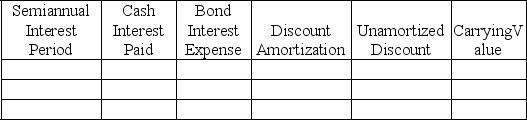 (2)Prepare the journal entry to record the first semiannual interest payment.
 (Essay)
4.8/5 (82)
(82) 
Filters
- Essay(0)
- Multiple Choice(0)
- Short Answer(0)
- True False(0)
- Matching(0)