



 Chat with AI
Exam 10: Accounting for Long-Term Liabilities

Exam 1: Accounting in Business285 Questions
Exam 2: Accounting for Business Transactions251 Questions
Exam 3: Adjusting Accounts for Financial Statements403 Questions
Exam 4: Accounting for Merchandising Operations252 Questions
Exam 5: Inventories and Cost of Sales238 Questions
Exam 6: Cash,fraud,and Internal Controls228 Questions
Exam 7: Accounting for Receivables219 Questions
Exam 8: Accounting for Long-Term Assets258 Questions
Exam 9: Accounting for Current Liabilities219 Questions
Exam 10: Accounting for Long-Term Liabilities231 Questions
Exam 11: Corporate Reporting and Analysis247 Questions
Exam 12: Reporting Cash Flows247 Questions
Exam 13: Analysis of Financial Statements245 Questions
Exam 14: Managerial Accounting Concepts and Principles252 Questions
Exam 15: Job Order Costing and Analysis215 Questions
Exam 16: Process Costing and Analysis225 Questions
Exam 17: Activity-Based Costing and Analysis223 Questions
Exam 18: Cost Behavior and Cost-Volume-Profit Analysis247 Questions
Exam 19: Variable Costing and Analysis202 Questions
Exam 20: Master Budgets and Performance Planning224 Questions
Exam 21: Flexible Budgets and Standard Costs223 Questions
Exam 22: Performance Measurement and Responsibility Accounting210 Questions
Exam 23: Relevant Costing for Managerial Decisions149 Questions
Exam 24: Capital Budgeting and Investment Analysis161 Questions
Exam 25: Time Value of Money84 Questions
Exam 26: Investments217 Questions
Exam 27: Lean Principles and Accounting30 Questions
Select questions type


Strider Corporation issued 14%,5-year bonds with a par value of $5,000,000 on January 1,Year 1.Interest is to be paid semiannually on each June 30 and December 31.The bonds are issued at $5,368,035 cash when the market rate for this bond is 12%.
(a)Prepare the general journal entry to record the issuance of the bonds on January 1,year 1.
(b)Show how the bonds would be reported on Strider's balance sheet at January 1,Year 1.
(c)Assume that Strider uses the effective interest method of amortization of any discount or premium on bonds.Prepare the general journal entry to record the first semiannual interest payment on June 30,Year 1.
(d)Assume instead that Strider uses the straight-line method of amortization of any discount or premium on bonds.Prepare the general journal entry to record the first semiannual interest payment on June 30,Year 1.
(Essay)
4.9/5  (71)
(71) Describe the journal entries required to record the issuance of bonds at par and the payment of bond interest.
(Essay)
4.9/5 (73)
(73) On August 1,a $30,000,6%,3-year installment note payable is issued by a company.The note requires equal payments of principal plus accrued interest of $11,223.34.The entry to record the first payment on July 31 would include:
(Multiple Choice)
4.8/5 (77)
(77) On January 1,a company issued a $500,000,10%,8-year bond payable,and received proceeds of $473,845.Interest is payable each June 30 and December 31.The company uses the straight-line method to amortize the discount.The amount of interest expense to be recorded on June 30 is $25,000.
(True/False)
4.9/5 (79)
(79) A company issued 10-year,9% bonds with a par value of $500,000 when the market rate was 9.5%.The company received $484,087 in cash proceeds.Using the straight-line method,prepare the issuer's journal entry to record the first semiannual interest payment and the amortization of any bond discount or premium.(Round amounts to the nearest whole dollar)
(Essay)
4.9/5 (74)
(74) A company's total liabilities divided by its total stockholders' equity is called the:
(Multiple Choice)
4.8/5 (77)
(77) On January 1,a company issues bonds dated January 1 with a par value of $400,000.The bonds mature in 5 years.The contract rate is 7%,and interest is paid semiannually on June 30 and December 31.The market rate is 8% and the bonds are sold for $383,793.The journal entry to record the second interest payment using the effective interest method of amortization is:
(Multiple Choice)
4.9/5 (86)
(86) A corporation plans to invest $1 million in oil exploration.The corporation is considering two plans to raise the money.Under Plan #1,bonds with a contract rate of interest of 6% would be issued.Under Plan #2,50,000 additional shares of common stock would be issued at $20 per share.The corporation currently has 300,000 shares of stock outstanding,and it expects to earn $700,000 per year before bond interest and income taxes.The net income and return on investment for both plans is shown below:
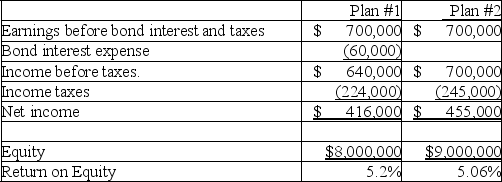 Comment on the relative effects of each alternative,including when one form of financing is preferred to another.
 (Essay)
5.0/5 (83)
(83) Adonis Corporation issued 10-year,8% bonds with a par value of $200,000.Interest is paid semiannually.The market rate on the issue date was 7.5%.Adonis received $206,948 in cash proceeds.Which of the following statements is true?
(Multiple Choice)
4.9/5 (76)
(76) A company issued 9%,10-year bonds with a par value of $100,000.Interest is paid semiannually.The market interest rate on the issue date was 10%,and the issuer received $95,016 cash for the bonds.On the first semiannual interest date,what amount of cash should be paid to the holders of these bonds for interest?
(Short Answer)
4.7/5 (77)
(77) A company issued 7%,5-year bonds with a par value of $100,000.The market rate when the bonds were issued was 7.5%.The company received $97,947 cash for the bonds.Using the effective interest method,the amount of interest expense for the first semiannual interest period is:
(Multiple Choice)
4.7/5 (85)
(85) Convertible bonds can be exchange for a fixed number of shares of the issuing corporation's stock.
(True/False)
4.9/5 (83)
(83) An annuity is a series of equal payments at equal time intervals.
(True/False)
4.9/5 (70)
(70) The party that has the right to exercise a call option on callable bonds is:
(Multiple Choice)
4.9/5 (84)
(84) On January 1,a company issued 10%,10-year bonds with a par value of $720,000.The bonds pay interest each July 1 and January 1.The bonds were sold for $817,860 cash,based on an annual market rate of 8%.Prepare the issuer's journal entry to record the first semiannual interest payment assuming the effective interest method is used.
(Essay)
4.8/5 (92)
(92) A company has 10%,20-year bonds outstanding with a par value of $500,000.The company calls the bonds at $480,000 when the unamortized discount is $24,500.Calculate the gain or loss on the retirement of these bonds.
(Essay)
5.0/5 (87)
(87) Collateral from unsecured loans may be sold to offset the loan obligation if the loan is in default.
(True/False)
4.8/5 (93)
(93) A company issued 9.2%,10-year bonds with a par value of $100,000.Interest is paid semiannually.The annual market interest rate on the issue date was 10%,and the issuer received $95,016 cash for the bonds.The issuer uses the effective interest method for amortization.On the first semiannual interest date,what amount of discount should the issuer amortize?
(Essay)
4.9/5 (68)
(68) On January 1,a company issues 6%,10 year $300,000 par value bonds that pay semiannual interest each June 30 and December 31.The bonds sell at par value.Prepare the general journal entry to record the issuance of the bonds on January 1.
(Essay)
4.8/5 (89)
(89) A company received cash proceeds of $206,948 on a bond issue with a par value of $200,000.The difference between par value and issue price for this bond is recorded as a:
(Multiple Choice)
4.9/5 (70)
(70) 
Filters
- Essay(0)
- Multiple Choice(0)
- Short Answer(0)
- True False(0)
- Matching(0)