



 Chat with AI
Exam 10: Accounting for Long-Term Liabilities

Exam 1: Accounting in Business285 Questions
Exam 2: Accounting for Business Transactions251 Questions
Exam 3: Adjusting Accounts for Financial Statements403 Questions
Exam 4: Accounting for Merchandising Operations252 Questions
Exam 5: Inventories and Cost of Sales238 Questions
Exam 6: Cash,fraud,and Internal Controls228 Questions
Exam 7: Accounting for Receivables219 Questions
Exam 8: Accounting for Long-Term Assets258 Questions
Exam 9: Accounting for Current Liabilities219 Questions
Exam 10: Accounting for Long-Term Liabilities231 Questions
Exam 11: Corporate Reporting and Analysis247 Questions
Exam 12: Reporting Cash Flows247 Questions
Exam 13: Analysis of Financial Statements245 Questions
Exam 14: Managerial Accounting Concepts and Principles252 Questions
Exam 15: Job Order Costing and Analysis215 Questions
Exam 16: Process Costing and Analysis225 Questions
Exam 17: Activity-Based Costing and Analysis223 Questions
Exam 18: Cost Behavior and Cost-Volume-Profit Analysis247 Questions
Exam 19: Variable Costing and Analysis202 Questions
Exam 20: Master Budgets and Performance Planning224 Questions
Exam 21: Flexible Budgets and Standard Costs223 Questions
Exam 22: Performance Measurement and Responsibility Accounting210 Questions
Exam 23: Relevant Costing for Managerial Decisions149 Questions
Exam 24: Capital Budgeting and Investment Analysis161 Questions
Exam 25: Time Value of Money84 Questions
Exam 26: Investments217 Questions
Exam 27: Lean Principles and Accounting30 Questions
Select questions type


On January 1,$300,000 of par value bonds with a carrying value of $310,000 is converted to 50,000 shares of $5 par value common stock.The entry to record the conversion of the bonds includes all of the following entries except:
(Multiple Choice)
4.9/5  (75)
(75) A company purchased two new delivery vans for a total of $250,000 on January 1,Year 1.The company paid $40,000 cash and signed a $210,000,3-year,8% note for the remaining balance.The note is to be paid in three annual end-of-year payments of $81,487 each,with the first payment on December 31,Year 1.Each payment includes interest on the unpaid balance plus principal.
(1)Prepare a note amortization table using the format below:
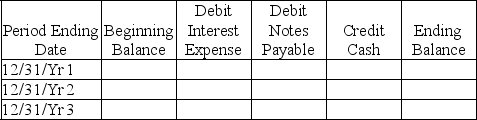 (2)Prepare the journal entries to record the purchase of the vans on January 1,Year 1 and the second annual installment payment on December 31,Year 2.
 (Essay)
4.7/5 (59)
(59) On January 1,a company issued a $500,000,10%,8-year bond payable,and received proceeds of $473,845.Interest is payable each June 30 and December 31.The company uses the straight-line method to amortize the discount.The amount of discount amortized each period is $1,634.69.
(True/False)
4.8/5 (84)
(84) ________ bonds are bonds that mature at more than one date,often in a series,and thus are usually repaid over a number of periods.
(Short Answer)
4.8/5 (76)
(76) An installment note is a liability of the issuing company that requires a series of payments to the lender.
(True/False)
4.9/5 (90)
(90) One of the similarities of bond and equity financing is that both dividends and equity distribution payments are tax deductible.
(True/False)
4.9/5 (88)
(88) ________ bonds have specific assets of the issuing company pledged as collateral.
(Short Answer)
4.9/5 (86)
(86) The contract rate on previously issued bonds changes as the market rate of interest changes.
(True/False)
4.7/5 (89)
(89) Callable bonds can be exchanged for a fixed number of shares of the issuing corporation's common stock.
(True/False)
4.9/5 (82)
(82) On January 1,a company issues 8%,5-year,$300,000 bonds that pay interest semiannually each June 30 and December 31.On the issue date,the annual market rate of interest is 6%.Compute the price of the bonds on their issue date.The following information is taken from present value tables:

(Essay)
4.8/5 (63)
(63) 
Filters
- Essay(0)
- Multiple Choice(0)
- Short Answer(0)
- True False(0)
- Matching(0)