



 Chat with AI
Exam 10: Accounting for Long-Term Liabilities

Exam 1: Accounting in Business285 Questions
Exam 2: Accounting for Business Transactions251 Questions
Exam 3: Adjusting Accounts for Financial Statements403 Questions
Exam 4: Accounting for Merchandising Operations252 Questions
Exam 5: Inventories and Cost of Sales238 Questions
Exam 6: Cash,fraud,and Internal Controls228 Questions
Exam 7: Accounting for Receivables219 Questions
Exam 8: Accounting for Long-Term Assets258 Questions
Exam 9: Accounting for Current Liabilities219 Questions
Exam 10: Accounting for Long-Term Liabilities231 Questions
Exam 11: Corporate Reporting and Analysis247 Questions
Exam 12: Reporting Cash Flows247 Questions
Exam 13: Analysis of Financial Statements245 Questions
Exam 14: Managerial Accounting Concepts and Principles252 Questions
Exam 15: Job Order Costing and Analysis215 Questions
Exam 16: Process Costing and Analysis225 Questions
Exam 17: Activity-Based Costing and Analysis223 Questions
Exam 18: Cost Behavior and Cost-Volume-Profit Analysis247 Questions
Exam 19: Variable Costing and Analysis202 Questions
Exam 20: Master Budgets and Performance Planning224 Questions
Exam 21: Flexible Budgets and Standard Costs223 Questions
Exam 22: Performance Measurement and Responsibility Accounting210 Questions
Exam 23: Relevant Costing for Managerial Decisions149 Questions
Exam 24: Capital Budgeting and Investment Analysis161 Questions
Exam 25: Time Value of Money84 Questions
Exam 26: Investments217 Questions
Exam 27: Lean Principles and Accounting30 Questions
Select questions type


On January 1,a company issues bonds dated January 1 with a par value of $400,000.The bonds mature in 5 years.The contract rate is 7%,and interest is paid semiannually on June 30 and December 31.The market rate is 8% and the bonds are sold for $383,793.
-The journal entry to record the first interest payment using straight-line amortization is:
(Multiple Choice)
4.9/5  (74)
(74) On January 1,Year 1 a company borrowed $70,000 cash by signing a 9% installment note that is to be repaid with 4 annual year-end payments of $21,607,the first of which is due on December 31,Year 1.
(a)Prepare the company's journal entry to record the note's issuance.
(b)Prepare the journal entries to record the first and second installment payments.
(Essay)
4.8/5 (81)
(81) A company borrowed cash from the bank by signing a 5-year,8% installment note.The present value for an annuity (series of payments)at 8% for 5 years is 3.9927.The present value of 1 (single sum)at 8% for 5 years is .6806.Each annual payment equals $75,000.The present value of the note is:
(Multiple Choice)
4.8/5 (81)
(81) Describe the recording procedures for the issuance,retirement,and payment of interest for installment notes.
(Essay)
4.9/5 (73)
(73) On January 1,Year 1,Stratton Company borrowed $100,000 on a 10-year,7% installment note payable.The terms of the note require Stratton to pay 10 equal payments of $14,238 each December 31 for 10 years.The required general journal entry to record the first payment on the note on December 31,Year 1 is:
(Multiple Choice)
4.8/5 (79)
(79) On January 1,Year 1 Cleaver Company borrowed $85,000 cash by signing a 7% installment note that is to be repaid with 4 annual year-end payments of $25,094,the first of which is due on December 31,Year 1.
(a)Prepare the company's journal entry to record the note's issuance.
(b)Prepare the journal entries to record the first installment payment.
(Essay)
4.7/5 (86)
(86) Two common ways of retiring bonds before maturity are to (1)exercise a call option or (2)purchase them on the open market.
(True/False)
4.8/5 (78)
(78) A company issued 10%,5-year bonds with a par value of $2,000,000,on January 1.Interest is to be paid semiannually each June 30 and December 31.The bonds were sold at $2,162,290 based on an annual market rate of 8%.The company uses the effective interest method of amortization.
(1)Prepare an amortization table for the first two semiannual payment periods using the format shown below.
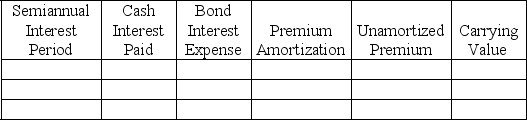 (2)Prepare the journal entry to record the first semiannual interest payment.
 (Essay)
4.7/5 (68)
(68) On January 1,Haymark Corporation signs a six-year lease for a truck that is accounted for as a finance lease.The lease requires six $15,252 lease payments (the first at the beginning of the lease and the rest at December 31 of years 1 through 5).The present value of the six annual lease payments,at 6% interest,is $79,500.The lease payment schedule follows.
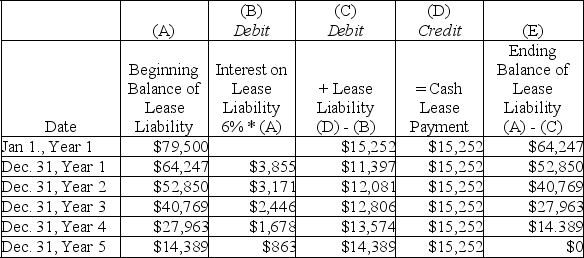 (a)Prepare the January 1 journal entry at the start of the lease to record any asset or liability.
(b)Prepare the January 1 journal entry to record the first $15,252 cash lease payment.
(b)Prepare the journal entry to record the cash lease payment at the end of Year 1 and the end of Year 2.
(c)Prepare the journal entry made at the end of each year to record straight-line amortization,assuming zero salvage value at the end of the six-year lease term.
(a)Prepare the January 1 journal entry at the start of the lease to record any asset or liability.
(b)Prepare the January 1 journal entry to record the first $15,252 cash lease payment.
(b)Prepare the journal entry to record the cash lease payment at the end of Year 1 and the end of Year 2.
(c)Prepare the journal entry made at the end of each year to record straight-line amortization,assuming zero salvage value at the end of the six-year lease term. (Essay)
4.8/5 (66)
(66) On July 1,Shady Creek Resort borrowed $250,000 cash by signing a 10-year,8% installment note requiring equal payments each June 30 of $37,258.What amount of interest expense will be included in the first annual payment?
(Multiple Choice)
4.8/5 (64)
(64) The equal total payments pattern for installment notes consists of changing amounts of interest but constant amounts of principal over the life of the note.
(True/False)
4.7/5 (76)
(76) The carrying value of a bond is computed as the face value minus any unamortized discount or plus any unamortized premium.
(True/False)
4.8/5 (82)
(82) The bonds' future cash flows include the par value paid at maturity and the interest payments.
(True/False)
4.9/5 (81)
(81) ________ bonds reduce a bondholder's risk by requiring the issuer to create a fund of assets set aside as specified amounts and dates to repay the bonds.
(Short Answer)
4.7/5 (68)
(68) What is a bond? Identify and discuss the different characteristics and features bonds may possess.
(Essay)
4.9/5 (77)
(77) The issue price of bonds is the ________ of the bonds' cash payments,discounted at the bonds' market rate.
(Short Answer)
4.8/5 (84)
(84) 
Filters
- Essay(0)
- Multiple Choice(0)
- Short Answer(0)
- True False(0)
- Matching(0)