



 Chat with AI
Exam 21: Electric Potential

Exam 1: Representing Motion113 Questions
Exam 2: Motion in One Dimension174 Questions
Exam 3: Vectors and Motion in Two Dimensions183 Questions
Exam 4: Forces and Newtons Laws of Motion64 Questions
Exam 5: Applying Newtons Laws82 Questions
Exam 6: Gravity96 Questions
Exam 7: Rotational Motion95 Questions
Exam 8: Equilibrium Ad Elasticity73 Questions
Exam 9: Momentum103 Questions
Exam 10: Energy and Work223 Questions
Exam 11: Using Energy106 Questions
Exam 12: Thermal Properties of Matter220 Questions
Exam 13: Fluids115 Questions
Exam 14: Oscillations105 Questions
Exam 15: Traveling Waves and Sound94 Questions
Exam 16: Superposition and Standing Waves66 Questions
Exam 17: Wave Optics129 Questions
Exam 18: Ray Optics155 Questions
Exam 19: Optical Instruments137 Questions
Exam 20: Electric Fields and Forces95 Questions
Exam 21: Electric Potential144 Questions
Exam 22: Current and Resistance125 Questions
Exam 23: Circuits157 Questions
Exam 24: Magnetic Fields and Forces168 Questions
Exam 25: EM Induction and Em Waves185 Questions
Exam 26: AC Electricity122 Questions
Exam 27: Relativity126 Questions
Exam 28: Quantum Physics86 Questions
Exam 29: Atoms and Molecules105 Questions
Exam 30: Nuclear Physics175 Questions
Select questions type


The three point charges shown in the figure form an equilateral triangle with sides 4.9 cm long. What is the electric potential (relative to infinity) at the point indicated with the dot, which is equidistant from all three charges? Assume that the numbers in the figure are all accurate to two significant figures. (k = 1/4πε0 = 9.0 × 10⁹ N ∙ m2/C2) 
(Multiple Choice)
4.8/5  (80)
(80) An ideal parallel-plate capacitor has a capacitance of C. If the area of the plates is doubled and the distance between the plates is halved, what is the new capacitance?
(Multiple Choice)
5.0/5 (88)
(88) The equipotential surfaces for two spherical conductors are shown in the figure, with the value of potential marked on the line for each surface.
(a) If the distance between points A and B is 2.5 cm what is the approximate intensity of the electric field between these two points?
(b) If the distance between points C and D is 2.5 cm what is the approximate intensity of the electric field between these two points? 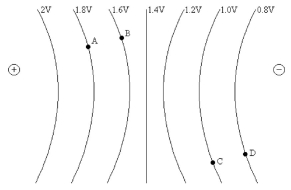
(Short Answer)
4.9/5 (84)
(84) A proton that is initially at rest is accelerated through an electric potential difference of magnitude 500 V. How much kinetic energy does it gain?
(e = 1.60 × 10⁻¹⁹ C)
(Multiple Choice)
4.8/5 (77)
(77) 
Filters
- Essay(0)
- Multiple Choice(0)
- Short Answer(0)
- True False(0)
- Matching(0)