



 Chat with AI
Exam 21: Electric Potential

Exam 1: Representing Motion113 Questions
Exam 2: Motion in One Dimension174 Questions
Exam 3: Vectors and Motion in Two Dimensions183 Questions
Exam 4: Forces and Newtons Laws of Motion64 Questions
Exam 5: Applying Newtons Laws82 Questions
Exam 6: Gravity96 Questions
Exam 7: Rotational Motion95 Questions
Exam 8: Equilibrium Ad Elasticity73 Questions
Exam 9: Momentum103 Questions
Exam 10: Energy and Work223 Questions
Exam 11: Using Energy106 Questions
Exam 12: Thermal Properties of Matter220 Questions
Exam 13: Fluids115 Questions
Exam 14: Oscillations105 Questions
Exam 15: Traveling Waves and Sound94 Questions
Exam 16: Superposition and Standing Waves66 Questions
Exam 17: Wave Optics129 Questions
Exam 18: Ray Optics155 Questions
Exam 19: Optical Instruments137 Questions
Exam 20: Electric Fields and Forces95 Questions
Exam 21: Electric Potential144 Questions
Exam 22: Current and Resistance125 Questions
Exam 23: Circuits157 Questions
Exam 24: Magnetic Fields and Forces168 Questions
Exam 25: EM Induction and Em Waves185 Questions
Exam 26: AC Electricity122 Questions
Exam 27: Relativity126 Questions
Exam 28: Quantum Physics86 Questions
Exam 29: Atoms and Molecules105 Questions
Exam 30: Nuclear Physics175 Questions
Select questions type


When a dielectric material is introduced between the plates of a parallel-plate capacitor and completely fills the space, the capacitance increases by a factor of 4. What is the dielectric constant of the material that was introduced?
(Multiple Choice)
4.8/5  (85)
(85) An ideal air-filled parallel-plate capacitor consists of two circular plates, each of radius How far apart should the plates be for the capacitance to be 300.0-pF? (ε0 = 8.85 × 10⁻¹² C2/N ∙ m2)
(Multiple Choice)
4.9/5 (80)
(80) A parallel-plate capacitor is connected to a battery and becomes fully charged. The capacitor is then disconnected, and the separation between the plates is increased in such a way that no charge leaks off. As the plates are being separated, the energy stored in this capacitor
(Multiple Choice)
4.8/5 (90)
(90) Four 2.0-µC point are at the corners of a rectangle with sides of length 3.0 cm and 4.0 cm. What is the electric potential (relative to infinity) at the midpoint of the rectangle? (k = 1/4πε0 = 9.0 × 10⁹ N ∙ m2/C2)
(Multiple Choice)
4.7/5 (82)
(82) A 4.0-g bead carries a charge of 20 μC. The bead is accelerated from rest through a potential difference V, and afterward the bead is moving at 2.0 m/s. What is the magnitude of the potential difference V?
(Multiple Choice)
4.7/5 (75)
(75) When a certain capacitor carries charges of ±10 µC on its plates, the potential difference cross the plates is 25 V. Which of the following statements about this capacitor are true? (There could be more than one correct choice.)
(Multiple Choice)
4.8/5 (75)
(75) As a proton moves in the direction the electric field lines
(Multiple Choice)
4.9/5 (93)
(93) Two 3.0 μC charges lie on the x-axis, one at the origin and the other at What is the potential (relative to infinity) due to these charges at a point at on the x-axis? (k = 1/4πε0 = 9.0 × 10⁹ N ∙ m2/C2)
(Multiple Choice)
4.9/5 (90)
(90) A +5.0-µC point charge is 12 cm from a -5.0-µC point charge. What is the magnitude of the electric field they produce at the point on the line connecting them where their electric potential (relative to infinity) is zero? (k = 1/4πε0 = 9.0 × 10⁹ N ∙ m2/C2)
(Multiple Choice)
4.9/5 (73)
(73) How much kinetic energy does a proton gain if it is accelerated, with no friction, through a potential difference of 1.00 V? The proton is 1836 times heavier than an electron, and e = 1.60 × 10⁻¹⁹ C.
(Multiple Choice)
4.9/5 (83)
(83) Two parallel plates that are initially uncharged are separated by 1.7 mm, have only air between them, and each have surface areas of 16 cm2. How much charge must be transferred from one plate to the other if 1.9 J of energy are to be stored in the plates? (ε0 = 8.85 × 10⁻¹² C2/N ∙ m2)
(Multiple Choice)
4.7/5 (75)
(75) When a 12.0-V battery causes 2.00 μC of charge to flow onto the plates of an air-filled capacitor, how much work did the battery do?
(Multiple Choice)
4.8/5 (62)
(62) When the magnitude of the charge on each plate of an air-filled capacitor is 4 μC, the potential difference between the plates is 80 V. What is the capacitance of this capacitor?
(Multiple Choice)
4.8/5 (93)
(93) A +4.0-μC and a -4.0-μC point charge are placed as shown in the figure. What is the potential difference between points A and B? (k = 1/4πε0 = 9.0 × 10⁹ N ∙ m2/C2) 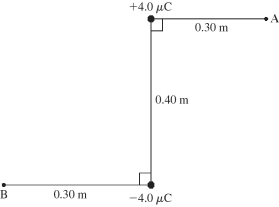
(Multiple Choice)
4.7/5 (83)
(83) Two large parallel plates are separated by 1.0 mm of air. If the potential difference between them is 3.0 V, what is the magnitude of their surface charge densities? (ε0 = 8.85 × 10⁻¹² C2/N ∙ m2)
(Multiple Choice)
4.8/5 (83)
(83) Two very small +3.00-μC charges are at the ends of a meter stick. Find the electric potential (relative to infinity) at the center of the meter stick.
(k = 1/4πε0 = 8.99 × 10⁹ N ∙ m2/C2)
(Multiple Choice)
4.8/5 (87)
(87) Two parallel circular plates, each with a radius of and carrying equal-magnitude surface charge densities of are separated by a distance of with only air between them. How much energy is stored in these plates? (ε0 = 8.85 × 10⁻¹² C2/N ∙ m2)
(Multiple Choice)
4.8/5 (84)
(84) An ideal air-filled parallel-plate capacitor consists of plates that are 1.0 mm apart and have an area of 1.5 × 10⁻⁴ m2. The capacitor is connected to a 12-V potential source (battery). (ε0 = 8.85 × 10⁻¹² C2/N ∙ m2)
(a) What is the capacitance of this capacitor?
(b) How much charge is on each of its plates?
(c) What is the strength of the electric field between the plates?
(Short Answer)
4.9/5 (72)
(72) A tiny particle with charge + 5.0 μC is initially moving at 55 m/s. It is then accelerated through a potential difference of 500 V. How much kinetic energy does this particle gain during the period of acceleration?
(Multiple Choice)
4.9/5 (85)
(85) Two ideal parallel-plate capacitors are identical in every respect except that one has twice the plate area of the other. If the smaller capacitor has capacitance C, the larger one has capacitance
(Multiple Choice)
5.0/5 (77)
(77) 
Filters
- Essay(0)
- Multiple Choice(0)
- Short Answer(0)
- True False(0)
- Matching(0)