



 Chat with AI
Exam 21: Electric Potential

Exam 1: Representing Motion113 Questions
Exam 2: Motion in One Dimension174 Questions
Exam 3: Vectors and Motion in Two Dimensions183 Questions
Exam 4: Forces and Newtons Laws of Motion64 Questions
Exam 5: Applying Newtons Laws82 Questions
Exam 6: Gravity96 Questions
Exam 7: Rotational Motion95 Questions
Exam 8: Equilibrium Ad Elasticity73 Questions
Exam 9: Momentum103 Questions
Exam 10: Energy and Work223 Questions
Exam 11: Using Energy106 Questions
Exam 12: Thermal Properties of Matter220 Questions
Exam 13: Fluids115 Questions
Exam 14: Oscillations105 Questions
Exam 15: Traveling Waves and Sound94 Questions
Exam 16: Superposition and Standing Waves66 Questions
Exam 17: Wave Optics129 Questions
Exam 18: Ray Optics155 Questions
Exam 19: Optical Instruments137 Questions
Exam 20: Electric Fields and Forces95 Questions
Exam 21: Electric Potential144 Questions
Exam 22: Current and Resistance125 Questions
Exam 23: Circuits157 Questions
Exam 24: Magnetic Fields and Forces168 Questions
Exam 25: EM Induction and Em Waves185 Questions
Exam 26: AC Electricity122 Questions
Exam 27: Relativity126 Questions
Exam 28: Quantum Physics86 Questions
Exam 29: Atoms and Molecules105 Questions
Exam 30: Nuclear Physics175 Questions
Select questions type


A small 4.0-µC charge and a small 1.5-µC charge are initially very far apart. How much work does it take to bring them to a final configuration in which the 4.0-µC charge is at the point x = 1.0 mm, y = 1.0 mm, and the 1.5-µC charge is at the point x = 1.0 mm, y = 3.0 mm?
(k = 1/4πε0 = 8.99 × 10⁹ N ∙ m2/C2)
(Multiple Choice)
4.8/5  (80)
(80) Each plate of an ideal air-filled parallel-plate capacitor has an area of 0.0010 , and the separation of the plates is An electric field of is present between the plates. What is the capacitance of this capacitor? (ε0 = 8.85 × 10⁻¹² C2/N ∙ m2)
(Multiple Choice)
4.8/5 (86)
(86) When the potential difference between the plates of an ideal air-filled parallel plate capacitor is 35 V, the electric field between the plates has a strength of 750 V/m. If the plate area is 4.0 × 10⁻² m2, what is the capacitance of this capacitor? (ε0 = 8.85 × 10⁻¹² C2/N ∙ m2)
(Multiple Choice)
4.9/5 (76)
(76) A proton is accelerated from rest through a potential difference V0 and gains a speed v0. If it were accelerated instead through a potential difference of 2V0, what speed would it gain?
(Multiple Choice)
4.8/5 (75)
(75) Measurements show that it takes 0.30 mJ of work to move 5.0-μC of charge from one plate to another of a certain air-filled capacitor while the potential difference between these plates is kept constant. What is the potential difference between the plates of this capacitor?
(Multiple Choice)
4.8/5 (77)
(77) Doubling the capacitance of a capacitor that is holding a constant charge causes the energy stored in that capacitor to
(Multiple Choice)
4.8/5 (77)
(77) After a proton with an initial speed of 1.50 × 10⁵ m/s has increased its speed by accelerating through a potential difference of 0.100 kV, what is its final speed?
(e = 1.60 × 10⁻¹⁹ C , mproton = 1.67 × 10⁻²⁷ kg)
(Multiple Choice)
4.9/5 (63)
(63) A +3.0-µC point charge is initially extremely far from a positive point charge Q. You find that it takes 41 J of work to bring the +3.0-µC charge to the point x = 3.0 mm, y = 0.0 mm and the point charge Q to the point x = -3.0 mm, y = 0.00 mm. What is Q? (k = …)
(Multiple Choice)
4.9/5 (79)
(79) If the electric field between the plates of a given air-filled capacitor is weakened by removing charge from the plates, the capacitance of that capacitor
(Multiple Choice)
4.8/5 (79)
(79) The plates of a parallel-plate capacitor are maintained with constant potential by a battery as they are pulled apart. During this process, the amount of charge on the plates
(Multiple Choice)
4.9/5 (83)
(83) A point charge of +3.00 μC and a second charge Q are initially very far apart. If it takes of work to bring them to a final configuration in which the charge is at the point x = 1.00 mm, y = 1.00 mm, and the second charge Q is at the point x = 1.00 mm, y = 3.00 mm, find the magnitude of the charge Q. (k = 1/4πε0 = 8.99 × 10⁹ N ∙ m2/C2)
(Multiple Choice)
4.9/5 (81)
(81) The figure shows a group of three particles, all of which have charge Q = 8.8 nC. How much work did it take to assemble this group of charges if they all started out extremely far from each other? (k = 1/4πε0 = 9.0 × 10⁹ N ∙ m2/C2) 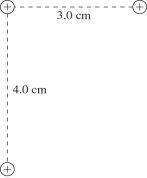
(Multiple Choice)
4.9/5 (87)
(87) An ideal parallel-plate capacitor consists of two parallel plates of area A separated by a distance d. This capacitor is connected to a battery and charged until its plates carry charges +Q and -Q, and the battery is then disconnected. If the separation between the plates is now doubled, the electrical energy stored in the capacitor will
(Multiple Choice)
4.9/5 (84)
(84) At a distance d from a point charge Q, the energy density in its electric field is u. If we now go to a distance d/2 from the charge, what is the energy density at the new location?
(Multiple Choice)
4.9/5 (83)
(83) At a distance d from a point charge Q, the energy density in its electric field is u. If we double the charge, what is the energy density at the same point?
(Multiple Choice)
4.8/5 (84)
(84) Three point charges are placed at the following points in a horizontal x-y plane: is at is at and is at Calculate the electrical potential (relative to infinity) at the origin due to these three point charges. (k = 1/4πε0 = 9.0 × 10⁹ N ∙ m2/C2)
(Short Answer)
4.9/5 (87)
(87) What the electric energy density at a point 1.0 cm from a proton? (e = 1.6 × 10⁻¹⁹ C, ε0 = 8.85 × 10⁻¹² C2/N ∙ m2, k = 1/4πε0 = 9.0 × 10⁹ N ∙ m2/C2)
(Short Answer)
4.9/5 (81)
(81) A 12.0-V battery (potential source) is connected across a 6.00-µF air-filled capacitor.
(a) How much energy can be stored this way?
(b) How much excess charge is on each plate of the capacitor?
(Short Answer)
4.9/5 (78)
(78) The potential difference between two square parallel plates is 4.00 V. If the plate separation is 6.00 cm and they each measure 1.5 m by 1.5 m, what is the magnitude of the electric field between the plates?
(Short Answer)
4.9/5 (84)
(84) The figure shows an arrangement of two particles each having charge Q = -6.8 nC and each separated by 5.0 mm from a proton.If the two particles are held fixed at their locations and the proton is set into motion as shown, what is the minimum speed the proton needs to totally escape from these particles? (mproton = 1.67 × 10⁻²⁷ kg, e = 1.60 × 10⁻¹⁹ C, k = 1/4πε0 = 9.0 × 10⁹ N ∙ m2/C2) 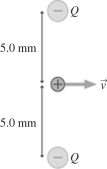
(Multiple Choice)
4.9/5 (81)
(81) 
Filters
- Essay(0)
- Multiple Choice(0)
- Short Answer(0)
- True False(0)
- Matching(0)