



 Chat with AI
Exam 21: Electric Potential

Exam 1: Representing Motion113 Questions
Exam 2: Motion in One Dimension174 Questions
Exam 3: Vectors and Motion in Two Dimensions183 Questions
Exam 4: Forces and Newtons Laws of Motion64 Questions
Exam 5: Applying Newtons Laws82 Questions
Exam 6: Gravity96 Questions
Exam 7: Rotational Motion95 Questions
Exam 8: Equilibrium Ad Elasticity73 Questions
Exam 9: Momentum103 Questions
Exam 10: Energy and Work223 Questions
Exam 11: Using Energy106 Questions
Exam 12: Thermal Properties of Matter220 Questions
Exam 13: Fluids115 Questions
Exam 14: Oscillations105 Questions
Exam 15: Traveling Waves and Sound94 Questions
Exam 16: Superposition and Standing Waves66 Questions
Exam 17: Wave Optics129 Questions
Exam 18: Ray Optics155 Questions
Exam 19: Optical Instruments137 Questions
Exam 20: Electric Fields and Forces95 Questions
Exam 21: Electric Potential144 Questions
Exam 22: Current and Resistance125 Questions
Exam 23: Circuits157 Questions
Exam 24: Magnetic Fields and Forces168 Questions
Exam 25: EM Induction and Em Waves185 Questions
Exam 26: AC Electricity122 Questions
Exam 27: Relativity126 Questions
Exam 28: Quantum Physics86 Questions
Exam 29: Atoms and Molecules105 Questions
Exam 30: Nuclear Physics175 Questions
Select questions type


A battery maintains the electrical potential difference of 6.0-V between two large parallel metal plates separated by 1.0 mm. What is the strength of the electric field between the plates?
(Multiple Choice)
4.9/5  (82)
(82) The potential (relative to infinity) at the midpoint of a square is 3.0 V when a point charge of +Q is located at one of the corners of the square. What is the potential (relative to infinity) at the center when each of the other corners is also contains a point charge of +Q?
(Multiple Choice)
4.8/5 (73)
(73) A 5.0 μF capacitor has a potential difference of applied across its plates. If the potential difference across its plates is increased to how much additional energy does the capacitor store?
(Multiple Choice)
4.9/5 (65)
(65) A parallel-plate capacitor consists of two parallel, square plates having dimensions 1.0 cm by 1.0 cm. The plates are separated by and the space between them is filled with Teflon, which has a dielectric constant of 2.1. What is the capacitance of this capacitor? (ε0 = 8.85 × 10⁻¹² C2/N ∙ m2)
(Multiple Choice)
5.0/5 (83)
(83) A parallel-plate air-filled capacitor is made from two plates that are 0.070 m on each side and spaced 9.2 mm apart. What must the potential difference between the plates be to produce an energy density of in the region between them? (ε0 = 8.85 × 10⁻¹² C2/N ∙ m2)
(Short Answer)
4.8/5 (83)
(83) A dielectric material such as paper is inserted between the plates of a capacitor as the capacitor holds a fixed charge on its plates. What happens to the electric field between the plates as the dielectric is inserted?
(Multiple Choice)
4.7/5 (69)
(69) An air-filled capacitor carries enough charge to store of potential energy. It is then accidentally filled with water in such a way as not to discharge its plates. How much energy does it continue to store after it is filled? The dielectric constant for water is 78 and for air it is 1.0006.
(Multiple Choice)
4.9/5 (84)
(84) In the figure, +4.0-μC and -4.0-μC point charges are located as shown. Now an additional +2.00-µC point charge is placed at point A. What is the electric potential energy of this system of three charges, relative to infinity? (k = 1/4πε0 = 8.99 × 10⁹ N ∙ m2/C2) 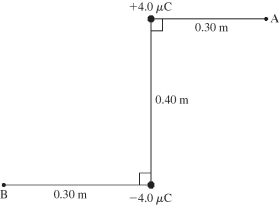
(Multiple Choice)
4.9/5 (87)
(87) A proton and an electron are released from rest, with only the electrostatic force acting. Which of the following statements must be true about them as they move toward each other? (There could be more than one correct choice.)
(Multiple Choice)
4.7/5 (70)
(70) Two tiny grains of sand having charges of 4.0 μC and -4.0 μC are situated along the x-axis at x1 = 2.0 m and x2 = -2.0 m. What is electric potential energy of these grains relative to infinity? (k = 1/4πε0 = 9.0 × 10⁹ N ∙ m2/C2)
(Multiple Choice)
4.8/5 (80)
(80) If the electric potential at a point in space is zero, then the electric field at that point must be
(Multiple Choice)
4.7/5 (77)
(77) A parallel-plate capacitor with plate separation of 4.0 cm has a plate area of 6.0 × .What is the capacitance of this capacitor if a dielectric material with a dielectric constant of 2.4 is placed between the plates, completely filling the space? (ε0 = 8.85 × 10⁻¹² C2/N ∙ m2)
(Multiple Choice)
5.0/5 (76)
(76) Two point charges of +2.00 μC and +4.00 μC are at the origin and at the point x = 0.000 m, y = -0.300 m, as shown in the figure. What is the electric potential due to these charges, relative to infinity, at the point P at x = 0.400 m on the x-axis? (k = 1/4πε0 = 8.99 × 10⁹ N ∙ m2/C2) 
(Multiple Choice)
4.8/5 (89)
(89) If the result of your calculations for a quantity has SI units of C2 ∙ s2/(kg ∙ m2), that quantity could be
(Multiple Choice)
4.8/5 (81)
(81) A 7.0-μC point charge and a point charge are initially extremely far apart. How much work does it take to bring the point charge to the point , and the point charge to the point (k = 1/4πε0 = 9.0 × 10⁹ N ∙ m2/C2)
(Multiple Choice)
4.9/5 (81)
(81) A 6.0-μF air-filled capacitor is connected across a 100-V potential source (a battery). After the battery fully charges the capacitor, it is left connected and the capacitor is immersed in transformer oil, which has a dielectric constant of 4.5. How much additional charge flows from the battery onto the capacitor during this process?
(Multiple Choice)
4.8/5 (74)
(74) How much work is needed to carry an electron from the positive terminal to the negative terminal of a 9.0-V battery. (e = 1.60 × 10⁻¹⁹ C , melectron = 9.11 × 10⁻³¹ kg)
(Multiple Choice)
4.9/5 (67)
(67) Doubling the potential across a given capacitor causes the energy stored in that capacitor to
(Multiple Choice)
4.8/5 (71)
(71) A spherical oil droplet with nine excess electrons is held stationary in an electric field between two large horizontal plates that are 2.25 cm apart. The field is produced by maintaining a potential difference of 0.3375 kV across the plates, and the density of the oil is 824 kg/m3. What is the radius of the oil drop?
(e = 1.60 × 10⁻¹⁹ C)
(Short Answer)
4.9/5 (80)
(80) Four charged particles (two having a charge +Q and two having a charge -Q) are arranged in the xy-plane as shown in the figure. The charges are all equidistant from the origin. The amount of work required to move a positively charged particle from point P to point O (both of which are on the z-axis) is 
(Multiple Choice)
4.7/5 (88)
(88) 
Filters
- Essay(0)
- Multiple Choice(0)
- Short Answer(0)
- True False(0)
- Matching(0)