



 Chat with AI
Exam 5: Economic Efficiency , Government Price Setting and Taxes

Exam 1: Economics Foundations and Models160 Questions
Exam 2: Choices and Trade - Offs in the Market192 Questions
Exam 3: Where Prices Come Frome : The Interaction of Demand and Supply202 Questions
Exam 4: Elasticity: The Responsiveness of Demand and Supply226 Questions
Exam 5: Economic Efficiency , Government Price Setting and Taxes187 Questions
Exam 6: Concumer Choice and Behavioural Economics254 Questions
Exam 7: Technology , Production and Costs300 Questions
Exam 8: Firms in Perfectly Compitive Markets270 Questions
Exam 9: Monopoly Markets281 Questions
Exam 10: Monopolistic Competition : The Competitive Model in More Realistic Setting255 Questions
Exam 11: Oligopoly : Firms in Less Competitve Markets186 Questions
Exam 12: The Market for Labour and Other Factors of Production253 Questions
Exam 13: International Trade111 Questions
Exam 14: Government Intervention in the Market122 Questions
Exam 15: Externalities , Environmental Policy and Public Goods212 Questions
Exam 16: The Distribution of Income and Social Policy120 Questions
Select questions type


Marginal benefit is equal to the ________ benefit a consumer receives from consuming one more unit of a good or service.
(Multiple Choice)
4.7/5  (79)
(79)  -Refer to Figure 5-4. The figure above represents the market for pecans. Assume that this is a competitive market. At a price of $9,
 (Multiple Choice)
4.8/5 (76)
(76) In a city with rent-controlled apartments, all of the following are true except
(Multiple Choice)
4.8/5 (93)
(93) Assume the market price for lemon grass is $4.00 per pound, but most buyers are willing to pay more than the market price. At the market price of $4.00, the quantity of lemon grass demanded is 1500 pounds per month, and quantity demanded does not reach zero until the price reaches $30.00 per pound. Construct a graph showing this data, calculate the total consumer surplus in the market for lemon grass, and show the consumer surplus on the graph.
(Short Answer)
4.8/5 (74)
(74)
-Refer to Table 5-4. Suppose that the quantity of labour demanded increases by 40 000 at each wage level. What are the new free market equilibrium hourly wage and the new equilibrium quantity of labour?
(Multiple Choice)
4.8/5 (80)
(80)  -Refer to Figure 5-1. If the market price is $1.50, what is the consumer surplus on the first burrito?
 (Multiple Choice)
5.0/5 (79)
(79) 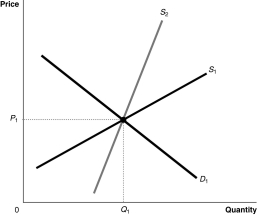 -Refer to Figure 5-8. Suppose the market is initially in equilibrium at price P1 and now the government imposes a tax on every unit sold. Which of the following statements best describes the impact of the tax? For demand curve D1
 (Multiple Choice)
4.7/5 (76)
(76)
-Refer to Table 5-1. The table above lists the highest prices three consumers, Tom, Dick and Harriet, are willing to pay for a short-sleeved polo shirt. If the price of the shirts falls from $28 to $20,
(Multiple Choice)
4.8/5 (87)
(87)
-Refer to Figure 5-1. Arnold's marginal benefit from consuming the fourth burrito is
-Refer to Figure 5-1. Arnold's marginal benefit from consuming the fourth burrito is (Multiple Choice)
4.8/5 (78)
(78)
-Refer to Table 5-3. The table above lists the marginal cost of cowboy hats by The Waco Kid, a firm that specialises in producing fancy dress costumes. If the market price of cowboy hats is $50, how many hats will be produced?
(Multiple Choice)
5.0/5 (75)
(75) What is marginal benefit? Which curve is also referred to as a marginal benefit curve?
(Essay)
4.7/5 (79)
(79)
-Refer to Figure 5-4. The figure above represents the market for pecans. Assume that this is a competitive market. If the price of pecans is $9, what changes in the market would result in an economically efficient output?
-Refer to Figure 5-4. The figure above represents the market for pecans. Assume that this is a competitive market. If the price of pecans is $9, what changes in the market would result in an economically efficient output? (Multiple Choice)
4.7/5 (84)
(84)  -Refer to Figure 5-3. What is the value of producer surplus at a price of $18?
 (Multiple Choice)
4.9/5 (88)
(88)
-Refer to Figure 5-3. What is the value of producer surplus at the equilibrium price of $15?
-Refer to Figure 5-3. What is the value of producer surplus at the equilibrium price of $15? (Multiple Choice)
4.9/5 (83)
(83) 
Filters
- Essay(0)
- Multiple Choice(0)
- Short Answer(0)
- True False(0)
- Matching(0)