



 Chat with AI
Exam 5: Economic Efficiency , Government Price Setting and Taxes

Exam 1: Economics Foundations and Models160 Questions
Exam 2: Choices and Trade - Offs in the Market192 Questions
Exam 3: Where Prices Come Frome : The Interaction of Demand and Supply202 Questions
Exam 4: Elasticity: The Responsiveness of Demand and Supply226 Questions
Exam 5: Economic Efficiency , Government Price Setting and Taxes187 Questions
Exam 6: Concumer Choice and Behavioural Economics254 Questions
Exam 7: Technology , Production and Costs300 Questions
Exam 8: Firms in Perfectly Compitive Markets270 Questions
Exam 9: Monopoly Markets281 Questions
Exam 10: Monopolistic Competition : The Competitive Model in More Realistic Setting255 Questions
Exam 11: Oligopoly : Firms in Less Competitve Markets186 Questions
Exam 12: The Market for Labour and Other Factors of Production253 Questions
Exam 13: International Trade111 Questions
Exam 14: Government Intervention in the Market122 Questions
Exam 15: Externalities , Environmental Policy and Public Goods212 Questions
Exam 16: The Distribution of Income and Social Policy120 Questions
Select questions type


Suppose an excise tax of $1 is imposed on every case of beer sold, and sellers are responsible for paying this tax. How would the imposition of the tax be illustrated in a graph?
(Multiple Choice)
5.0/5  (82)
(82) The division of the burden of a tax between buyers and sellers in a market is called tax allocation.
(True/False)
4.8/5 (79)
(79)  -Refer to Figure 5-5. What is the value of the deadweight loss after the imposition of the ceiling?
 (Multiple Choice)
4.8/5 (78)
(78) A price ceiling is a legally determined maximum price that sellers may charge.
(True/False)
5.0/5 (71)
(71) Which of the following is not a result of imposing a rent ceiling?
(Multiple Choice)
4.7/5 (91)
(91) 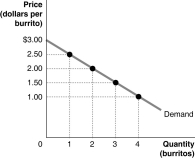 -Refer to Figure 5-1. If the market price is $3.00, what is the maximum number of burritos that Arnold will buy?
 (Multiple Choice)
4.9/5 (73)
(73) The incidence of a tax depends on whether the government collects the tax from buyers or sellers.
(True/False)
4.9/5 (73)
(73) If marginal benefit is greater than marginal cost, output is inefficiently high.
(True/False)
5.0/5 (86)
(86) The actual division of the burden of a tax between buyers and sellers in a market is called
(Multiple Choice)
4.9/5 (74)
(74)
-Refer to Table 5-4. Suppose that the quantity of labour supplied increases by 40 000 at each wage level. What are the new free market equilibrium hourly wage and the new equilibrium quantity of labour?
(Multiple Choice)
4.8/5 (80)
(80)
-Refer to Table 5-2. The table above lists the highest prices five consumers are willing to pay for a theatre ticket. If the price of one of the tickets is $18,
(Multiple Choice)
4.8/5 (76)
(76) If the demand curve for a product is vertical, any tax increase on the product is paid for entirely by the consumer.
(True/False)
4.8/5 (76)
(76)
-Refer to Table 5-2. The table above lists the highest prices five consumers are willing to pay for a theatre ticket. If the price of one ticket is $25,
(Multiple Choice)
4.8/5 (69)
(69)
-Refer to Table 5-4. If a minimum wage of $12.50 an hour is mandated, what is the quantity of labour supplied?
(Multiple Choice)
4.9/5 (74)
(74) 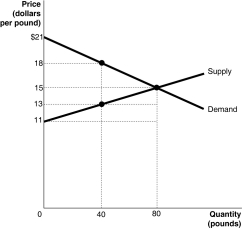 -Refer to Figure 5-3. At the equilibrium price of $15, consumers are willing to buy 80 pounds of tiger shrimp. Is this an economically efficient quantity?
 (Multiple Choice)
4.9/5 (80)
(80) 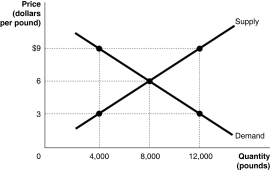 -Refer to Figure 5-4. The figure above represents the market for pecans. Assume that this is a competitive market. If 4000 pounds of pecans are sold,
 (Multiple Choice)
4.8/5 (74)
(74) Economists are reluctant to state that price controls are desirable or undesirable because
(Multiple Choice)
4.8/5 (105)
(105) In cities with rent controls, the actual rents paid can be higher than the legal maximum. One explanation for this is
(Multiple Choice)
5.0/5 (78)
(78) 
Filters
- Essay(0)
- Multiple Choice(0)
- Short Answer(0)
- True False(0)
- Matching(0)