



 Chat with AI
Exam 16: Mixtures

Exam 1: Patterns of Motion and Equilibrium94 Questions
Exam 2: Newtons Laws of Motion109 Questions
Exam 3: Momentum and Energy128 Questions
Exam 4: Gravity, Projectiles, and Satellites114 Questions
Exam 5: Fluid Mechanics120 Questions
Exam 6: Thermal Energy and Thermodynamics100 Questions
Exam 7: Heat Transfer and Change of Phase115 Questions
Exam 8: Static and Current Electricity144 Questions
Exam 9: Magnetism and Electromagnetic Induction105 Questions
Exam 10: Waves and Sound120 Questions
Exam 11: Light146 Questions
Exam 12: Atoms and the Periodic Table128 Questions
Exam 13: The Atomic Nucleus and Radioactivity124 Questions
Exam 14: Elements of Chemistry49 Questions
Exam 15: How Atoms Bond and Molecules Attract150 Questions
Exam 16: Mixtures141 Questions
Exam 17: How Chemicals React118 Questions
Exam 18: Two Classes of Chemical Reactions182 Questions
Exam 19: Organic Compounds98 Questions
Exam 20: Rocks and Minerals170 Questions
Exam 21: Plate Tectonics and Earths Interior175 Questions
Exam 22: Shaping Earths Surface175 Questions
Exam 23: Geologic Timereading the Rock Record145 Questions
Exam 24: The Oceans, Atmosphere, and Climatic Effects172 Questions
Exam 25: Driving Forces of Weather145 Questions
Exam 26: The Solar System87 Questions
Exam 27: Stars and Galaxies84 Questions
Exam 28: The Structure of Space and Time55 Questions
Exam 29: Prologue: the Nature of Science22 Questions
Select questions type


Why can't the elements of a compound be separated from one another by physical means?
(Multiple Choice)
4.9/5  (86)
(86) How would you classify the following material? a cappuccino (with foam)
(Multiple Choice)
4.9/5 (80)
(80) Cells at the top of a tree have a higher concentration of sugars than cells at the bottom. How might this fact assist a tree in moving water upward from its roots?
(Multiple Choice)
4.9/5 (76)
(76) A student is told to use 20.0 grams of sodium chloride to make an aqueous solution that has a concentration of 10.0 grams of sodium chloride per liter of solution. Assuming that 20.0 grams of sodium chloride has a volume of 7.5 milliliters, about how much water will she use in making this solution?
(Multiple Choice)
4.9/5 (81)
(81) If you were to increase the pressure of a gas above a liquid (such as by pressing a piston above a liquid)what happens?
(Multiple Choice)
4.8/5 (66)
(66) Which of the following statements describes a saturated solution?
(Multiple Choice)
4.9/5 (92)
(92) What is the molarity when water is added to 2 moles of sodium chloride to make 0.5 liter of solution?
(Multiple Choice)
4.9/5 (78)
(78) How many grams of sodium chloride are needed to make 15 L of a solution that has a concentration of 3.0 g per liter of solution?
(Multiple Choice)
5.0/5 (70)
(70) If the solubility of a compound is 30 grams per liter, how much solid is left undissolved if you mix 30 g of the compound in 0.33 L of solution?
(Multiple Choice)
4.9/5 (77)
(77) What happens when the molecule-to-molecule attractions in the solute are comparable to those in the solvent?
(Multiple Choice)
4.9/5 (66)
(66) Mixtures can be separated into their components by taking advantage of differences in the chemical properties of the components. Why might this separation method be less convenient than taking advantage of differences in the physical properties of the components?
(Multiple Choice)
4.7/5 (89)
(89) Why are there few odors emanating from a properly managed composting toilet?
(Multiple Choice)
4.9/5 (80)
(80) Which of the following statements best describes what is happening in a water softening unit?
(Multiple Choice)
4.9/5 (78)
(78) Deuterium oxide, D2O, and water, H2O, have the same chemical structure and differ only in that D2O possesses the deuterium isotope of hydrogen, whereas water possesses the protium isotope. Deuterium oxide, also known as "heavy water," is 11 percent heavier than water. Might you expect its boiling temperature also to be about 11 percent greater? Why or why not?
(Multiple Choice)
4.8/5 (88)
(88) Which of the following boxes represents a suspension? 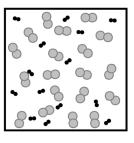
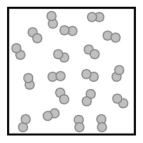
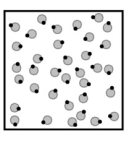 A B C
A B C (Multiple Choice)
4.8/5 (85)
(85) How many molecules of sucrose are in a 0.5 moles of sucrose?
(Multiple Choice)
4.8/5 (92)
(92) Why do red blood cells, which contain an aqueous solution of dissolved ions and minerals, burst when placed in fresh water?
(Multiple Choice)
4.9/5 (74)
(74) 
Filters
- Essay(0)
- Multiple Choice(0)
- Short Answer(0)
- True False(0)
- Matching(0)