



 Chat with AI
Exam 16: Mixtures

Exam 1: Patterns of Motion and Equilibrium94 Questions
Exam 2: Newtons Laws of Motion109 Questions
Exam 3: Momentum and Energy128 Questions
Exam 4: Gravity, Projectiles, and Satellites114 Questions
Exam 5: Fluid Mechanics120 Questions
Exam 6: Thermal Energy and Thermodynamics100 Questions
Exam 7: Heat Transfer and Change of Phase115 Questions
Exam 8: Static and Current Electricity144 Questions
Exam 9: Magnetism and Electromagnetic Induction105 Questions
Exam 10: Waves and Sound120 Questions
Exam 11: Light146 Questions
Exam 12: Atoms and the Periodic Table128 Questions
Exam 13: The Atomic Nucleus and Radioactivity124 Questions
Exam 14: Elements of Chemistry49 Questions
Exam 15: How Atoms Bond and Molecules Attract150 Questions
Exam 16: Mixtures141 Questions
Exam 17: How Chemicals React118 Questions
Exam 18: Two Classes of Chemical Reactions182 Questions
Exam 19: Organic Compounds98 Questions
Exam 20: Rocks and Minerals170 Questions
Exam 21: Plate Tectonics and Earths Interior175 Questions
Exam 22: Shaping Earths Surface175 Questions
Exam 23: Geologic Timereading the Rock Record145 Questions
Exam 24: The Oceans, Atmosphere, and Climatic Effects172 Questions
Exam 25: Driving Forces of Weather145 Questions
Exam 26: The Solar System87 Questions
Exam 27: Stars and Galaxies84 Questions
Exam 28: The Structure of Space and Time55 Questions
Exam 29: Prologue: the Nature of Science22 Questions
Select questions type


Each circle represents an atom. Which of the following boxes contains an element? A compound? A mixture? 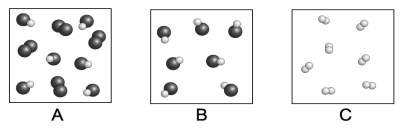
(Multiple Choice)
4.8/5  (79)
(79) A sample of water that is 99.9999 percent pure contains 0.0001 percent impurities. Consider from Chapter 1 that a glass of water contains on the order of a trillion trillion (1 × 1024)molecules. If 0.0001 percent of these molecules were the molecules of some impurity, about how many impurity molecules would this be?
(Multiple Choice)
4.8/5 (87)
(87) Classify the following as element, compound, or mixture, and justify your classifications: table salt, stainless steel, table sugar, aluminum, ice.
(Multiple Choice)
4.9/5 (74)
(74) How is most of the energy required for secondary waste water treatment consumed?
(Multiple Choice)
4.8/5 (72)
(72) Which of the following picture might best describe a soap or detergent? 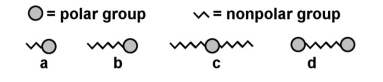
(Multiple Choice)
4.8/5 (72)
(72) Why might softened water not be good for some one who is trying to reduce their dietary sodium ion intake?
(Multiple Choice)
4.7/5 (89)
(89) What makes a semipermeable membrane selective for one chemical species but not another?
(Multiple Choice)
4.9/5 (73)
(73) When blue food coloring is stirred into water, the result is a ________.
(Multiple Choice)
4.8/5 (81)
(81) Based on atomic size, which would you expect to be more soluble in water: helium, He, or nitrogen, N2?
(Multiple Choice)
4.8/5 (85)
(85) How does the purchase and use of a home beverage carbonator help to minimize carbon dioxide emissions?
(Multiple Choice)
4.8/5 (73)
(73) A combination of two or more substances in which they no longer retain their chemical properties is called a(n)________.
(Multiple Choice)
4.8/5 (79)
(79) If the solubility of a compound is 72 grams per liter, how many grams of the compound will dissolve in 0.50 liters?
(Multiple Choice)
4.9/5 (79)
(79) Why might sodium carbonate (washing soda, Na2CO3)be added to hard water to aid in cleaning?
(Multiple Choice)
4.8/5 (80)
(80) Allowing water to cascade or bubble in a fountain during the purification process is an example of ________.
(Multiple Choice)
4.9/5 (91)
(91) Where does most of the solid mass of raw sewage end up after being collected at a treatment facility?
(Multiple Choice)
4.8/5 (79)
(79) Which solute graphed above has a solubility in water that does not markedly increase with increasing temperature?
(Multiple Choice)
4.9/5 (83)
(83) 
Filters
- Essay(0)
- Multiple Choice(0)
- Short Answer(0)
- True False(0)
- Matching(0)