



 Chat with AI
Exam 12: Atoms and the Periodic Table

Exam 1: Patterns of Motion and Equilibrium94 Questions
Exam 2: Newtons Laws of Motion109 Questions
Exam 3: Momentum and Energy128 Questions
Exam 4: Gravity, Projectiles, and Satellites114 Questions
Exam 5: Fluid Mechanics120 Questions
Exam 6: Thermal Energy and Thermodynamics100 Questions
Exam 7: Heat Transfer and Change of Phase115 Questions
Exam 8: Static and Current Electricity144 Questions
Exam 9: Magnetism and Electromagnetic Induction105 Questions
Exam 10: Waves and Sound120 Questions
Exam 11: Light146 Questions
Exam 12: Atoms and the Periodic Table128 Questions
Exam 13: The Atomic Nucleus and Radioactivity124 Questions
Exam 14: Elements of Chemistry49 Questions
Exam 15: How Atoms Bond and Molecules Attract150 Questions
Exam 16: Mixtures141 Questions
Exam 17: How Chemicals React118 Questions
Exam 18: Two Classes of Chemical Reactions182 Questions
Exam 19: Organic Compounds98 Questions
Exam 20: Rocks and Minerals170 Questions
Exam 21: Plate Tectonics and Earths Interior175 Questions
Exam 22: Shaping Earths Surface175 Questions
Exam 23: Geologic Timereading the Rock Record145 Questions
Exam 24: The Oceans, Atmosphere, and Climatic Effects172 Questions
Exam 25: Driving Forces of Weather145 Questions
Exam 26: The Solar System87 Questions
Exam 27: Stars and Galaxies84 Questions
Exam 28: The Structure of Space and Time55 Questions
Exam 29: Prologue: the Nature of Science22 Questions
Select questions type


Suppose that a certain atom possesses only four distinct energy levels. Assuming that all transitions between levels are possible, how many spectral lines will this atom exhibit? 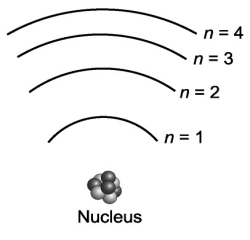
(Multiple Choice)
4.8/5  (90)
(90) If an atom has 43 electrons, 56 neutrons, and 43 protons, what is its approximate atomic mass? What is the name of this element?
(Multiple Choice)
4.8/5 (89)
(89) The nucleus of an electrically neutral iron atom contains 26 protons. How many electrons does this iron atom have?
(Multiple Choice)
4.9/5 (93)
(93) How can a hydrogen atom, which has only one electron, have so many spectral lines?
(Multiple Choice)
4.9/5 (86)
(86) Which of the following physical properties would you expect for krypton (Kr)?
(Multiple Choice)
4.9/5 (83)
(83) Which of these does not describe a metal at room temperature?
(Multiple Choice)
4.9/5 (82)
(82) Would you use a physical model or a conceptual model to describe the following: a gold coin, dollar bill, car engine, air pollution, virus, spread of sexually transmitted disease?
(Multiple Choice)
4.8/5 (79)
(79) Which of the following statements does not describe a proton?
(Multiple Choice)
4.7/5 (77)
(77) What happens to the properties of elements across any period of the periodic table?
(Multiple Choice)
4.8/5 (86)
(86) Oxygen, O, (number 8), sulfur, S, (number 16), and selenium, Se, (number 34)have such similar chemical properties because
(Multiple Choice)
4.9/5 (83)
(83) Helium, He, is a nonmetallic gas and the second element in the periodic table. Rather than being placed adjacent to hydrogen, H, however, helium is placed on the far right of the table because
(Multiple Choice)
4.9/5 (71)
(71) If a neutral element has 8 neutrons and 7 electrons, which expression correctly identifies the element?
(Multiple Choice)
4.8/5 (91)
(91) The following statement describes which subatomic particle best? It is a nucleon.
(Multiple Choice)
4.8/5 (70)
(70) What is the relationship between the light emitted by an atom and the energies of the electrons in the atom?
(Multiple Choice)
4.7/5 (74)
(74) Which of the following could be represented by a physical model?
(Multiple Choice)
4.9/5 (99)
(99) Light is emitted as an electron transitions from a higher energy state to a lower energy state. How long does it take for the actual transition to take place?
(Multiple Choice)
4.9/5 (74)
(74) Which of the following images could describe an element at the atomic level?
(Multiple Choice)
4.8/5 (80)
(80) What do the electron configurations for all the group 18 noble gases have in common?
(Multiple Choice)
4.9/5 (72)
(72) 
Filters
- Essay(0)
- Multiple Choice(0)
- Short Answer(0)
- True False(0)
- Matching(0)