



 Chat with AI
Exam 23: Electric Fields

Exam 1: Physics and Measurement25 Questions
Exam 2: Motion in One Dimension66 Questions
Exam 3: Vectors47 Questions
Exam 4: Motion in Two Dimensions79 Questions
Exam 5: The Laws of Motion113 Questions
Exam 6: Circular Motion and Other Applications of Newtons Laws55 Questions
Exam 7: Energy of a System74 Questions
Exam 8: Conservation of Energy84 Questions
Exam 9: Linear Momentum and Collisions89 Questions
Exam 10: Rotation of a Rigid Object About a Fixed Axis82 Questions
Exam 11: Angular Momentum46 Questions
Exam 12: Static Equilibrium and Elasticity34 Questions
Exam 13: Universal Gravitation47 Questions
Exam 14: Fluid Mechanics53 Questions
Exam 15: Oscillatory Motion41 Questions
Exam 16: Wave Motion46 Questions
Exam 17: Sound Waves48 Questions
Exam 18: Superposition and Standing Waves60 Questions
Exam 19: Temperature47 Questions
Exam 20: The First Law of Thermodynamics61 Questions
Exam 21: The Kinetic Theory of Gases38 Questions
Exam 22: Heat Engines, entropy, and the Second Law of Thermodynamics55 Questions
Exam 23: Electric Fields83 Questions
Exam 24: Gausss Law80 Questions
Exam 25: Electric Potential97 Questions
Exam 26: Capacitance and Dielectrics63 Questions
Exam 27: Current and Resistance34 Questions
Exam 28: Direct-Current Circuits84 Questions
Exam 29: Magnetic Fields80 Questions
Exam 30: Sources of the Magnetic Field105 Questions
Exam 31: Faradays Law62 Questions
Exam 32: Inductance23 Questions
Exam 33: Alternating-Current Circuits65 Questions
Exam 34: Electromagnetic Waves40 Questions
Exam 35: The Nature of Light and the Principles of Ray Optics38 Questions
Exam 36: Image Formation46 Questions
Exam 37: Wave Optics48 Questions
Exam 38: Diffraction Patterns and Polarization47 Questions
Exam 39: Relativity34 Questions
Exam 40: Introduction to Quantum Physics48 Questions
Exam 41: Quantum Mechanics33 Questions
Exam 42: Atomic Physics59 Questions
Exam 43: Molecules and Solids46 Questions
Exam 44: Nuclear Structure50 Questions
Exam 45: Applications of Nuclear Physics40 Questions
Exam 46: Particle Physics and Cosmology34 Questions
Select questions type


A particle (q = 3.0 mC,m = 20 g)has a speed of 20 m/s when it enters a region where the electric field has a constant magnitude of 80 N/C and a direction which is the same as the velocity of the particle.What is the speed of the particle 3.0 s after it enters this region?
(Multiple Choice)
4.8/5  (71)
(71) A 24-nC charge is distributed uniformly along the x axis from x = 2 m to x = 6 m.Which of the following integrals is correct for the magnitude (in N/C)of the electric field at x = +8 m on the x axis?
(Multiple Choice)
4.8/5 (64)
(64) If Q = 20 μC and L = 60 cm,what is the magnitude of the electrostatic force on any one of the charges shown? 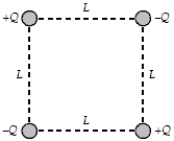
(Multiple Choice)
4.9/5 (79)
(79) A +20-nC point charge is placed on the x axis at x = 2.0 m,and a −25-nC point charge is placed on the y axis at y = −3.0 m.What is the direction of the electric field at the origin?
(Multiple Choice)
4.7/5 (91)
(91) Rubber rods charged by rubbing with cat fur repel each other.Glass rods charged by rubbing with silk repel each other.A rubber rod and a glass rod charged respectively as above attract each other.A possible explanation is that
(Multiple Choice)
4.9/5 (73)
(73) Three point charges,two positive and one negative,each having a magnitude of 20 μC are placed at the vertices of an equilateral triangle (30 cm on a side).What is the magnitude of the electrostatic force on the negative charge?
(Multiple Choice)
4.8/5 (82)
(82) Identical point charges Q are placed at each of the four corners of a 3.0 m × 4.0 m rectangle.If Q = 40 μC,what is the magnitude of the electrostatic force on any one of the charges?
(Multiple Choice)
4.8/5 (76)
(76) Charge of uniform density 4.0 nC/m is distributed along the x axis from x = −2.0 m to x = +3.0 m.What is the magnitude of the electric field at the point x = +5.0 m on the x axis?
(Multiple Choice)
4.8/5 (69)
(69) Two charged particles,Q1 and Q2,are a distance r apart with Q2 = 5Q1.Compare the forces they exert on one another when  Is the force Q2 exerts on Q1 and
 Is the force Q1 exerts on Q2.
Is the force Q2 exerts on Q1 and
Is the force Q1 exerts on Q2. (Multiple Choice)
4.9/5 (72)
(72) Enrico says that positive charge is created when you rub a glass rod with silk,and that negative charge is simply the absence of positive charge.Rosetta says that negative charge is created and that positive charge is the absence of positive charge.(She has heard that Ben Franklin should have reversed the signs he associated with the charges. )Which one,if either,is correct?
(Multiple Choice)
4.9/5 (75)
(75) In a diagram of charges and electric field lines charge  Has twelve field lines going outward from it and charge
 Has three field lines going into it.If one of the charges is 100 nC,what is the other one?
Has twelve field lines going outward from it and charge
Has three field lines going into it.If one of the charges is 100 nC,what is the other one? (Multiple Choice)
4.9/5 (81)
(81) The velocity of a particle (m = 10 mg,q = −4.0 μC)at t = 0 is 20 m/s in the positive x direction.If the particle moves in a uniform electric field of 20 N/C in the positive x direction,what is the particle's speed at t = 5.0 s?
(Multiple Choice)
4.9/5 (67)
(67) If Q = 25 μC,q = 10 μC,and L = 40 cm in the figure,what is the magnitude of the electrostatic force on q? 
(Multiple Choice)
5.0/5 (81)
(81) A uniform linear charge of 2.0 nC/m is distributed along the x axis from x = 0 to x = 3 m.Which of the following integrals is correct for the y component of the electric field at y = 4 m on the y axis?
(Multiple Choice)
4.9/5 (76)
(76) A +15-nC point charge is placed on the x axis at x = 1.5 m,and a −20-nC charge is placed on the y axis at y = −2.0m.What is the magnitude of the electric field at the origin?
(Multiple Choice)
4.9/5 (79)
(79) A negatively charged particle is moving in the +x-direction when it enters a region with a uniform electric field pointing in the +x-direction.Which graph gives its position as a function of time correctly? (Its initial position is x = 0 at t = 0. )
(Multiple Choice)
4.9/5 (85)
(85) A uniformly charged rod (length = 2.0 m,charge per unit length = 3.0 nC/m)is bent to form a semicircle.What is the magnitude of the electric field at the center of the circle?
(Multiple Choice)
4.8/5 (76)
(76) Two tiny metal spheres are fixed to the ends of a non-conducting string of length  )Equal charges,+q,are placed on the metal spheres.Randall says that the force on the string has magnitude
 )Tilden says that the tension in the string has magnitude
 )Which one,if either,is correct?
)Equal charges,+q,are placed on the metal spheres.Randall says that the force on the string has magnitude
)Tilden says that the tension in the string has magnitude
)Which one,if either,is correct? (Multiple Choice)
4.7/5 (84)
(84) When a positive charge q is placed in the field created by two other charges Q1 and Q2,each a distance r away from q,the acceleration of q is
(Multiple Choice)
4.9/5 (80)
(80) Two imaginary spherical surfaces of radius R and 2R respectively surround a positive point charge Q located at the center of the concentric spheres.When compared to the number of field lines N1 going through the sphere of radius R,the number of electric field lines N2 going through the sphere of radius 2R is
(Multiple Choice)
4.7/5 (78)
(78) 
Filters
- Essay(0)
- Multiple Choice(0)
- Short Answer(0)
- True False(0)
- Matching(0)