



 Chat with AI
Exam 9: Linear Momentum and Collisions

Exam 1: Physics and Measurement25 Questions
Exam 2: Motion in One Dimension66 Questions
Exam 3: Vectors47 Questions
Exam 4: Motion in Two Dimensions79 Questions
Exam 5: The Laws of Motion113 Questions
Exam 6: Circular Motion and Other Applications of Newtons Laws55 Questions
Exam 7: Energy of a System74 Questions
Exam 8: Conservation of Energy84 Questions
Exam 9: Linear Momentum and Collisions89 Questions
Exam 10: Rotation of a Rigid Object About a Fixed Axis82 Questions
Exam 11: Angular Momentum46 Questions
Exam 12: Static Equilibrium and Elasticity34 Questions
Exam 13: Universal Gravitation47 Questions
Exam 14: Fluid Mechanics53 Questions
Exam 15: Oscillatory Motion41 Questions
Exam 16: Wave Motion46 Questions
Exam 17: Sound Waves48 Questions
Exam 18: Superposition and Standing Waves60 Questions
Exam 19: Temperature47 Questions
Exam 20: The First Law of Thermodynamics61 Questions
Exam 21: The Kinetic Theory of Gases38 Questions
Exam 22: Heat Engines, entropy, and the Second Law of Thermodynamics55 Questions
Exam 23: Electric Fields83 Questions
Exam 24: Gausss Law80 Questions
Exam 25: Electric Potential97 Questions
Exam 26: Capacitance and Dielectrics63 Questions
Exam 27: Current and Resistance34 Questions
Exam 28: Direct-Current Circuits84 Questions
Exam 29: Magnetic Fields80 Questions
Exam 30: Sources of the Magnetic Field105 Questions
Exam 31: Faradays Law62 Questions
Exam 32: Inductance23 Questions
Exam 33: Alternating-Current Circuits65 Questions
Exam 34: Electromagnetic Waves40 Questions
Exam 35: The Nature of Light and the Principles of Ray Optics38 Questions
Exam 36: Image Formation46 Questions
Exam 37: Wave Optics48 Questions
Exam 38: Diffraction Patterns and Polarization47 Questions
Exam 39: Relativity34 Questions
Exam 40: Introduction to Quantum Physics48 Questions
Exam 41: Quantum Mechanics33 Questions
Exam 42: Atomic Physics59 Questions
Exam 43: Molecules and Solids46 Questions
Exam 44: Nuclear Structure50 Questions
Exam 45: Applications of Nuclear Physics40 Questions
Exam 46: Particle Physics and Cosmology34 Questions
Select questions type


The only force acting on a 2.0-kg object moving along the x axis is shown.If the velocity vx is +2.0 m/s at t = 0,what is the velocity at t = 4.0 s? 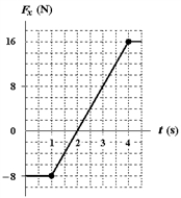

Free
(Multiple Choice)
4.8/5  (71)
(71) Correct Answer: Verified
A
A 3.00-kg stone is dropped from a 39.2 m high building.When the stone has fallen 19.6 m,the magnitude of the impulse it has received from the gravitational force is
Free
(Multiple Choice)
4.8/5 (80)
(80) Correct Answer:Verified
VerifiedD
A 6.0-kg object moving 5.0 m/s collides with and sticks to a 2.0-kg object.After the collision the composite object is moving 2.0 m/s in a direction opposite to the initial direction of motion of the 6.0-kg object.Determine the speed of the 2.0-kg object before the collision.
Free
(Multiple Choice)
4.9/5 (83)
(83) Correct Answer:Verified
VerifiedD
The value of the momentum of a system is the same at a later time as at an earlier time if there are no
(Multiple Choice)
4.9/5 (85)
(85) At the instant a 2.0-kg particle has a velocity of 4.0 m/s in the positive x direction,a 3.0-kg particle has a velocity of 5.0 m/s in the positive y direction.What is the speed of the center of mass of the two-particle system?
(Multiple Choice)
4.8/5 (84)
(84) A 1.0-kg object moving 9.0 m/s collides with a 2.0-kg object moving 6.0 m/s in a direction that is perpendicular to the initial direction of motion of the 1.0-kg object.The two masses remain together after the collision,and this composite object then collides with and sticks to a 3.0-kg object.After these collisions,the final composite (6.0-kg)object remains at rest.What was the speed of the 3.0-kg object before the collisions?
(Multiple Choice)
4.9/5 (71)
(71) Three particles are placed in the xy plane.A 40-g particle is located at (3,4)m,and a 50-g particle is positioned at (−2,−6)m.Where must a 20-g particle be placed so that the center of mass of this three-particle system is located at the origin?
(Multiple Choice)
4.8/5 (86)
(86) A 2.4-kg ball falling vertically hits the floor with a speed of 2.5 m/s and rebounds with a speed of 1.5 m/s.What is the magnitude of the impulse exerted on the ball by the floor?
(Multiple Choice)
4.9/5 (83)
(83) An 8.0-kg object moving 4.0 m/s in the positive x direction has a one-dimensional collision with a 2.0-kg object moving 3.0 m/s in the opposite direction.The final velocity of the 8.0-kg object is 2.0 m/s in the positive x direction.What is the total kinetic energy of the two-mass system after the collision?
(Multiple Choice)
4.9/5 (81)
(81) An astronaut outside a spaceship hammers a loose rivet back in place.What happens to the astronaut as he swings the hammer?
(Multiple Choice)
4.8/5 (83)
(83) Two 0.20-kg balls,moving at 4 m/s east,strike a wall.Ball A bounces backwards at the same speed.Ball B stops.Which statement correctly describes the change in momentum of the two balls?
(Multiple Choice)
4.8/5 (70)
(70) A 5.0-g particle moving 60 m/s collides with a 2.0-g particle initially at rest.After the collision each of the particles has a velocity that is directed 30° from the original direction of motion of the 5.0-g particle.What is the speed of the 2.0-g particle after the collision?
(Multiple Choice)
4.7/5 (85)
(85) A uniform thin wire has a length  and is bent into a semicircular arc of radius R.If the wire starts at (x,y)= (R,0)and curves counterclockwise to (x,y)= (−R,0),what is the y coordinate of its center of mass?
 (Short Answer)
4.8/5 (68)
(68) A 1.5-kg playground ball is moving with a velocity of 3.0 m/s directed 30° below the horizontal just before it strikes a horizontal surface.The ball leaves this surface 0.50 s later with a velocity of 2.0 m/s directed 60° above the horizontal.What is the magnitude of the average resultant force on the ball?
(Multiple Choice)
4.9/5 (69)
(69) A catapult fires an 800-kg rock with an initial velocity of 100 m/s at a 40° angle to the ground.The magnitude of the horizontal impulse the catapult receives from the rock is
(Multiple Choice)
4.9/5 (74)
(74) A rocket engine consumes 450 kg of fuel per minute.If the exhaust speed of the ejected fuel is 5.2 km/s,what is the thrust of the rocket?
(Multiple Choice)
4.7/5 (86)
(86) High-speed stroboscopic photographs show that the head of a golf club of mass 200 grams is traveling at 55.0 m/s just before it strikes a 46.0-gram golf ball at rest on a tee.After the collision,the clubhead travels (in the same direction)at 40.0 m/s.Find the speed of the golf ball just after impact.
(Short Answer)
4.8/5 (100)
(100) A ball falls to the ground from height h and bounces to height h'.Momentum is conserved in the ball-earth system
(Multiple Choice)
4.8/5 (75)
(75) A 3.0-kg mass is released from rest at point A of a circular frictionless track of radius 0.40 m as shown in the figure.The mass slides down the track and collides with a 1.4-kg mass that is initially at rest on a horizontal frictionless surface.If the masses stick together,what is their speed after the collision? 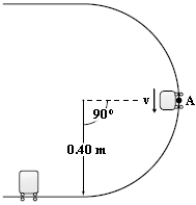
(Multiple Choice)
4.9/5 (85)
(85) A 2.0-kg object moving 3.0 m/s strikes a 1.0-kg object initially at rest.Immediately after the collision,the 2.0-kg object has a velocity of 1.5 m/s directed 30° from its initial direction of motion.What is the x component of the velocity of the 1.0-kg object just after the collision?
(Multiple Choice)
4.8/5 (87)
(87) 
Filters
- Essay(0)
- Multiple Choice(0)
- Short Answer(0)
- True False(0)
- Matching(0)