



 Chat with AI
Exam 9: Linear Momentum and Collisions

Exam 1: Physics and Measurement25 Questions
Exam 2: Motion in One Dimension66 Questions
Exam 3: Vectors47 Questions
Exam 4: Motion in Two Dimensions79 Questions
Exam 5: The Laws of Motion113 Questions
Exam 6: Circular Motion and Other Applications of Newtons Laws55 Questions
Exam 7: Energy of a System74 Questions
Exam 8: Conservation of Energy84 Questions
Exam 9: Linear Momentum and Collisions89 Questions
Exam 10: Rotation of a Rigid Object About a Fixed Axis82 Questions
Exam 11: Angular Momentum46 Questions
Exam 12: Static Equilibrium and Elasticity34 Questions
Exam 13: Universal Gravitation47 Questions
Exam 14: Fluid Mechanics53 Questions
Exam 15: Oscillatory Motion41 Questions
Exam 16: Wave Motion46 Questions
Exam 17: Sound Waves48 Questions
Exam 18: Superposition and Standing Waves60 Questions
Exam 19: Temperature47 Questions
Exam 20: The First Law of Thermodynamics61 Questions
Exam 21: The Kinetic Theory of Gases38 Questions
Exam 22: Heat Engines, entropy, and the Second Law of Thermodynamics55 Questions
Exam 23: Electric Fields83 Questions
Exam 24: Gausss Law80 Questions
Exam 25: Electric Potential97 Questions
Exam 26: Capacitance and Dielectrics63 Questions
Exam 27: Current and Resistance34 Questions
Exam 28: Direct-Current Circuits84 Questions
Exam 29: Magnetic Fields80 Questions
Exam 30: Sources of the Magnetic Field105 Questions
Exam 31: Faradays Law62 Questions
Exam 32: Inductance23 Questions
Exam 33: Alternating-Current Circuits65 Questions
Exam 34: Electromagnetic Waves40 Questions
Exam 35: The Nature of Light and the Principles of Ray Optics38 Questions
Exam 36: Image Formation46 Questions
Exam 37: Wave Optics48 Questions
Exam 38: Diffraction Patterns and Polarization47 Questions
Exam 39: Relativity34 Questions
Exam 40: Introduction to Quantum Physics48 Questions
Exam 41: Quantum Mechanics33 Questions
Exam 42: Atomic Physics59 Questions
Exam 43: Molecules and Solids46 Questions
Exam 44: Nuclear Structure50 Questions
Exam 45: Applications of Nuclear Physics40 Questions
Exam 46: Particle Physics and Cosmology34 Questions
Select questions type


A pitcher claims he can throw a baseball with as much momentum as a 3.00-g bullet moving with a speed of 1500 m/s.A baseball has a mass of 0.145 kg.What must be its speed if the pitcher's claim is valid?
(Short Answer)
4.7/5  (72)
(72) A rocket moving in outer space maintains a constant acceleration (magnitude = 20 m/s2)while ejecting fuel at a speed of 15 km/s relative to the rocket.If the initial mass of the rocket is 3 000 kg,what is the magnitude of the thrust after 800 kg of fuel have been consumed?
(Multiple Choice)
4.9/5 (81)
(81) Exhibit 9-1
Two birds of prey hurtling after the same mouse collide in mid-air and grab each other with their talons.Each 250-g bird is flying at 30 m/s at a 60° angle to the ground. 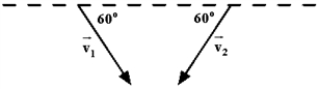 Use this exhibit to answer the following question(s).
-Refer to Exhibit 9-1.What is the magnitude of their velocity,in m/s,immediately after the collision?
Use this exhibit to answer the following question(s).
-Refer to Exhibit 9-1.What is the magnitude of their velocity,in m/s,immediately after the collision? (Multiple Choice)
5.0/5 (87)
(87) When the rate of burn and the exhaust velocity are constant,a rocket ascends with
(Multiple Choice)
4.9/5 (85)
(85) A 4.0-kg mass has a velocity of 4.0 m/s,east when it explodes into two 2.0-kg masses.After the explosion one of the masses has a velocity of 3.0 m/s at an angle of 60° north of east.What is the magnitude of the velocity of the other mass after the explosion?
(Multiple Choice)
5.0/5 (96)
(96) Two bodies with masses m1 and m2 are both moving east with velocities of magnitudes v1 and v2,where v1 is less than v2.The magnitude of the velocity of the center of mass of this system of two bodies is
(Multiple Choice)
5.0/5 (72)
(72) A 4.0-kg mass,initially at rest on a horizontal frictionless surface,is struck by a 2.0-kg mass moving along the x axis with a speed of 8.0 m/s.After the collision,the 2.0-kg mass has a speed of 4.0 m/s at an angle of 37° from the positive x axis.What is the speed of the 4.0-kg mass after the collision?
(Multiple Choice)
5.0/5 (73)
(73) A 1.0-kg ball is attached to the end of a 2.5-m string to form a pendulum.This pendulum is released from rest with the string horizontal.At the lowest point in its swing when it is moving horizontally,the ball collides elastically with a 2.0-kg block initially at rest on a horizontal frictionless surface.What is the speed of the block just after the collision?
(Multiple Choice)
4.8/5 (86)
(86) Assume that the average mass of each of the approximately 1 billion people in China is 55 kg.Assume that they all gather in one place and climb to the top of 2 m high ladders.The center of mass of the Earth (mE = 5.90  1024 kg)is then displaced
 (Multiple Choice)
4.8/5 (66)
(66) 
Filters
- Essay(0)
- Multiple Choice(0)
- Short Answer(0)
- True False(0)
- Matching(0)