



 Chat with AI
Exam 23: Electric Fields

Exam 1: Physics and Measurement25 Questions
Exam 2: Motion in One Dimension66 Questions
Exam 3: Vectors47 Questions
Exam 4: Motion in Two Dimensions79 Questions
Exam 5: The Laws of Motion113 Questions
Exam 6: Circular Motion and Other Applications of Newtons Laws55 Questions
Exam 7: Energy of a System74 Questions
Exam 8: Conservation of Energy84 Questions
Exam 9: Linear Momentum and Collisions89 Questions
Exam 10: Rotation of a Rigid Object About a Fixed Axis82 Questions
Exam 11: Angular Momentum46 Questions
Exam 12: Static Equilibrium and Elasticity34 Questions
Exam 13: Universal Gravitation47 Questions
Exam 14: Fluid Mechanics53 Questions
Exam 15: Oscillatory Motion41 Questions
Exam 16: Wave Motion46 Questions
Exam 17: Sound Waves48 Questions
Exam 18: Superposition and Standing Waves60 Questions
Exam 19: Temperature47 Questions
Exam 20: The First Law of Thermodynamics61 Questions
Exam 21: The Kinetic Theory of Gases38 Questions
Exam 22: Heat Engines, entropy, and the Second Law of Thermodynamics55 Questions
Exam 23: Electric Fields83 Questions
Exam 24: Gausss Law80 Questions
Exam 25: Electric Potential97 Questions
Exam 26: Capacitance and Dielectrics63 Questions
Exam 27: Current and Resistance34 Questions
Exam 28: Direct-Current Circuits84 Questions
Exam 29: Magnetic Fields80 Questions
Exam 30: Sources of the Magnetic Field105 Questions
Exam 31: Faradays Law62 Questions
Exam 32: Inductance23 Questions
Exam 33: Alternating-Current Circuits65 Questions
Exam 34: Electromagnetic Waves40 Questions
Exam 35: The Nature of Light and the Principles of Ray Optics38 Questions
Exam 36: Image Formation46 Questions
Exam 37: Wave Optics48 Questions
Exam 38: Diffraction Patterns and Polarization47 Questions
Exam 39: Relativity34 Questions
Exam 40: Introduction to Quantum Physics48 Questions
Exam 41: Quantum Mechanics33 Questions
Exam 42: Atomic Physics59 Questions
Exam 43: Molecules and Solids46 Questions
Exam 44: Nuclear Structure50 Questions
Exam 45: Applications of Nuclear Physics40 Questions
Exam 46: Particle Physics and Cosmology34 Questions
Select questions type


If a = 60 cm,b = 80 cm,Q = −4.0 nC,and q = 1.5 nC,what is the magnitude of the electric field at point P? 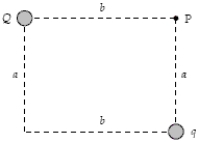
(Multiple Choice)
4.9/5  (93)
(93) Which one of the diagrams below is not a possible electric field configuration for a region of space which does not contain any charges?
(Multiple Choice)
4.8/5 (77)
(77) Each of two small non-conducting spheres is charged positively,the combined charge being 40 μC.When the two spheres are 50 cm apart,each sphere is repelled from the other by a force of magnitude 2.0 N.Determine the magnitude of the smaller of the two charges.
(Multiple Choice)
4.9/5 (87)
(87) The symbol  Appears in Coulomb's law because we use independently defined units for
 (Multiple Choice)
5.0/5 (90)
(90) Two uniform rods,each of length 2.0 m,are bent to form semicircles.One rod has a charger per unit lent of 1.5 nC/m,and the other has a charge per unit length of -1.5 nC/m.The semicircles are joined to make a circle.What is the magnitude of the electric field at the center of the circle?
(Multiple Choice)
5.0/5 (84)
(84) A +2.0-nC point charge is placed at one corner of a square (1.5 m on a side),and a −3.0-nC charge is placed on a corner diagonally away from the first charge.What is the magnitude of the electric field at either of the two unoccupied corners?
(Multiple Choice)
4.8/5 (82)
(82) If Q = 16 nC,a = 3.0 m,and b = 4.0 m,what is the magnitude of the electric field at point P? 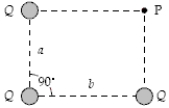
(Multiple Choice)
4.8/5 (77)
(77) A particle (m = 20 mg,q = −5.0 μC)moves in a uniform electric field of 60 N/C in the positive x direction.At t = 0,the particle is moving 25 m/s in the positive x direction and is passing through the origin.How far is the particle from the origin at t = 2.0 s?
(Multiple Choice)
4.8/5 (76)
(76) Three 2.50 μC charges are placed on tiny conducting spheres at the ends of 1.00 m-long strings that are connected at 120° angles as shown below.The magnitude,in N,of the tension in any one of the strings is 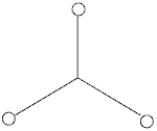
(Multiple Choice)
4.9/5 (69)
(69) Imagine for a minute that the Moon is held in its orbit about the Earth by electrical forces rather than by gravitation.What electrical charges −Q on the Earth and +Q on the Moon are necessary to hold the Moon in a circular orbit with a period of 27.3 days? The Earth-Moon distance is 384 000 km and the mass of the Moon is 7.35 × 10²² kg.
(Short Answer)
4.7/5 (73)
(73) Suppose a uniform electric field of 4 N/C is in the positive x direction.When a charge is placed at and fixed to the origin,the resulting electric field on the x axis at x = 2 m becomes zero.What is the magnitude of the electric field at x = 4 m on the x axis at this time?
(Multiple Choice)
4.9/5 (79)
(79) A point charge Q is placed on the x axis at x = −2.0 m.A second point charge,−Q,is placed at x = 1.0 m.If Q = 60 μC,what is the magnitude of the electrostatic force on a 40-μC charge placed at the origin?
(Multiple Choice)
4.9/5 (81)
(81) A particle (m = 20 mg,q = −5.0 μC)moves in a uniform electric field of 60 N/C in the positive x direction.At t = 0,the particle is moving 30 m/s in the positive x direction and is passing through the origin.Determine the maximum distance beyond x = 0 the particle travels in the positive x direction.
(Multiple Choice)
4.7/5 (79)
(79) A 16-nC charge is distributed uniformly along the x axis from x = 0 to x = 4 m.Which of the following integrals is correct for the magnitude (in N/C)of the electric field at x = +10 m on the x axis?
(Multiple Choice)
4.9/5 (94)
(94) The electron gun in a television tube accelerates electrons (mass = 9.11 × 10⁻³¹ kg,charge = 1.60 × 10⁻¹⁹ C)from rest to 3.00 × 10⁷ m/s within a distance of 2.00 cm.What electric field is required?
(Short Answer)
4.9/5 (78)
(78) When gravitational,magnetic and any forces other than static electric forces are not present,electric field lines in the space surrounding a charge distribution show
(Multiple Choice)
4.7/5 (82)
(82) A proton moving at 3 × 10⁴ m/s is projected at an angle of 30° above a horizontal plane.If an electric field of 400 N/C is directed downwards,how long does it take the proton to return to the horizontal plane? (HINT: Ignore gravity. )[mProton = 1.67 × 10⁻²⁷ kg,qProton = +1.6 × 10⁻¹⁹ C.]
(Short Answer)
4.8/5 (71)
(71) A particle (mass = 5.0 g,charge = 40 mC)moves in a region of space where the electric field is uniform and is given by Ex = −2.3 N/C,Ey = Ez = 0.If the position and velocity of the particle at t = 0 are given by x = y = z = 0 and vz = 20 m/s,vx = vy = 0,what is the distance from the origin to the particle at t = 2.0 s?
(Multiple Choice)
4.9/5 (81)
(81) A point charge Q is placed at the origin.A second charge,2Q,is placed on the x axis at x = −3.0 m.If Q = 50 μC,what is the magnitude of the electrostatic force on a third point charge,−Q,placed on the y axis at y = +4.0 m?
(Multiple Choice)
4.8/5 (75)
(75) A particle (m = 50 g,q = 5.0 μC)is released from rest when it is 50 cm from a second particle (Q = −20 μC).Determine the magnitude of the initial acceleration of the 50-g particle.
(Multiple Choice)
4.8/5 (83)
(83) 
Filters
- Essay(0)
- Multiple Choice(0)
- Short Answer(0)
- True False(0)
- Matching(0)