



 Chat with AI
Exam 20: The First Law of Thermodynamics

Exam 1: Physics and Measurement25 Questions
Exam 2: Motion in One Dimension66 Questions
Exam 3: Vectors47 Questions
Exam 4: Motion in Two Dimensions79 Questions
Exam 5: The Laws of Motion113 Questions
Exam 6: Circular Motion and Other Applications of Newtons Laws55 Questions
Exam 7: Energy of a System74 Questions
Exam 8: Conservation of Energy84 Questions
Exam 9: Linear Momentum and Collisions89 Questions
Exam 10: Rotation of a Rigid Object About a Fixed Axis82 Questions
Exam 11: Angular Momentum46 Questions
Exam 12: Static Equilibrium and Elasticity34 Questions
Exam 13: Universal Gravitation47 Questions
Exam 14: Fluid Mechanics53 Questions
Exam 15: Oscillatory Motion41 Questions
Exam 16: Wave Motion46 Questions
Exam 17: Sound Waves48 Questions
Exam 18: Superposition and Standing Waves60 Questions
Exam 19: Temperature47 Questions
Exam 20: The First Law of Thermodynamics61 Questions
Exam 21: The Kinetic Theory of Gases38 Questions
Exam 22: Heat Engines, entropy, and the Second Law of Thermodynamics55 Questions
Exam 23: Electric Fields83 Questions
Exam 24: Gausss Law80 Questions
Exam 25: Electric Potential97 Questions
Exam 26: Capacitance and Dielectrics63 Questions
Exam 27: Current and Resistance34 Questions
Exam 28: Direct-Current Circuits84 Questions
Exam 29: Magnetic Fields80 Questions
Exam 30: Sources of the Magnetic Field105 Questions
Exam 31: Faradays Law62 Questions
Exam 32: Inductance23 Questions
Exam 33: Alternating-Current Circuits65 Questions
Exam 34: Electromagnetic Waves40 Questions
Exam 35: The Nature of Light and the Principles of Ray Optics38 Questions
Exam 36: Image Formation46 Questions
Exam 37: Wave Optics48 Questions
Exam 38: Diffraction Patterns and Polarization47 Questions
Exam 39: Relativity34 Questions
Exam 40: Introduction to Quantum Physics48 Questions
Exam 41: Quantum Mechanics33 Questions
Exam 42: Atomic Physics59 Questions
Exam 43: Molecules and Solids46 Questions
Exam 44: Nuclear Structure50 Questions
Exam 45: Applications of Nuclear Physics40 Questions
Exam 46: Particle Physics and Cosmology34 Questions
Select questions type


A gas expands as shown in the graph.If the heat taken in during this process is 1.02 × 10⁶ J and 1 atm = 1.01 × 10⁵ N/m2,the change in internal energy of the gas (in J)is 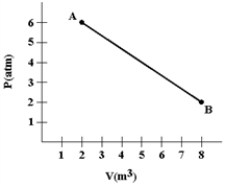
(Multiple Choice)
4.7/5  (62)
(62) A 100-g cube of ice is heated from −120°C to +120°C.In which of the following processes is the greatest amount of energy absorbed by this material?
(Multiple Choice)
4.9/5 (75)
(75) A 5-kg piece of lead (specific heat 0.03 cal/g⋅°C)having a temperature of 80°C is added to 500 g of water having a temperature of 20°C.What is the final equilibrium temperature (in °C)of the system?
(Multiple Choice)
4.9/5 (82)
(82) For an astronaut working outside a spaceship,the greatest loss of heat would occur by means of
(Multiple Choice)
4.9/5 (75)
(75) A child has a temperature of 101°F.If her total cross-sectional area is 2 m2,find the energy lost each second (in W)due to radiation,assuming the emissivity is 1.(Assume the room temperature is 70°F. )
(Multiple Choice)
4.8/5 (70)
(70) Beryl states that insulation with the smallest possible thermal conductivity is best to keep a house warm in winter,but worst for keeping a house cool in summer.Sapphire insists the reverse is true: low thermal conductivity is good in the summer,but bad in the winter.Which one,if either is correct?
(Multiple Choice)
4.8/5 (83)
(83) Two kilograms of water at 100°C is converted to steam at 1 atm.Find the change in internal energy (in J).(Lv = 2.26 × 10⁶ J/kg. )
(Multiple Choice)
4.8/5 (84)
(84) How many calories of heat are required to raise the temperature of 4 kg of water from 50°F to the boiling point?
(Multiple Choice)
4.8/5 (79)
(79) A block of material of mass m and specific heat c falls from height h and reaches speed v just before striking the ground.Its temperature is measured immediately after it strikes the ground.If we ignore any change in temperature owing to interaction with the air,the change in temperature of the block of material is
(Multiple Choice)
4.9/5 (81)
(81) A styrofoam container used as a picnic cooler contains a block of ice at 0°C.If 225 grams of ice melts in 1 hour,how much heat energy per second is passing through the walls of the container? (The heat of fusion of ice is 3.33 × 10⁵ J/kg).
(Short Answer)
4.8/5 (73)
(73) Five moles of an ideal gas expands isothermally at 100°C to five times its initial volume.Find the heat flow into the system.
(Multiple Choice)
5.0/5 (71)
(71) How much heat,in joules,is required to convert 1.00 kg of ice at 0°C into steam at 100°C? (Lice = 333 J/g;Lsteam = 2.26 × 10³ J/g. )
(Multiple Choice)
4.9/5 (75)
(75) In a thermodynamic process,the internal energy of a system in a container with adiabatic walls decreases by 800 J.Which statement is correct?
(Multiple Choice)
4.9/5 (82)
(82) If 25 kg of ice at 0°C is combined with 4 kg of steam at 100°C,what will be the final equilibrium temperature (in °C)of the system?
(Multiple Choice)
4.7/5 (83)
(83) Steel blocks A and B,which have equal masses,are at TA = 300 °C and TB = 400 °C.Block C,with mC = 2mA,is at TC = 350 °C.Blocks A and B are placed in contact,isolated,and allowed to come into equilibrium.Then they are placed in contact with block C.At that instant,
(Multiple Choice)
4.8/5 (82)
(82) Gas in a container expands at a constant pressure of 3 atm.Find the work done (in J)by the gas if the initial volume is 5 liters and the final volume is 10 liters.
(Multiple Choice)
4.9/5 (77)
(77) The Earth intercepts 1.27 × 10¹⁷ W of radiant energy from the Sun.Suppose the Earth,of volume 1.08 × 10²¹ m3,was composed of water.How long would it take for the Earth at 0°C to reach 100°C,if none of the energy was radiated or reflected back out into space?
(Multiple Choice)
4.9/5 (72)
(72) Which of the following substances has the greatest specific heat?
(Multiple Choice)
4.9/5 (91)
(91) 
Filters
- Essay(0)
- Multiple Choice(0)
- Short Answer(0)
- True False(0)
- Matching(0)