



 Chat with AI
Exam 20: The First Law of Thermodynamics

Exam 1: Physics and Measurement25 Questions
Exam 2: Motion in One Dimension66 Questions
Exam 3: Vectors47 Questions
Exam 4: Motion in Two Dimensions79 Questions
Exam 5: The Laws of Motion113 Questions
Exam 6: Circular Motion and Other Applications of Newtons Laws55 Questions
Exam 7: Energy of a System74 Questions
Exam 8: Conservation of Energy84 Questions
Exam 9: Linear Momentum and Collisions89 Questions
Exam 10: Rotation of a Rigid Object About a Fixed Axis82 Questions
Exam 11: Angular Momentum46 Questions
Exam 12: Static Equilibrium and Elasticity34 Questions
Exam 13: Universal Gravitation47 Questions
Exam 14: Fluid Mechanics53 Questions
Exam 15: Oscillatory Motion41 Questions
Exam 16: Wave Motion46 Questions
Exam 17: Sound Waves48 Questions
Exam 18: Superposition and Standing Waves60 Questions
Exam 19: Temperature47 Questions
Exam 20: The First Law of Thermodynamics61 Questions
Exam 21: The Kinetic Theory of Gases38 Questions
Exam 22: Heat Engines, entropy, and the Second Law of Thermodynamics55 Questions
Exam 23: Electric Fields83 Questions
Exam 24: Gausss Law80 Questions
Exam 25: Electric Potential97 Questions
Exam 26: Capacitance and Dielectrics63 Questions
Exam 27: Current and Resistance34 Questions
Exam 28: Direct-Current Circuits84 Questions
Exam 29: Magnetic Fields80 Questions
Exam 30: Sources of the Magnetic Field105 Questions
Exam 31: Faradays Law62 Questions
Exam 32: Inductance23 Questions
Exam 33: Alternating-Current Circuits65 Questions
Exam 34: Electromagnetic Waves40 Questions
Exam 35: The Nature of Light and the Principles of Ray Optics38 Questions
Exam 36: Image Formation46 Questions
Exam 37: Wave Optics48 Questions
Exam 38: Diffraction Patterns and Polarization47 Questions
Exam 39: Relativity34 Questions
Exam 40: Introduction to Quantum Physics48 Questions
Exam 41: Quantum Mechanics33 Questions
Exam 42: Atomic Physics59 Questions
Exam 43: Molecules and Solids46 Questions
Exam 44: Nuclear Structure50 Questions
Exam 45: Applications of Nuclear Physics40 Questions
Exam 46: Particle Physics and Cosmology34 Questions
Select questions type


In which process will the internal energy of the system NOT change?
(Multiple Choice)
4.9/5  (90)
(90) A 5-gallon container of water (approximately 20 kg)having a temperature of 212°F is added to a 50-gallon tub (approximately 200 kg)of water having a temperature of 50°F.What is the final equilibrium temperature (in °C)of the mixture?
(Multiple Choice)
4.9/5 (72)
(72) The R value of fiberglass batting,3.5 inches thick,is 11 ft2⋅°F⋅h/BTU.What is the thermal conductivity (in BTU/ft⋅°F⋅s)?
(Multiple Choice)
5.0/5 (89)
(89) Determine the heat capacity (in calories/°C)of a lake containing one million gallons (approximately 4 million kilograms)of water at 15°C.
(Multiple Choice)
4.9/5 (71)
(71) A 5-g coin is dropped from a 300-m building.If it reaches a terminal velocity of 45 m/s,and the rest of the energy is converted to heating the coin,what is the change in temperature (in °C)of the coin? (The specific heat of copper is 387 J/kg⋅°C. )
(Multiple Choice)
4.9/5 (79)
(79) How much heat (in kcal)must be removed to make ice at −10°C from 2 kg of water at 20°C? (The specific heat of ice is 0.50 cal/g⋅°C. )
(Multiple Choice)
4.7/5 (80)
(80) An 8 000-kg aluminum flagpole 100-m long is heated by the sun from a temperature of 10°C to 20°C.Find the work done (in J)by the aluminum if the linear expansion coefficient is 24 × 10−6 (°C)−1.(The density of aluminum is 2.7 × 10³ kg/m3 and 1 atm = 1.0 × 10⁵ N/m2. )
(Multiple Choice)
4.8/5 (73)
(73) The R-value of an insulating material is the thickness of the material divided by its thermal conductivity.When an insulating material consists of three layers with R-values R1,R2 and R3,the overall R-value of the insulation is given by
(Multiple Choice)
4.8/5 (66)
(66) How much water at 20°C is needed to melt 1 kilogram of solid mercury at its melting point of −39°C? (The heat of fusion of mercury is 2.8 cal/gram).
(Short Answer)
4.8/5 (86)
(86) In braking an automobile,the friction between the brake drums and brake shoes converts the car's kinetic energy into heat.If a 1 500-kg automobile traveling at 30 m/s brakes to a halt,how much does the temperature rise in each of the four 8.0-kg brake drums? (The specific heat of each iron brake drum is 448 J/kg⋅°C).
(Short Answer)
4.8/5 (67)
(67) Water at room temperature,20°C,is pumped into a reactor core where it is converted to steam at 200°C.How much heat (in J)is transferred to each kilogram of water in this process? (csteam = 2 010 J/kg⋅°C;Lsteam = 2.26 × 10³ J/g;1 cal = 4.186 J. )
(Multiple Choice)
4.7/5 (70)
(70) A wall is constructed of a 2 inch layer of fiberglass board (R = 8)and six inches of fiberglass batting (R = 19).If the temperature on the outside surface of the fiberglass board is 50°F and the temperature on the inside surface of the fiberglass batting is 68°F,what is the temperature (in °F)at the interface? (The units of R are ft2⋅°F⋅h/BTU. )
(Multiple Choice)
4.9/5 (68)
(68) Determine the work done by 5 moles of an ideal gas that is kept at 100°C in an expansion from 1 liter to 5 liters.
(Multiple Choice)
4.9/5 (81)
(81) How much heat (in kilocalories)is needed to convert 1.00 kg of ice at 0°C into steam at 100°C?
(Multiple Choice)
4.9/5 (83)
(83) A cup of coffee is enclosed on all sides in an insulated container 1/2 cm thick in the shape of a cube 10 cm on a side.The temperature of the coffee is 95°C,and the temperature of the surroundings is 21°C.Find the rate of heat loss (in J/s)due to conduction if the thermal conductivity of the cup is 2 × 10⁻⁴ cal/s⋅cm⋅°C.
(Multiple Choice)
4.8/5 (79)
(79) Gas in a container increases its pressure from 1 atm to 3 atm while keeping its volume constant.Find the work done (in J)by the gas if the volume is 5 liters.
(Multiple Choice)
4.8/5 (85)
(85) A gas expands from A to B as shown in the graph.Calculate the work (in joules)done by the gas.(1 atm= 1.01 × 10⁵ N/m2. ) 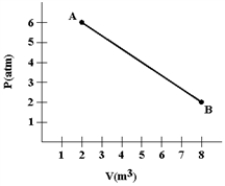
(Multiple Choice)
4.8/5 (85)
(85) 
Filters
- Essay(0)
- Multiple Choice(0)
- Short Answer(0)
- True False(0)
- Matching(0)