



 Chat with AI
Exam 13: Universal Gravitation

Exam 1: Physics and Measurement25 Questions
Exam 2: Motion in One Dimension66 Questions
Exam 3: Vectors47 Questions
Exam 4: Motion in Two Dimensions79 Questions
Exam 5: The Laws of Motion113 Questions
Exam 6: Circular Motion and Other Applications of Newtons Laws55 Questions
Exam 7: Energy of a System74 Questions
Exam 8: Conservation of Energy84 Questions
Exam 9: Linear Momentum and Collisions89 Questions
Exam 10: Rotation of a Rigid Object About a Fixed Axis82 Questions
Exam 11: Angular Momentum46 Questions
Exam 12: Static Equilibrium and Elasticity34 Questions
Exam 13: Universal Gravitation47 Questions
Exam 14: Fluid Mechanics53 Questions
Exam 15: Oscillatory Motion41 Questions
Exam 16: Wave Motion46 Questions
Exam 17: Sound Waves48 Questions
Exam 18: Superposition and Standing Waves60 Questions
Exam 19: Temperature47 Questions
Exam 20: The First Law of Thermodynamics61 Questions
Exam 21: The Kinetic Theory of Gases38 Questions
Exam 22: Heat Engines, entropy, and the Second Law of Thermodynamics55 Questions
Exam 23: Electric Fields83 Questions
Exam 24: Gausss Law80 Questions
Exam 25: Electric Potential97 Questions
Exam 26: Capacitance and Dielectrics63 Questions
Exam 27: Current and Resistance34 Questions
Exam 28: Direct-Current Circuits84 Questions
Exam 29: Magnetic Fields80 Questions
Exam 30: Sources of the Magnetic Field105 Questions
Exam 31: Faradays Law62 Questions
Exam 32: Inductance23 Questions
Exam 33: Alternating-Current Circuits65 Questions
Exam 34: Electromagnetic Waves40 Questions
Exam 35: The Nature of Light and the Principles of Ray Optics38 Questions
Exam 36: Image Formation46 Questions
Exam 37: Wave Optics48 Questions
Exam 38: Diffraction Patterns and Polarization47 Questions
Exam 39: Relativity34 Questions
Exam 40: Introduction to Quantum Physics48 Questions
Exam 41: Quantum Mechanics33 Questions
Exam 42: Atomic Physics59 Questions
Exam 43: Molecules and Solids46 Questions
Exam 44: Nuclear Structure50 Questions
Exam 45: Applications of Nuclear Physics40 Questions
Exam 46: Particle Physics and Cosmology34 Questions
Select questions type


Suppose the gravitational force of the Earth on a body was 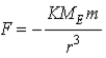 )What escape velocity ve would a body need to escape the gravitational field of the Earth?
 (Multiple Choice)
4.8/5  (82)
(82) Knowing that  At sea level and that RE = 6.37 × 10⁶ m,we find that the value of g in
 At a distance RE from the surface of the Earth is
At sea level and that RE = 6.37 × 10⁶ m,we find that the value of g in
At a distance RE from the surface of the Earth is (Multiple Choice)
4.8/5 (80)
(80) A satellite revolves around the Earth in a circular orbit with a mechanical energy of  j.What is its kinetic energy?
 (Multiple Choice)
4.9/5 (87)
(87) A satellite of mass m circles a planet of mass M and radius R in an orbit at a height 2R above the surface of the planet.What minimum energy is required to change the orbit to one for which the height of the satellite is 3R above the surface of the planet?
(Multiple Choice)
4.9/5 (81)
(81) The figure below shows a planet traveling in a counterclockwise direction on an elliptical path around a star located at one focus of the ellipse.When the planet is at point A, 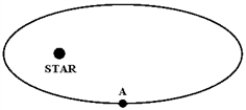
(Multiple Choice)
4.7/5 (71)
(71) A 50-kg satellite circles the Earth in an orbit with a period of 120 min.What minimum energy is required to change the orbit to another circular orbit with a period of 180 min? (Earth: radius = 6.4 × 10⁶ m,mass = 6.0 × 1024 kg)
(Multiple Choice)
4.9/5 (79)
(79) Calculate the Earth's angular momentum in the approximation that treats the Earth's orbit around the sun as a circle.(MSun = 1.99 × 1030 kg;T = 3.156 × 10⁷ s;ME = 5.98 × 1024 kg. )
(Short Answer)
4.9/5 (81)
(81) 
Filters
- Essay(0)
- Multiple Choice(0)
- Short Answer(0)
- True False(0)
- Matching(0)