



 Chat with AI
Exam 13: Universal Gravitation

Exam 1: Physics and Measurement25 Questions
Exam 2: Motion in One Dimension66 Questions
Exam 3: Vectors47 Questions
Exam 4: Motion in Two Dimensions79 Questions
Exam 5: The Laws of Motion113 Questions
Exam 6: Circular Motion and Other Applications of Newtons Laws55 Questions
Exam 7: Energy of a System74 Questions
Exam 8: Conservation of Energy84 Questions
Exam 9: Linear Momentum and Collisions89 Questions
Exam 10: Rotation of a Rigid Object About a Fixed Axis82 Questions
Exam 11: Angular Momentum46 Questions
Exam 12: Static Equilibrium and Elasticity34 Questions
Exam 13: Universal Gravitation47 Questions
Exam 14: Fluid Mechanics53 Questions
Exam 15: Oscillatory Motion41 Questions
Exam 16: Wave Motion46 Questions
Exam 17: Sound Waves48 Questions
Exam 18: Superposition and Standing Waves60 Questions
Exam 19: Temperature47 Questions
Exam 20: The First Law of Thermodynamics61 Questions
Exam 21: The Kinetic Theory of Gases38 Questions
Exam 22: Heat Engines, entropy, and the Second Law of Thermodynamics55 Questions
Exam 23: Electric Fields83 Questions
Exam 24: Gausss Law80 Questions
Exam 25: Electric Potential97 Questions
Exam 26: Capacitance and Dielectrics63 Questions
Exam 27: Current and Resistance34 Questions
Exam 28: Direct-Current Circuits84 Questions
Exam 29: Magnetic Fields80 Questions
Exam 30: Sources of the Magnetic Field105 Questions
Exam 31: Faradays Law62 Questions
Exam 32: Inductance23 Questions
Exam 33: Alternating-Current Circuits65 Questions
Exam 34: Electromagnetic Waves40 Questions
Exam 35: The Nature of Light and the Principles of Ray Optics38 Questions
Exam 36: Image Formation46 Questions
Exam 37: Wave Optics48 Questions
Exam 38: Diffraction Patterns and Polarization47 Questions
Exam 39: Relativity34 Questions
Exam 40: Introduction to Quantum Physics48 Questions
Exam 41: Quantum Mechanics33 Questions
Exam 42: Atomic Physics59 Questions
Exam 43: Molecules and Solids46 Questions
Exam 44: Nuclear Structure50 Questions
Exam 45: Applications of Nuclear Physics40 Questions
Exam 46: Particle Physics and Cosmology34 Questions
Select questions type


When two solid spheres of the same material and same radius r are in contact,the magnitude of the gravitational force each exerts on the other is directly proportional to
(Multiple Choice)
4.8/5  (78)
(78) When a falling meteor is at a distance above the Earth's surface of 3 times the Earth's radius,what is its acceleration due to the Earth's gravity?
(Short Answer)
4.8/5 (82)
(82) A spaceship of mass m circles a planet (mass = M)in an orbit of radius R.How much energy is required to transfer the spaceship to a circular orbit of radius 3R?
(Multiple Choice)
4.9/5 (82)
(82) Exhibit 13-1
Three 5.0-kg masses are located at points in the xy plane as shown in the figure. 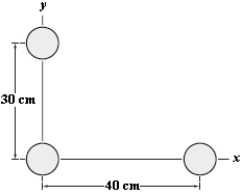 Use this exhibit to answer the following question(s).
-Refer to Exhibit 13-1.What is the magnitude of the resultant force (caused by the other two masses)on the mass at the origin?
Use this exhibit to answer the following question(s).
-Refer to Exhibit 13-1.What is the magnitude of the resultant force (caused by the other two masses)on the mass at the origin? (Multiple Choice)
5.0/5 (70)
(70) In an isolated system of two bodies that exert gravitational forces on one another,the quantity (quantities)that remain(s)constant is(are)
(Multiple Choice)
4.8/5 (88)
(88) The figure below shows a planet traveling in a clockwise direction on an elliptical path around a star located at one focus of the ellipse.When the planet is at point A, 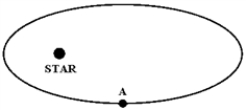
(Multiple Choice)
4.8/5 (58)
(58) The figure below shows a planet traveling in a counterclockwise direction on an elliptical path around a star located at one focus of the ellipse.When the planet is at point A, 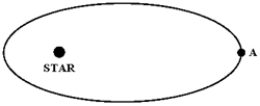
(Multiple Choice)
4.9/5 (86)
(86) The figure below shows a planet traveling in a counterclockwise direction on an elliptical path around a star located at one focus of the ellipse.When the planet is at point A, 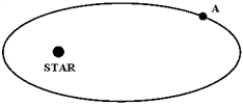
(Multiple Choice)
4.7/5 (86)
(86) Two stars of masses M and 6M are separated by a distance D.Determine the distance (measured from M)to a point at which the net gravitational force on a third mass would be zero.
(Multiple Choice)
4.8/5 (86)
(86) What is the period of revolution of a planet in circular orbit around a star of 4.0 solar masses if it is at a distance from the star equal to that of the Earth from the Sun?
(Short Answer)
5.0/5 (70)
(70) Which of the following quantities is conserved for a planet orbiting a star in a circular orbit? Only the planet itself is to be taken as the system;the star is not included.
(Multiple Choice)
4.7/5 (69)
(69) The planet Venus requires 225 days to orbit the sun,which has a mass M = 1.99 × 1030 kg,in an almost circular trajectory.Calculate the radius of the orbit and the orbital speed of Venus as it circles the sun.
(Short Answer)
4.7/5 (91)
(91) The figure below shows a planet traveling in a clockwise direction on an elliptical path around a star located at one focus of the ellipse.When the planet is at point A, 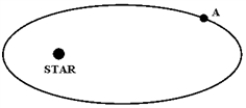
(Multiple Choice)
4.9/5 (87)
(87) Three 5.0-kg masses are located at points in the xy plane,as shown.What is the magnitude of the resultant force (caused by the other two masses)on the mass at x = 0,y = 0.30 m? 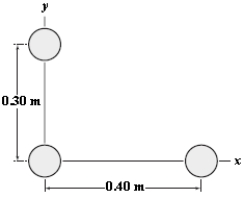
(Multiple Choice)
4.9/5 (81)
(81) An object is released from rest when it is a height h above the surface of a planet of mass M and radius R.What is the speed of the object just before striking the surface of the planet? Neglect any air resistance.Let h = 4.0 × 10⁶ m,R = 5.0 × 10⁶ m,and M = 4.0 × 1024 kg.
(Multiple Choice)
4.9/5 (94)
(94) Exhibit 13-1
Three 5.0-kg masses are located at points in the xy plane as shown in the figure. Use this exhibit to answer the following question(s).
-Refer to Exhibit 13-1.What is the magnitude of the resultant force (caused by the other two masses)on the mass at x = 0.40 m,y = 0?
Use this exhibit to answer the following question(s).
-Refer to Exhibit 13-1.What is the magnitude of the resultant force (caused by the other two masses)on the mass at x = 0.40 m,y = 0? (Multiple Choice)
4.9/5 (82)
(82) Three galaxies,each of mass M = 4.0 × 1041 kg,lie in a plane at the corners of an equilateral triangle with sides of 5.0 × 10²² m length.The magnitude of the force the other two galaxies exert on each galaxy is
(Multiple Choice)
4.9/5 (77)
(77) What is the escape speed from a planet of mass M and radius R if M = 3.2 × 10²³ kg and R = 2.4 × 10⁶ m?
(Multiple Choice)
4.8/5 (80)
(80) An asteroid revolves around the Sun with a perihelion 0.5 AU and an aphelion of 7.5 AU.What is its period of revolution?
(Multiple Choice)
4.7/5 (86)
(86) Two identical planets orbit a star in concentric circular orbits in the star's equatorial plane.Of the two,the planet that is farther from the star must have
(Multiple Choice)
4.8/5 (80)
(80) 
Filters
- Essay(0)
- Multiple Choice(0)
- Short Answer(0)
- True False(0)
- Matching(0)