



 Chat with AI
Exam 5: The Laws of Motion

Exam 1: Physics and Measurement25 Questions
Exam 2: Motion in One Dimension66 Questions
Exam 3: Vectors47 Questions
Exam 4: Motion in Two Dimensions79 Questions
Exam 5: The Laws of Motion113 Questions
Exam 6: Circular Motion and Other Applications of Newtons Laws55 Questions
Exam 7: Energy of a System74 Questions
Exam 8: Conservation of Energy84 Questions
Exam 9: Linear Momentum and Collisions89 Questions
Exam 10: Rotation of a Rigid Object About a Fixed Axis82 Questions
Exam 11: Angular Momentum46 Questions
Exam 12: Static Equilibrium and Elasticity34 Questions
Exam 13: Universal Gravitation47 Questions
Exam 14: Fluid Mechanics53 Questions
Exam 15: Oscillatory Motion41 Questions
Exam 16: Wave Motion46 Questions
Exam 17: Sound Waves48 Questions
Exam 18: Superposition and Standing Waves60 Questions
Exam 19: Temperature47 Questions
Exam 20: The First Law of Thermodynamics61 Questions
Exam 21: The Kinetic Theory of Gases38 Questions
Exam 22: Heat Engines, entropy, and the Second Law of Thermodynamics55 Questions
Exam 23: Electric Fields83 Questions
Exam 24: Gausss Law80 Questions
Exam 25: Electric Potential97 Questions
Exam 26: Capacitance and Dielectrics63 Questions
Exam 27: Current and Resistance34 Questions
Exam 28: Direct-Current Circuits84 Questions
Exam 29: Magnetic Fields80 Questions
Exam 30: Sources of the Magnetic Field105 Questions
Exam 31: Faradays Law62 Questions
Exam 32: Inductance23 Questions
Exam 33: Alternating-Current Circuits65 Questions
Exam 34: Electromagnetic Waves40 Questions
Exam 35: The Nature of Light and the Principles of Ray Optics38 Questions
Exam 36: Image Formation46 Questions
Exam 37: Wave Optics48 Questions
Exam 38: Diffraction Patterns and Polarization47 Questions
Exam 39: Relativity34 Questions
Exam 40: Introduction to Quantum Physics48 Questions
Exam 41: Quantum Mechanics33 Questions
Exam 42: Atomic Physics59 Questions
Exam 43: Molecules and Solids46 Questions
Exam 44: Nuclear Structure50 Questions
Exam 45: Applications of Nuclear Physics40 Questions
Exam 46: Particle Physics and Cosmology34 Questions
Select questions type


Given the equation  ,which answer or answers provide(s)the best description of a possible physical situation?
 (Multiple Choice)
4.8/5  (93)
(93) Exhibit 5-2
A 4.00 kg block is suspended from the roof of an elevator.A 2.00 kg block is suspended from the 4.00 kg block.The tensions in strings 1 and 2 are labeled  and
 .
 Use this exhibit to answer the following question(s).
-Refer to Exhibit 5-2.When the elevator accelerates downwards with an acceleration of 2.20 m/s2,the magnitudes of
 And
 Are
and . Use this exhibit to answer the following question(s).
-Refer to Exhibit 5-2.When the elevator accelerates downwards with an acceleration of 2.20 m/s2,the magnitudes of And Are (Multiple Choice)
4.7/5 (90)
(90) A heavy weight is supported by two cables that exert tensions of magnitude T1 and T2.Which statement is correct? 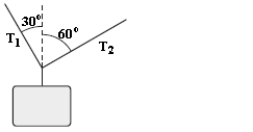
(Multiple Choice)
4.7/5 (72)
(72) The only two forces acting on a body have magnitudes of 20 N and 35 N and directions that differ by 80°.The resulting acceleration has a magnitude of 20 m/s2.What is the mass of the body?
(Multiple Choice)
4.8/5 (67)
(67) A 5.0-kg mass sits on the floor of an elevator that has a downward acceleration of 1.0 m/s2.On top of the 5.0-kg mass is an object of unknown mass.The force of the elevator on the 5.0-kg mass is 80 N up.Determine the unknown mass.
(Multiple Choice)
4.8/5 (75)
(75) A bumper car is moving at constant velocity when another bumper car starts to push on it with a constant force at an angle of 60 degrees with respect to the first car's initial velocity.The second bumper car continues pushing in exactly that direction for some time.What is most likely to happen is that
(Multiple Choice)
4.8/5 (90)
(90) A 2.0-kg block slides on a frictionless 25° inclined plane.A force of 4.6 N acting parallel to the incline and up the incline is applied to the block.What is the acceleration of the block?
(Multiple Choice)
4.7/5 (72)
(72) In the figure shown,the coefficient of kinetic friction between the block and the incline is 0.40.What is the magnitude of the acceleration of the suspended block as it falls? Disregard any pulley mass or friction in the pulley. 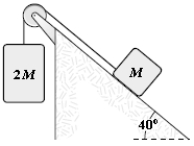
(Multiple Choice)
4.8/5 (91)
(91) The total force needed to drag a box at constant speed across a surface with coefficient of kinetic friction μk is least when the force is applied at an angle θ such that
(Multiple Choice)
4.7/5 (91)
(91) At an instant when a 4.0-kg object has an acceleration equal to  M/s2,one of the two forces acting on the object is known to be
 n.Determine the magnitude of the other force acting on the object.
M/s2,one of the two forces acting on the object is known to be
n.Determine the magnitude of the other force acting on the object. (Multiple Choice)
4.7/5 (84)
(84) An object of unknown weight is suspended as shown.The tension in rope 1 is 25 lb,and the tension in rope 2 is 31 lb.What is the weight of the suspended object? 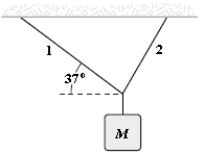
(Multiple Choice)
4.9/5 (91)
(91) A 1.5-kg mass has an acceleration of (4.0  − 3)0
 )m/s2.Only two forces act on the mass.If one of the forces is (2.0
 − 1)4
 )N,what is the magnitude of the other force?
− 3)0
)m/s2.Only two forces act on the mass.If one of the forces is (2.0
− 1)4
)N,what is the magnitude of the other force? (Multiple Choice)
4.9/5 (82)
(82) A 4.0-kg block slides down a 35° incline at a constant speed when a 16-N force is applied acting up and parallel to the incline.What is the coefficient of kinetic friction between the block and the surface of the incline?
(Multiple Choice)
4.9/5 (79)
(79) If α = 40°,β = 60°,and M = 4.0 kg,determine the tension in string 1. 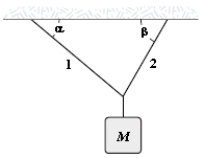
(Multiple Choice)
4.8/5 (69)
(69) If α = 40° and the tension in string 2 is 30 N,determine M. 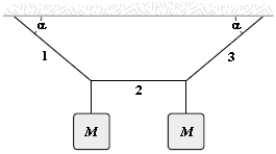
(Multiple Choice)
4.9/5 (73)
(73) A 4.0-kg block is pushed up a 36° incline by a force of magnitude P applied parallel to the incline.When P is 31 N,it is observed that the block moves up the incline with a constant speed.What value of P would be required to lower the block down the incline at a constant speed?
(Multiple Choice)
4.8/5 (80)
(80) A 2.0-kg block slides on a frictionless 15° inclined plane.A force acting parallel to the incline is applied to the block.The acceleration of the block is 1.5 m/s2 down the incline.What is the applied force?
(Multiple Choice)
4.9/5 (86)
(86) The horizontal surface on which the objects slide is frictionless.If M = 2.0 kg,the tension in string 1 is 12 N.Determine F. 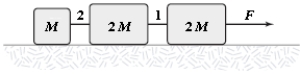
(Multiple Choice)
4.9/5 (95)
(95) A 1.8-kg block is projected up a rough 10° inclined plane.As the block slides up the incline,its acceleration is 3.8 m/s2 down the incline.What is the magnitude of the force of friction acting on the block?
(Multiple Choice)
4.7/5 (89)
(89) 
Filters
- Essay(0)
- Multiple Choice(0)
- Short Answer(0)
- True False(0)
- Matching(0)