



 Chat with AI
Exam 5: The Laws of Motion

Exam 1: Physics and Measurement25 Questions
Exam 2: Motion in One Dimension66 Questions
Exam 3: Vectors47 Questions
Exam 4: Motion in Two Dimensions79 Questions
Exam 5: The Laws of Motion113 Questions
Exam 6: Circular Motion and Other Applications of Newtons Laws55 Questions
Exam 7: Energy of a System74 Questions
Exam 8: Conservation of Energy84 Questions
Exam 9: Linear Momentum and Collisions89 Questions
Exam 10: Rotation of a Rigid Object About a Fixed Axis82 Questions
Exam 11: Angular Momentum46 Questions
Exam 12: Static Equilibrium and Elasticity34 Questions
Exam 13: Universal Gravitation47 Questions
Exam 14: Fluid Mechanics53 Questions
Exam 15: Oscillatory Motion41 Questions
Exam 16: Wave Motion46 Questions
Exam 17: Sound Waves48 Questions
Exam 18: Superposition and Standing Waves60 Questions
Exam 19: Temperature47 Questions
Exam 20: The First Law of Thermodynamics61 Questions
Exam 21: The Kinetic Theory of Gases38 Questions
Exam 22: Heat Engines, entropy, and the Second Law of Thermodynamics55 Questions
Exam 23: Electric Fields83 Questions
Exam 24: Gausss Law80 Questions
Exam 25: Electric Potential97 Questions
Exam 26: Capacitance and Dielectrics63 Questions
Exam 27: Current and Resistance34 Questions
Exam 28: Direct-Current Circuits84 Questions
Exam 29: Magnetic Fields80 Questions
Exam 30: Sources of the Magnetic Field105 Questions
Exam 31: Faradays Law62 Questions
Exam 32: Inductance23 Questions
Exam 33: Alternating-Current Circuits65 Questions
Exam 34: Electromagnetic Waves40 Questions
Exam 35: The Nature of Light and the Principles of Ray Optics38 Questions
Exam 36: Image Formation46 Questions
Exam 37: Wave Optics48 Questions
Exam 38: Diffraction Patterns and Polarization47 Questions
Exam 39: Relativity34 Questions
Exam 40: Introduction to Quantum Physics48 Questions
Exam 41: Quantum Mechanics33 Questions
Exam 42: Atomic Physics59 Questions
Exam 43: Molecules and Solids46 Questions
Exam 44: Nuclear Structure50 Questions
Exam 45: Applications of Nuclear Physics40 Questions
Exam 46: Particle Physics and Cosmology34 Questions
Select questions type


A 3.0-kg block slides on a rough horizontal surface.A force of 8.0 N acting parallel to the surface is applied to the block.The coefficient of kinetic friction between the block and the surface is 0.15.What is the magnitude of the block's acceleration?
(Multiple Choice)
4.8/5  (81)
(81) If the only forces acting on a 2.0-kg mass are 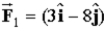 N and
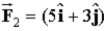 N,what is the magnitude of the acceleration of the particle?
N and
N,what is the magnitude of the acceleration of the particle? (Multiple Choice)
4.7/5 (87)
(87) A book is placed on a chair.Then a videocassette is placed on the book.The floor exerts a normal force
(Multiple Choice)
4.9/5 (71)
(71) A 5.0-kg mass is attached to the ceiling of an elevator by a rope whose mass is negligible.What force does the mass exert on the rope when the elevator has an acceleration of 4.0 m/s2 upward?
(Multiple Choice)
4.8/5 (87)
(87) A book is placed on a chair.Then a videocassette is placed on the book.The floor exerts a normal force
(Multiple Choice)
4.9/5 (84)
(84) Exhibit 5-1
A 2.30 kg mass is suspended from the ceiling and a 1.70 kg mass is suspended from the 2.30 kg mass,as shown.The tensions in the strings are labeled  and
 .
 Use this exhibit to answer the following question(s).
-Refer to Exhibit 5-1.The string supporting the 1.70 kg mass is cut.The magnitudes of the tension in string 1 before and after string 2 is cut are
and . Use this exhibit to answer the following question(s).
-Refer to Exhibit 5-1.The string supporting the 1.70 kg mass is cut.The magnitudes of the tension in string 1 before and after string 2 is cut are (Multiple Choice)
4.8/5 (88)
(88) The coefficient of kinetic friction between the surface and the larger block is 0.25,and the coefficient of kinetic friction between the surface and the smaller block is 0.40.If F = 22N and M = 1.0 kg in the figure,what is the magnitude of the acceleration of either block? 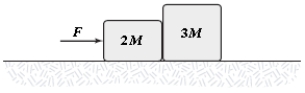
(Multiple Choice)
4.9/5 (80)
(80) A 1.5-kg object has a velocity of 5  M/s at t = 0.It is accelerated at a constant rate for five seconds after which it has a velocity of (6
 + 12
 )m/s.What is the magnitude of the resultant force acting on the object during this time interval?
M/s at t = 0.It is accelerated at a constant rate for five seconds after which it has a velocity of (6
+ 12
)m/s.What is the magnitude of the resultant force acting on the object during this time interval? (Multiple Choice)
4.8/5 (77)
(77) An astronaut who weighs 800 N on the surface of the earth lifts off from planet Zuton in a space ship.The free-fall acceleration on Zuton is 3.0 m/s2 (down).At the moment of liftoff the acceleration of the space ship is 0.50 m/s2 (up).What is the magnitude of the force of the space ship on the astronaut?
(Multiple Choice)
4.8/5 (82)
(82) The horizontal surface on which the block slides is frictionless.If F = 20 N and M = 5.0 kg,what is the magnitude of the resulting acceleration of the block? 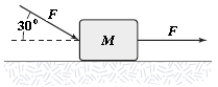
(Multiple Choice)
4.9/5 (86)
(86) When the vector sum of three co-planar forces,  ,
 And
 ,is parallel to
 ,we can conclude that
 And

,
And
,is parallel to
,we can conclude that
And (Multiple Choice)
4.8/5 (76)
(76) Exhibit 5-2
A 4.00 kg block is suspended from the roof of an elevator.A 2.00 kg block is suspended from the 4.00 kg block.The tensions in strings 1 and 2 are labeled  and
 .
 Use this exhibit to answer the following question(s).
-Which type of force would be the equal and opposite force to a gravitational force?
and . Use this exhibit to answer the following question(s).
-Which type of force would be the equal and opposite force to a gravitational force? (Multiple Choice)
4.9/5 (70)
(70) Only two forces act on a 3.0-kg mass.One of the forces is 9.0 N east,and the other is 8.0 N in the direction of 62° north of west.What is the magnitude of the acceleration of the mass?
(Multiple Choice)
4.9/5 (78)
(78) When you drag a toy teddy bear along the floor by a force that is parallel to the floor,the magnitude of the force of friction
(Multiple Choice)
4.8/5 (72)
(72) The first of two identical boxes of mass m is sitting on level ground.The second box is sitting on a ramp that makes an angle with the ground.When a force of magnitude F is applied to each box in a direction parallel to the surface it is on,upwards on the box on the ramp,neither box moves.Which statement comparing the friction force on the box on the level,fL,to the friction force on the box on the ramp,fR,is correct?
(Multiple Choice)
4.8/5 (89)
(89) The frictional force of the floor on a large suitcase is least when the suitcase is
(Multiple Choice)
4.8/5 (93)
(93) A chair is placed on a rug.Then a book is placed on the chair.The floor exerts a normal force
(Multiple Choice)
4.9/5 (92)
(92) The three blocks shown are released from rest and are observed to move with accelerations that have a magnitude of 1.5 m/s2.What is the magnitude of the friction force on the block that slides horizontally? Disregard any pulley mass or friction in the pulley and let M = 2.0 kg. 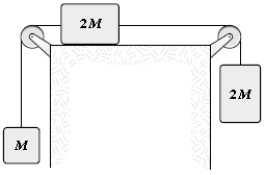
(Multiple Choice)
4.8/5 (75)
(75) Exhibit 5-1
A 2.30 kg mass is suspended from the ceiling and a 1.70 kg mass is suspended from the 2.30 kg mass,as shown.The tensions in the strings are labeled and . Use this exhibit to answer the following question(s).
-A 6.00 kg block is placed on a 30.0° incline and connected to another block on a 36.87° incline.Although the surfaces are frictionless the blocks do not move.What is the mass in kilograms of the block on the 36.87° incline? 
and . Use this exhibit to answer the following question(s).
-A 6.00 kg block is placed on a 30.0° incline and connected to another block on a 36.87° incline.Although the surfaces are frictionless the blocks do not move.What is the mass in kilograms of the block on the 36.87° incline? (Multiple Choice)
4.8/5 (78)
(78) If F = 5.0 N,what is the magnitude of the force exerted by block 2 on block 1? 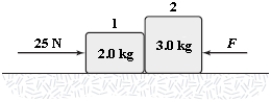
(Multiple Choice)
4.9/5 (86)
(86) 
Filters
- Essay(0)
- Multiple Choice(0)
- Short Answer(0)
- True False(0)
- Matching(0)