



 Chat with AI
Exam 12: Unsaturated Hydrocarbons

Exam 1: Matter, measurements, and Calculations92 Questions
Exam 2: Atoms and Molecules89 Questions
Exam 3: Electronic Structure and the Periodic Law86 Questions
Exam 4: Forces Between Particles89 Questions
Exam 5: Chemical Reactions89 Questions
Exam 6: The States of Matter89 Questions
Exam 7: Solutions and Colloids88 Questions
Exam 8: Reaction Rates and Equilibrium87 Questions
Exam 9: Acids,bases,and Salts86 Questions
Exam 10: Radioactivity and Nuclear Processes86 Questions
Exam 11: Organic Compounds: Alkanes87 Questions
Exam 12: Unsaturated Hydrocarbons88 Questions
Exam 13: Alcohols, phenols, and Ethers87 Questions
Exam 14: Aldehydes and Ketones86 Questions
Exam 15: Carboxylic Acids and Esters86 Questions
Exam 16: Amines and Amides85 Questions
Exam 17: Carbohydrates88 Questions
Exam 18: Lipids91 Questions
Exam 19: Proteins89 Questions
Exam 20: Enzymes88 Questions
Exam 21: Nucleic Acids and Protein Synthesis90 Questions
Exam 22: Nutrition and Energy for Life89 Questions
Exam 23: Carbohydrate Metabolism90 Questions
Exam 24: Lipid and Amino Acid Metabolism94 Questions
Exam 25: Body Fluids86 Questions
Select questions type


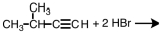

What type of hybridization is associated with alkyne bonding?
(Multiple Choice)
4.8/5  (85)
(85) Comparing unbranched alkanes and alkenes of the same length,alkenes have higher melting and boiling points.
(True/False)
4.8/5 (80)
(80) The addition of two moles of hydrogen to an alkyne produces an _____ .
(Multiple Choice)
5.0/5 (87)
(87) In the IUPAC name for the following compound,the -Br group is located at what position of the compound shown?
CH3CHBrCH=CH2
(Multiple Choice)
4.8/5 (73)
(73) The addition of bromine to an alkene results in an alkane because one bond of the multiple bond is broken.
(True/False)
4.9/5 (82)
(82) 
Filters
- Essay(0)
- Multiple Choice(0)
- Short Answer(0)
- True False(0)
- Matching(0)