



 Chat with AI
Exam 8: Risk and Return

Exam 1: The Role of Managerial Finance134 Questions
Exam 2: The Financial Market Environment91 Questions
Exam 3: Financial Statements and Ratio Analysis208 Questions
Exam 4: Cash Flow and Financial Planning185 Questions
Exam 5: Time Value of Money173 Questions
Exam 6: Interest Rates and Bond Valuation224 Questions
Exam 7: Stock Valuation188 Questions
Exam 8: Risk and Return188 Questions
Exam 9: The Cost of Capital137 Questions
Exam 10: Capital Budgeting Techniques167 Questions
Exam 11: Capital Budgeting Cash Flows117 Questions
Exam 12: Risk and Refinements in Capital Budgeting106 Questions
Exam 13: Leverage and Capital Structure217 Questions
Exam 14: Payout Policy130 Questions
Exam 15: Working Capital and Current Assets Management336 Questions
Exam 16: Current Liabilities Management171 Questions
Exam 17: Hybrid and Derivative Securities185 Questions
Exam 18: Mergers, Lbos, Divestitures, and Business Failure191 Questions
Exam 19: International Managerial Finance108 Questions
Select questions type


Even if assets are not negatively correlated, lower the positive correlation between them, the lower the resulting risk.
(True/False)
4.7/5  (83)
(83) Table 8.3
Consider the following two securities X and Y.  -Which security (X or Y) in Table 8.3 has the least total risk? Which has the least systematic risk?
 (Multiple Choice)
4.7/5 (92)
(92) For a risk-averse manager, the required return increases for an increase in risk.
(True/False)
4.8/5 (79)
(79) The interest rate risk associated with Treasury bonds is much higher than with bills.
(True/False)
4.9/5 (87)
(87) War, inflation, and the condition of the foreign markets are all examples of ________.
(Multiple Choice)
4.8/5 (81)
(81) Assuming the following returns and corresponding probabilities for asset A, compute its standard deviation and coefficient of variation. 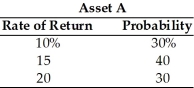
(Essay)
4.9/5 (91)
(91) Two assets whose returns move in the same direction and have a correlation coefficient of +1 are very risky assets.
(True/False)
4.9/5 (86)
(86) Returns from internationally diversified portfolios tend to be superior to those yielded by purely domestic ones.
(True/False)
4.8/5 (84)
(84) The risk of a portfolio containing international stocks generally does not contain less nondiversifiable risk than one that contains only domestic stocks.
(True/False)
4.9/5 (85)
(85) The capital asset pricing model (CAPM) links together unsystematic risk and return for all assets.
(True/False)
4.8/5 (78)
(78) For a risk-indifferent manager, no change in return would be required for an increase in risk.
(True/False)
4.8/5 (70)
(70) The expected value and the standard deviation of returns for asset A is ________. (See below.) Asset A 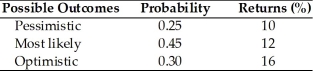
(Multiple Choice)
4.9/5 (72)
(72) A common approach of estimating the variability of returns involving the forecast of pessimistic, most likely, and optimistic returns associated with an asset is called ________.
(Multiple Choice)
4.8/5 (68)
(68) Adam wants to determine the required return on a stock portfolio with a beta coefficient of 0.5. Assuming the risk-free rate of 6 percent and the market return of 12 percent, compute the required rate of return.
(Essay)
4.8/5 (88)
(88) The expected value, standard deviation of returns, and coefficient of variation for asset A are ________. (See below.) Asset A 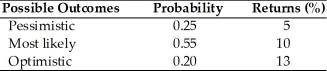
(Multiple Choice)
4.9/5 (85)
(85) A financial manager's goal for the firm is to create a portfolio that maximizes return for a given level of risk.
(True/False)
5.0/5 (78)
(78) In general, the lower the correlation between asset returns, the greater the potential diversification of risk.
(True/False)
4.9/5 (80)
(80) Table 8.2
You are going to invest $20,000 in a portfolio consisting of assets X, Y, and Z, as follows:  -Given the information in Table 8.2, what is the expected annual return of this portfolio?
 (Multiple Choice)
4.8/5 (69)
(69) Higher the coefficient of variation, the greater the risk and therefore the higher the expected return.
(True/False)
4.9/5 (93)
(93) 
Filters
- Essay(0)
- Multiple Choice(0)
- Short Answer(0)
- True False(0)
- Matching(0)