



 Chat with AI
Exam 8: Risk and Return

Exam 1: The Role of Managerial Finance134 Questions
Exam 2: The Financial Market Environment91 Questions
Exam 3: Financial Statements and Ratio Analysis208 Questions
Exam 4: Cash Flow and Financial Planning185 Questions
Exam 5: Time Value of Money173 Questions
Exam 6: Interest Rates and Bond Valuation224 Questions
Exam 7: Stock Valuation188 Questions
Exam 8: Risk and Return188 Questions
Exam 9: The Cost of Capital137 Questions
Exam 10: Capital Budgeting Techniques167 Questions
Exam 11: Capital Budgeting Cash Flows117 Questions
Exam 12: Risk and Refinements in Capital Budgeting106 Questions
Exam 13: Leverage and Capital Structure217 Questions
Exam 14: Payout Policy130 Questions
Exam 15: Working Capital and Current Assets Management336 Questions
Exam 16: Current Liabilities Management171 Questions
Exam 17: Hybrid and Derivative Securities185 Questions
Exam 18: Mergers, Lbos, Divestitures, and Business Failure191 Questions
Exam 19: International Managerial Finance108 Questions
Select questions type


Changes in risk aversion, and therefore shifts in the SML, result from changing tastes and preferences of investors, which generally result from various economic, political, and social events.
(True/False)
4.9/5  (62)
(62) Champion Breweries must choose between two asset purchases. The annual rate of return and related probabilities given below summarize the firm's analysis. 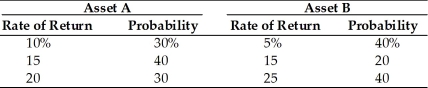 For each asset, compute
(a) the expected rate of return.
(b) the standard deviation of the expected return.
(c) the coefficient of variation of the return.
(d) Which asset should Champion select?
For each asset, compute
(a) the expected rate of return.
(b) the standard deviation of the expected return.
(c) the coefficient of variation of the return.
(d) Which asset should Champion select? (Essay)
4.9/5 (61)
(61) The inclusion of assets from countries that are less sensitive to the U.S. business cycle reduces the portfolio's responsiveness to market movement and to foreign currency fluctuation.
(True/False)
4.9/5 (81)
(81) A beta coefficient of -1 represents an asset that ________.
(Multiple Choice)
4.9/5 (71)
(71) As any investor can create a portfolio of assets that will eliminate all, or virtually all, nondiversifiable risk, the only relevant risk is diversifiable risk.
(True/False)
4.8/5 (84)
(84) Asset A was purchased six months ago for $25,000 and has generated $1,500 cash flow during that period. What is the asset's rate of return if it can be sold for $26,750 today?
(Essay)
4.9/5 (70)
(70) In the capital asset pricing model, an increase in inflationary expectations will be reflected by ________.
(Multiple Choice)
4.9/5 (81)
(81) An increase in the beta of a corporation, all else being the same, indicates ________.
(Multiple Choice)
4.9/5 (74)
(74) The CAPM is based on an assumed efficient market in which there are many small investors, each having the same information and expectations with respect to securities; there are no restrictions on investment, no taxes, and no transactions costs; and all investors are rational, view securities similarly, and are risk-averse, preferring higher returns and lower risk.
(True/False)
4.9/5 (82)
(82) The beta of a portfolio is a function of the standard deviations of the individual securities in the portfolio, the proportion of the portfolio invested in those securities, and the correlation between the returns of those securities.
(True/False)
4.8/5 (72)
(72) Diversifiable risk is the relevant portion of risk attributable to market factors that affect all firms.
(True/False)
4.8/5 (71)
(71) A change in inflationary expectations resulting from events such as international trade embargoes or major changes in Federal Reserve policy will result in a shift in the SML.
(True/False)
4.9/5 (87)
(87) Given the following information about the two assets A and B, determine which asset is preferred. 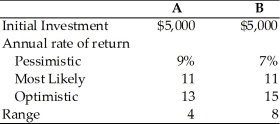
(Essay)
4.9/5 (83)
(83) The return on an asset is the change in its value plus any cash distribution over a given period of time, expressed as a percentage of its ending value.
(True/False)
4.9/5 (68)
(68) Combining negatively correlated assets can reduce the overall variability of returns.
(True/False)
4.7/5 (77)
(77) The correlation coefficient is an index of the degree of movement of an asset's return in response to a change in the risk-free asset return.
(True/False)
5.0/5 (73)
(73) Akai has a portfolio of three assets. Find the expected rate of return for the portfolio assuming he invests 50 percent of its money in asset A with 10 percent rate of return, 30 percent in asset B with a rate of return of 20 percent, and the rest in asset C with 30 percent rate of return.
(Essay)
4.8/5 (70)
(70) 
Filters
- Essay(0)
- Multiple Choice(0)
- Short Answer(0)
- True False(0)
- Matching(0)