



 Chat with AI
Exam 8: Risk and Return

Exam 1: The Role of Managerial Finance134 Questions
Exam 2: The Financial Market Environment91 Questions
Exam 3: Financial Statements and Ratio Analysis208 Questions
Exam 4: Cash Flow and Financial Planning185 Questions
Exam 5: Time Value of Money173 Questions
Exam 6: Interest Rates and Bond Valuation224 Questions
Exam 7: Stock Valuation188 Questions
Exam 8: Risk and Return188 Questions
Exam 9: The Cost of Capital137 Questions
Exam 10: Capital Budgeting Techniques167 Questions
Exam 11: Capital Budgeting Cash Flows117 Questions
Exam 12: Risk and Refinements in Capital Budgeting106 Questions
Exam 13: Leverage and Capital Structure217 Questions
Exam 14: Payout Policy130 Questions
Exam 15: Working Capital and Current Assets Management336 Questions
Exam 16: Current Liabilities Management171 Questions
Exam 17: Hybrid and Derivative Securities185 Questions
Exam 18: Mergers, Lbos, Divestitures, and Business Failure191 Questions
Exam 19: International Managerial Finance108 Questions
Select questions type


Diversified investors should be concerned solely with nondiversifiable risk because it can create a portfolio of assets that will eliminate all, or virtually all, diversifiable risk.
(True/False)
4.8/5  (86)
(86) If a manager prefers a higher return investment regardless of its risk, then he is following a ________ strategy.
(Multiple Choice)
5.0/5 (94)
(94) The ________ of a given outcome is its chance of occurring.
(Multiple Choice)
4.9/5 (87)
(87) Beta coefficient is an index that measures the degree of movement of an asset's return in response to a change in the market return.
(True/False)
4.9/5 (75)
(75) Which asset would the risk-averse financial manager prefer? (See below.) 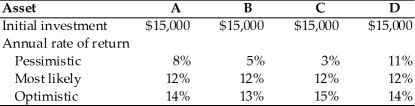
(Multiple Choice)
4.9/5 (79)
(79) A(n) ________ in the beta coefficient normally causes ________ in the required return and therefore ________ in the price of the stock, everything else remaining the same.
(Multiple Choice)
4.9/5 (74)
(74) An investment advisor has recommended a $50,000 portfolio containing assets R, J, and K; $25,000 will be invested in asset R, with an expected annual return of 12 percent; $10,000 will be invested in asset J, with an expected annual return of 18 percent; and $15,000 will be invested in asset K, with an expected annual return of 8 percent. The expected annual return of this portfolio is ________.
(Multiple Choice)
4.9/5 (75)
(75) In U.S., during the past 75 years, on an average the return on large-company stocks has exceeded the return on small-company stocks.
(True/False)
4.8/5 (81)
(81) The range of an asset's risk is found by subtracting the worst outcome from the best outcome.
(True/False)
4.9/5 (91)
(91) The term "risk" is used interchangeably with "uncertainty" to refer to the variability of returns associated with a given asset.
(True/False)
4.8/5 (79)
(79) The total rate of return on an investment over a given period of time is calculated by ________.
(Multiple Choice)
4.9/5 (84)
(84) In the capital asset pricing model, the beta coefficient is a measure of ________.
(Multiple Choice)
4.8/5 (90)
(90) In U.S., during the past 75 years, on an average the return on small-company stocks has levelled the return on large-company stocks.
(True/False)
4.8/5 (67)
(67) Standard deviation is a measure of relative dispersion that is useful in comparing the risks of assets with different expected returns.
(True/False)
4.8/5 (83)
(83) Table 8.1  -If you were to create a portfolio designed to reduce risk by investing equal proportions in each of two different assets, which portfolio would you recommend? (See Table 8.1)
 (Multiple Choice)
4.8/5 (85)
(85) Dr. Dan is considering investment in a project with beta coefficient of 1.75. What would you recommend him to do if this investment has an 11.5 percent rate of return, risk-free rate is 5.5 percent, and the rate of return on the market portfolio of assets is 8.5 percent?
(Essay)
4.7/5 (100)
(100) Tangshan China's stock is currently selling for $160.00 per share and the firm's dividends are expected to grow at 5 percent indefinitely. In addition, Tangshan China's most recent dividend was $5.50. The expected risk free rate of return is 3 percent, the expected market return is 8 percent, and Tangshan has a beta of 1.20.
(a) What is the expected return based on the dividend valuation model?
(b) What is the required return based on the CAPM?
(c) Would Tangshan China be a good investment at this time? Explain
(Essay)
4.8/5 (73)
(73) 
Filters
- Essay(0)
- Multiple Choice(0)
- Short Answer(0)
- True False(0)
- Matching(0)