



 Chat with AI
Exam 8: Risk and Return

Exam 1: The Role of Managerial Finance134 Questions
Exam 2: The Financial Market Environment91 Questions
Exam 3: Financial Statements and Ratio Analysis208 Questions
Exam 4: Cash Flow and Financial Planning185 Questions
Exam 5: Time Value of Money173 Questions
Exam 6: Interest Rates and Bond Valuation224 Questions
Exam 7: Stock Valuation188 Questions
Exam 8: Risk and Return188 Questions
Exam 9: The Cost of Capital137 Questions
Exam 10: Capital Budgeting Techniques167 Questions
Exam 11: Capital Budgeting Cash Flows117 Questions
Exam 12: Risk and Refinements in Capital Budgeting106 Questions
Exam 13: Leverage and Capital Structure217 Questions
Exam 14: Payout Policy130 Questions
Exam 15: Working Capital and Current Assets Management336 Questions
Exam 16: Current Liabilities Management171 Questions
Exam 17: Hybrid and Derivative Securities185 Questions
Exam 18: Mergers, Lbos, Divestitures, and Business Failure191 Questions
Exam 19: International Managerial Finance108 Questions
Select questions type


________ is the extent of an asset's risk. It is found by subtracting the pessimistic outcome from the optimistic outcome.
(Multiple Choice)
4.8/5  (83)
(83) Systematic risk is that portion of an asset's risk that is attributable to firm-specific, random causes.
(True/False)
4.9/5 (74)
(74) The creation of a portfolio by combining two assets having perfectly positively correlated returns cannot reduce the portfolio's overall risk below the risk of the least risky asset.
(True/False)
4.9/5 (81)
(81) In the capital asset pricing model, the beta coefficient is a measure of ________.
(Multiple Choice)
4.8/5 (86)
(86) Given the following probability distribution for assets X and Y, compute the expected rate of return, variance, standard deviation, and coefficient of variation for the two assets. Which asset is a better investment? 
(Essay)
4.9/5 (84)
(84) Beta coefficient is an index of the degree of movement of an asset's return in response to a change in the risk-free asset.
(True/False)
4.7/5 (75)
(75) An efficient portfolio is a portfolio that maximizes return for a given level of risk or minimizes risk for a given level of return.
(True/False)
4.7/5 (76)
(76) Tangshan Antiques has a beta of 1.40, the annual risk-free rate of interest is currently 10 percent, and the required return on the market portfolio is 16 percent. The firm estimates that its future dividends will continue to increase at an annual compound rate consistent with that experienced over the 2010-2013 period. 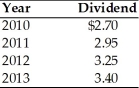 (a) Estimate the value of Tangshan Antiques stock.
(b) A lawsuit has been filed against the company by a competitor in 2013, and the potential loss has increased risk, which is reflected in the company's beta, increasing it to 1.6. What is the estimated price of the stock following the filing of the lawsuit in 2013?
(a) Estimate the value of Tangshan Antiques stock.
(b) A lawsuit has been filed against the company by a competitor in 2013, and the potential loss has increased risk, which is reflected in the company's beta, increasing it to 1.6. What is the estimated price of the stock following the filing of the lawsuit in 2013? (Essay)
4.8/5 (82)
(82) A(n) ________ distribution shows all possible outcomes and associated probabilities for a given event.
(Multiple Choice)
4.7/5 (73)
(73) Table 8.2
You are going to invest $20,000 in a portfolio consisting of assets X, Y, and Z, as follows:  -The beta of the portfolio in Table 8.2, containing assets X, Y, and Z is ________.
 (Multiple Choice)
4.8/5 (91)
(91) Table 8.2
You are going to invest $20,000 in a portfolio consisting of assets X, Y, and Z, as follows:
-The beta of the portfolio in Table 8.2 indicates this portfolio ________.
-The beta of the portfolio in Table 8.2 indicates this portfolio ________. (Multiple Choice)
4.8/5 (67)
(67) A portfolio of two negatively correlated assets has less risk than either of the individual assets.
(True/False)
4.9/5 (87)
(87) Under no circumstances, adding assets to a portfolio would result in greater risk than that of the riskiest asset included in the portfolio.
(True/False)
4.8/5 (84)
(84) ________ is a statistical measure of the relationship between any two series of numbers.
(Multiple Choice)
4.8/5 (78)
(78) A ________ measures the dispersion around the expected value.
(Multiple Choice)
4.7/5 (81)
(81) Assuming a risk-free rate of 8 percent and a market return of 12 percent, would a wise investor acquire a security with a beta of 1.5 and a rate of return of 14 percent given the facts above?
(Essay)
4.7/5 (86)
(86) Table 8.3
Consider the following two securities X and Y.  -Using the data from Table 8.3, what is the portfolio expected return if you invest 100 percent of your money in X, borrow an amount equal to half of your own investment at the risk-free rate and invest your borrowings in asset X?
 (Multiple Choice)
4.9/5 (80)
(80) Last year, Mike bought 100 shares of Dallas Corporation common stock for $53 per share. During the year he received dividends of $1.45 per share. The stock is currently selling for $60 per share. What rate of return did Mike earn over the year?
(Multiple Choice)
4.9/5 (87)
(87) 
Filters
- Essay(0)
- Multiple Choice(0)
- Short Answer(0)
- True False(0)
- Matching(0)