



 Chat with AI
Exam 14: Chromosomes and Human Inheritance

Exam 1: Invitation to Biology79 Questions
Exam 2: Life's Chemical Bases67 Questions
Exam 3: Molecules of Life87 Questions
Exam 4: Cell Structure106 Questions
Exam 5: Ground Rules of Metabolism69 Questions
Exam 6: Where it Starts—Photosynthesis69 Questions
Exam 7: How Cells Release Chemical Energy75 Questions
Exam 8: DNA Structure and Function61 Questions
Exam 9: From DNA to Protein64 Questions
Exam 10: Control of Gene Expression63 Questions
Exam 11: How Cells Reproduce77 Questions
Exam 12: Meiosis and Sexual Reproduction59 Questions
Exam 13: Observing Patterns in Inherited Traits95 Questions
Exam 14: Chromosomes and Human Inheritance76 Questions
Exam 15: Studying and Manipulating Genomes58 Questions
Exam 16: Evidence of Evolution55 Questions
Exam 17: Processes of Evolution74 Questions
Exam 18: Organizing Information about Species46 Questions
Exam 19: Life's Origin and Early Evolution60 Questions
Exam 20: Viruses, Bacteria, and Archaea56 Questions
Exam 21: Protists: The Simplest Eukaryotes61 Questions
Exam 22: The Land Plants66 Questions
Exam 23: Fungi52 Questions
Exam 24: Animal Evolution: The Invertebrates74 Questions
Exam 25: Animal Evolution: The Chordates71 Questions
Exam 26: Human Evolution51 Questions
Exam 27: Plant Tissues96 Questions
Exam 28: Plant Nutrition and Transport69 Questions
Exam 29: Life Cycles of Flowering Plants89 Questions
Exam 30: Communication Strategies in Plants72 Questions
Exam 31: Animal Tissues and Organ Systems79 Questions
Exam 32: Neural Control97 Questions
Exam 33: Sensory Perception69 Questions
Exam 34: Endocrine Control90 Questions
Exam 35: Structural Support and Movement72 Questions
Exam 36: Circulation58 Questions
Exam 37: Immunity73 Questions
Exam 38: Respiration78 Questions
Exam 39: Digestion and Nutrition98 Questions
Exam 40: Maintaining the Internal Environment73 Questions
Exam 41: Animal Reproductive System105 Questions
Exam 42: Animal Development72 Questions
Exam 43: Animal Behavior74 Questions
Exam 44: Population Ecology59 Questions
Exam 45: Community Ecology71 Questions
Exam 46: Ecosystems64 Questions
Exam 47: The Biosphere73 Questions
Exam 48: Human Impacts on the Biosphere67 Questions
Select questions type


An X-linked recessive gene (c)produces red-green color blindness.A normal woman whose father was color blind marries a color-blind man.What are the chances that the first son will be color blind?
(Multiple Choice)
4.9/5  (60)
(60) Select the disorder that best matches each the following statements.
-This disorder is also known as trisomy 21.
(Multiple Choice)
4.9/5 (63)
(63) In humans,which of the following traits is affected by a single gene?
(Multiple Choice)
4.9/5 (82)
(82) A mother expresses the symptoms for Huntington's disease,an autosomal dominant trait.What are the chances that her offspring would carry a mutated allele if her partner is unaffected by the disease?
(Multiple Choice)
4.7/5 (80)
(80) Which syndrome is characterized by a karyotype with 45 chromosomes?
(Multiple Choice)
4.9/5 (72)
(72) Excerpt from Figure 14.8
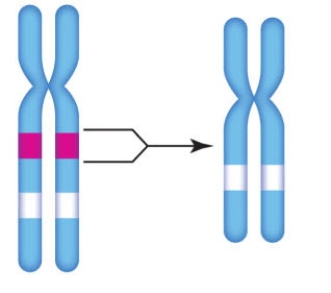 -The accompanying figure represents which chromosomal change?
 (Multiple Choice)
4.9/5 (74)
(74) Select the disorder that best matches each the following statements.
-This disorder is an autosomal dominant disorder characterized by premature aging of body tissues.
(Multiple Choice)
4.8/5 (71)
(71) Hemophilia is caused by an X-linked recessive gene.A normal woman whose father had hemophilia marries a normal man.What are the chances of hemophilia in their children?
(Multiple Choice)
4.9/5 (87)
(87) What is the sex chromosome composition of a person with Klinefelter syndrome?
(Multiple Choice)
4.7/5 (77)
(77) In humans,an X-linked disorder called coloboma iridia (a fissure in the iris)is a recessive trait.A normal couple has an afflicted daughter.What would be the most plausible scenario for this situation?
(Multiple Choice)
4.9/5 (69)
(69) __________ is a diagnostic tool that reveals missing or extra chromosomes and some structural changes in an individual's chromosomes.
(Short Answer)
4.9/5 (73)
(73) Males tend to be affected in greater numbers by X-linked recessive genetic disorders than are females because
(Multiple Choice)
5.0/5 (62)
(62) 
Filters
- Essay(0)
- Multiple Choice(0)
- Short Answer(0)
- True False(0)
- Matching(0)