



 Chat with AI
Exam 14: Chromosomes and Human Inheritance

Exam 1: Invitation to Biology79 Questions
Exam 2: Life's Chemical Bases67 Questions
Exam 3: Molecules of Life87 Questions
Exam 4: Cell Structure106 Questions
Exam 5: Ground Rules of Metabolism69 Questions
Exam 6: Where it Starts—Photosynthesis69 Questions
Exam 7: How Cells Release Chemical Energy75 Questions
Exam 8: DNA Structure and Function61 Questions
Exam 9: From DNA to Protein64 Questions
Exam 10: Control of Gene Expression63 Questions
Exam 11: How Cells Reproduce77 Questions
Exam 12: Meiosis and Sexual Reproduction59 Questions
Exam 13: Observing Patterns in Inherited Traits95 Questions
Exam 14: Chromosomes and Human Inheritance76 Questions
Exam 15: Studying and Manipulating Genomes58 Questions
Exam 16: Evidence of Evolution55 Questions
Exam 17: Processes of Evolution74 Questions
Exam 18: Organizing Information about Species46 Questions
Exam 19: Life's Origin and Early Evolution60 Questions
Exam 20: Viruses, Bacteria, and Archaea56 Questions
Exam 21: Protists: The Simplest Eukaryotes61 Questions
Exam 22: The Land Plants66 Questions
Exam 23: Fungi52 Questions
Exam 24: Animal Evolution: The Invertebrates74 Questions
Exam 25: Animal Evolution: The Chordates71 Questions
Exam 26: Human Evolution51 Questions
Exam 27: Plant Tissues96 Questions
Exam 28: Plant Nutrition and Transport69 Questions
Exam 29: Life Cycles of Flowering Plants89 Questions
Exam 30: Communication Strategies in Plants72 Questions
Exam 31: Animal Tissues and Organ Systems79 Questions
Exam 32: Neural Control97 Questions
Exam 33: Sensory Perception69 Questions
Exam 34: Endocrine Control90 Questions
Exam 35: Structural Support and Movement72 Questions
Exam 36: Circulation58 Questions
Exam 37: Immunity73 Questions
Exam 38: Respiration78 Questions
Exam 39: Digestion and Nutrition98 Questions
Exam 40: Maintaining the Internal Environment73 Questions
Exam 41: Animal Reproductive System105 Questions
Exam 42: Animal Development72 Questions
Exam 43: Animal Behavior74 Questions
Exam 44: Population Ecology59 Questions
Exam 45: Community Ecology71 Questions
Exam 46: Ecosystems64 Questions
Exam 47: The Biosphere73 Questions
Exam 48: Human Impacts on the Biosphere67 Questions
Select questions type


Answer the following questions in reference to the five items listed below.
-How many chromosomes are present in the somatic cells of a child born with Down syndrome (trisomy 21)?
(Multiple Choice)
4.9/5  (63)
(63) Select the best process listed below for each of the following statements. Note that you need to know that the sequence of amino acids directly reflects the sequence of genes that coded for their placement.
-A small region of a protein from three species is sequenced and found to be as follows:
species X is alanine,glycine,threonine,alanine
species Y is alanine,glycine,threonine,alanine
species Z is alanine,valine,glycine,threonine,alanine
The difference in the amino acid sequence of species Z is most likely due to this.
(Multiple Choice)
4.9/5 (77)
(77) A woman heterozygous for color blindness (an X-linked recessive allele)marries a man with normal color vision.What is the probability that their first child (male or female)will be color blind?
(Multiple Choice)
5.0/5 (87)
(87) Some autosomal dominant diseases do not run in the family because they are lethal before the affected individual can __________.
(Short Answer)
4.8/5 (69)
(69) It is now possible to analyze the genetics of an in vitro fertilized embryo by
(Multiple Choice)
4.8/5 (67)
(67) Red-green color blindness is an X-linked recessive trait (dominant allele denoted as C).Two normal-vision parents have a color-blind son.The genotypes of the father,mother,and son are respectively _____,_____,_____.
(Short Answer)
4.8/5 (81)
(81) Select the best process listed below for each of the following statements. Note that you need to know that the sequence of amino acids directly reflects the sequence of genes that coded for their placement.
-The nucleotide sequences of homologous regions of DNA of two species are AATGCCCCGTTA and AATGCCCCGCTTA.If this is not the result of a nucleotide base-pair addition,then it is most likely the result of this.
(Multiple Choice)
4.9/5 (79)
(79) The probability of producing a normal child by two parents who are carriers for an autosomal recessive disorder is ____.
(Multiple Choice)
4.8/5 (66)
(66) Select the best process listed below for each of the following statements. Note that you need to know that the sequence of amino acids directly reflects the sequence of genes that coded for their placement.
-A small region of a protein from three species is sequenced and found to be as follows:
species X is alanine,glycine,glycine,threonine,alanine
species Y is alanine,glycine,threonine,alanine
species Z is alanine,glycine,glycine,threonine,alanine
The difference in the amino acid sequence of species Y is most likely due to this.
(Multiple Choice)
4.8/5 (81)
(81) A father who has red-green color blindness and a mother who has normal vision may have the following child:
(Multiple Choice)
4.9/5 (74)
(74) Excerpt from Figure 14.8
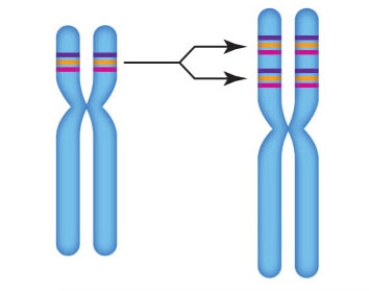 -The accompanying figure represents which chromosomal change?
 (Multiple Choice)
4.9/5 (90)
(90) Answer the following questions in reference to the five items listed below.
-The normal sperm cell of species X carries 11 chromosomes.Following nondisjunction in the formation of secondary spermatocytes and their subsequent fertilization of normal ova,some of the zygotes will have 21 chromosomes,and the remainder will have how many chromosomes?
(Multiple Choice)
4.9/5 (71)
(71) Select the best process listed below for each of the following statements. Note that you need to know that the sequence of amino acids directly reflects the sequence of genes that coded for their placement.
-Homologous sets of genes ABCDEF and aBCdEF are located on nonhomologous chromosomes.Crossing over between them is suppressed because their locations are the result of this.
(Multiple Choice)
4.8/5 (63)
(63) 
Filters
- Essay(0)
- Multiple Choice(0)
- Short Answer(0)
- True False(0)
- Matching(0)