



 Chat with AI
Exam 11: Liquids and Intermolecular Forces

Exam 1: Introduction: Matter and Measurement151 Questions
Exam 2: Atoms, Molecules, and Ions230 Questions
Exam 3: Stoichiometry: Calculations With Chemical Formulas and Equations170 Questions
Exam 4: Aqueous Reactions and Solution Stoichiometry177 Questions
Exam 5: Thermochemistry148 Questions
Exam 6: Electronic Structure of Atoms180 Questions
Exam 7: Periodic Properties of the Elements171 Questions
Exam 8: Basic Concepts of Chemical Bonding141 Questions
Exam 9: Molecular Geometry and Bonding Theories177 Questions
Exam 10: Gases172 Questions
Exam 11: Liquids and Intermolecular Forces119 Questions
Exam 12: Solids and Modern Materials78 Questions
Exam 13: Properties of Solutions151 Questions
Exam 14: Chemical Kinetics130 Questions
Exam 15: Chemical Equilibrium92 Questions
Exam 16: Acid-Base Equilibria134 Questions
Exam 17: Additional Aspects of Aqueous Equilibria111 Questions
Exam 18: Chemistry of the Environment121 Questions
Exam 19: Chemical Thermodynamics120 Questions
Exam 20: Electrochemistry110 Questions
Exam 21: Nuclear Chemistry158 Questions
Exam 22: Chemistry of the Nonmetals192 Questions
Exam 23: Transition Metals and Coordination Chemistry147 Questions
Exam 24: The Chemistry of Life: Organic and Biological Chemistry124 Questions
Select questions type


Based on molecular mass and dipole moment of the five compounds in the table below, which should have the highest boiling point? 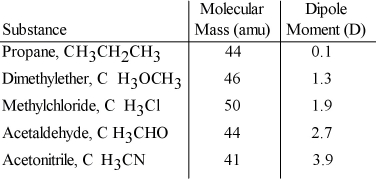
(Multiple Choice)
4.8/5  (65)
(65) __________ is the energy required to expand the surface area of a liquid by a unit amount of area.
(Multiple Choice)
4.9/5 (73)
(73) Which of the following has dispersion forces as its only intermolecular force?
(Multiple Choice)
4.7/5 (82)
(82) When the phase diagram for a substance has a solid-liquid phase boundary line that has a negative slope (leans to the left), the substance __________.
(Multiple Choice)
4.8/5 (77)
(77) The phase diagram of a substance is shown above. The area labeled __________ indicates the solid phase for the substance.
(Multiple Choice)
4.8/5 (82)
(82) Of the following, __________ should have the highest critical temperature.
(Multiple Choice)
4.8/5 (82)
(82) The property responsible for the "beading up" of water is __________.
(Multiple Choice)
4.9/5 (81)
(81) Based on the figure above, the boiling point of ethyl alcohol under an external pressure of 0.0724 atm is __________°C.
(Multiple Choice)
4.9/5 (81)
(81) Cholesteric liquid crystals are colored because __________.
(Multiple Choice)
4.8/5 (81)
(81) The enthalpy change for converting 10.0 g of ice at -25.0°C to water at 80.0°C is __________ kJ. The specific heats of ice, water, and steam are 2.09 J/g-K, 4.18 J/g-K, and 1.84 J/g-K, respectively. For H2O, ΔHfus = 6.01 kJ/mol, and ΔHvap = 40.67 kJ/mol
(Multiple Choice)
4.9/5 (76)
(76) Some things take longer to cook at high altitudes than at low altitudes because __________.
(Multiple Choice)
5.0/5 (86)
(86) The normal boiling point of the substance with the phase diagram shown above is __________°C.
(Multiple Choice)
4.7/5 (83)
(83) Molecules containing only single bonds do not exhibit liquid-crystal behavior because free rotation can occur around single bonds making these molecules flexible.
(True/False)
4.9/5 (75)
(75) According to the phase diagram shown above, the normal boiling point of this substance is __________°C.
(Multiple Choice)
4.8/5 (84)
(84) A substance that expands to fill its container yet has a density approaching that of a liquid, and that can behave as a solvent is called a(n)__________.
(Multiple Choice)
4.9/5 (87)
(87) 
Filters
- Essay(0)
- Multiple Choice(0)
- Short Answer(0)
- True False(0)
- Matching(0)